Father of SCU Student Killed in Car Crash Calls for Change on El Camino Real
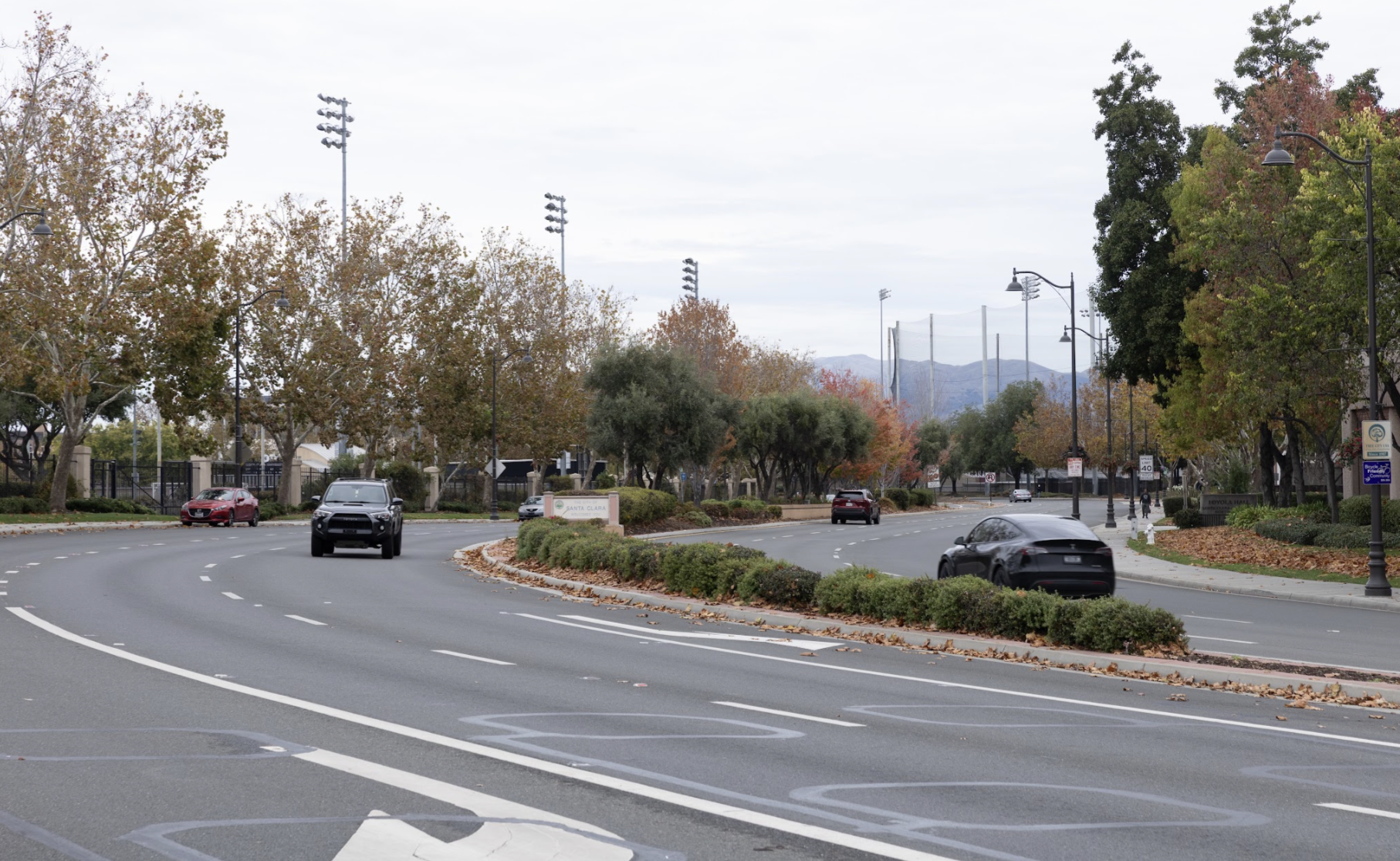
This six-lane stretch of El Camino Real separates the Santa Clara University Villas for upperclassmen, left, from the main campus, right. (Nina Glick/The Santa Clara)
A court date has been set on Jun. 18 for the driver charged with the death of Santa Clara University student Kephas Pope ’27 in a Nov. 2024 car crash.
Pope, 18, was walking his bike across El Camino Real—a busy road cutting through Santa Clara University’s campus—when Jonathan Drake, 39, of San Jose lost control of his car while driving at speeds of up to 81 miles an hour, according to the Santa Clara Police report. His vehicle crossed the center median before hitting a tree and the student. Pope was pronounced dead at Santa Clara Valley Medical Center.
Drake has been charged with vehicular manslaughter with gross negligence, according to the arrest warrant filed in Jan. 2026. He was not under the influence of alcohol nor drugs at the time of the accident, according to the police report.
El Camino Real has been a cause of concern in the Santa Clara community for several years. The father of Kephas, Nathan Pope, is still pursuing change.
“I really feel like the risk is still there because no mitigation, no changes have been made,” he said. “And it’s hurtful because I feel like Kephas’ death was preventable.”
“I died on Nov. 21, just like Kephas,” said Pope. “I cope by going to the daily mass a lot, I got close to my faith. I do not want this to happen to another family and another student.”
The City of Santa Clara implemented Vision Zero in March 2026, an action plan aimed at eliminating traffic fatalities and severe injuries by 2050. The city’s plan includes identifying problem areas with high collision rates and prioritizing investment in safe infrastructure, while emphasizing “vulnerable” road users like pedestrians and cyclists.
El Camino Real is specifically mentioned in the plan’s priority corridor projects. However, the stretch dividing Santa Clara University’s campus in half is outside of the proposed improvement zone.
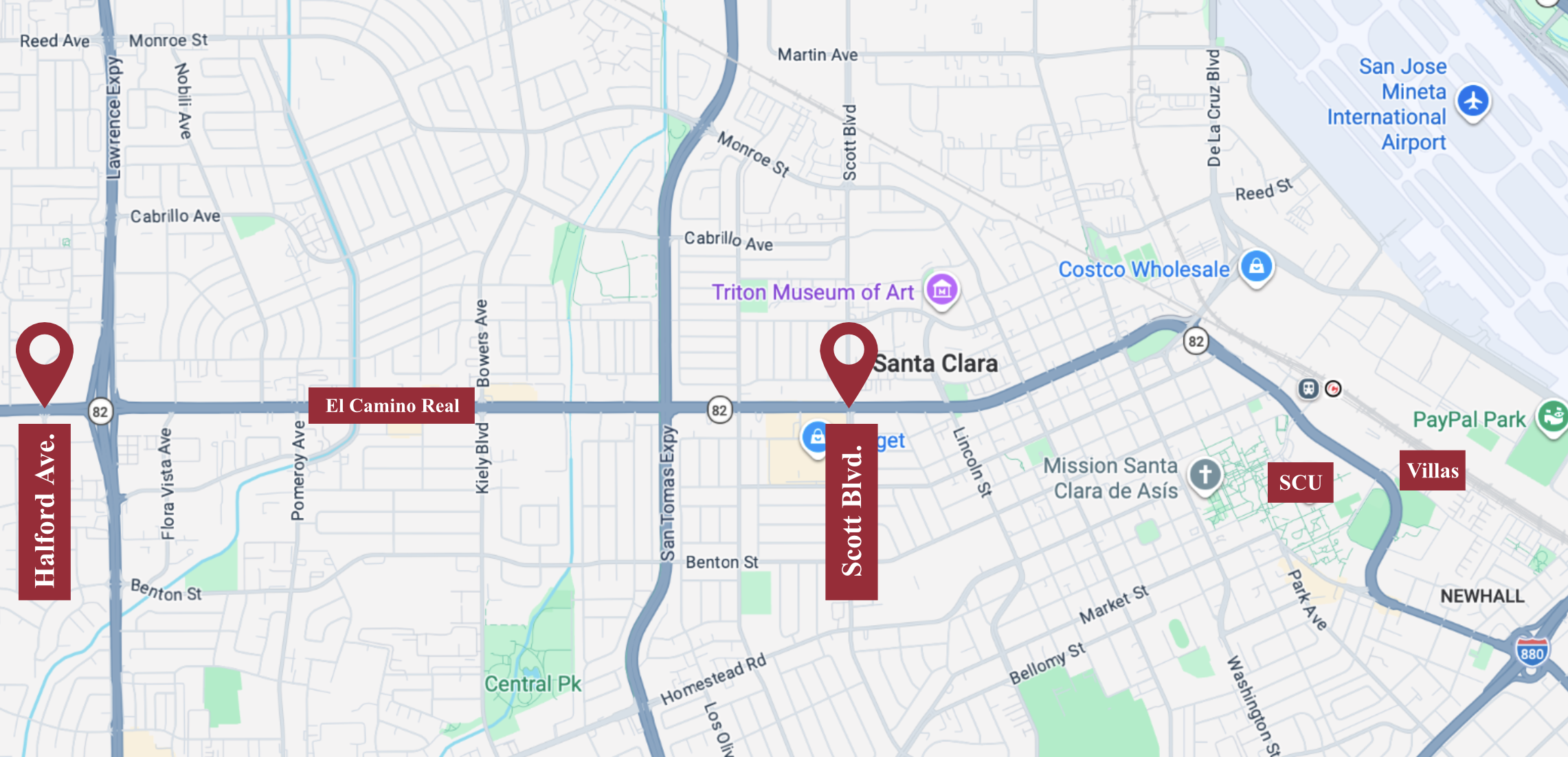
The City of Santa Clara’s Vision Zero Action Plan focuses on the stretch of El Camino Real between Halford Ave. and Scott Blvd. (MJ Kaspura/The Santa Clara)
At least four projects centered on bicycle safety are currently in progress, with improvements to bike lanes, installation of speed bumps and reduced parking on roads noted as key steps to meet Vision Zero’s goals.
Despite these governmental action plans, Pope claims to still see cars regularly speeding on the curved El Camino Real. “Three lanes each way gives it a bit of a highway feel,” said Pope. “The problem is that students shouldn’t have to cross a highway.”
With buildings for graduate students and 138 townhouses for upperclassmen located on the opposite side of El Camino Real from the University’s main campus, Pope estimates hundreds of students cross and walk alongside the road daily. “It really doesn’t matter if you’re walking on the sidewalk or if you’re crossing in a crosswalk. The fact is, every student on the sidewalk or crosswalk is in danger of a speeding car losing control and crashing into them.”
The primary collision cause from 2017 to 2022 was unsafe speed, according to the city’s Bikeway Planning Studies performed on De La Cruz Blvd., Benton St. and Monroe St. On Walsh Ave., unsafe speed was second only to right-of-way violations.
Pedestrian deaths—of which Kephas Pope is not legally considered, as he was walking his bicycle at the time of the crash—have been on an upward trend since 2010 and are most concentrated on multilane, wide roads with fast-moving vehicles, according to the Washington Post.
This problem of pedestrian-vehicle crashes is “uniquely American,” says the Post. Factors such as a lack of pedestrian-focused infrastructure, homelessness and impaired walking or cycling increase the risk of injuries and death in car-related crashes.
The United States “has become a global outlier” in terms of pedestrian and cyclist fatalities by vehicle crashes, according to the Post. Internationally, fatality rates have declined almost 30% in developed countries over a decade while America’s rate continues to climb.
In Santa Clara County, the rate of homelessness rose by 8.2% from 2023 to 2025, according to the county’s Office of Communications and Public Affairs. This national issue of poverty and homelessness is just one piece of the complex puzzle that is safe road infrastructure, and reveals how Santa Clara fits into the bigger picture.
Pope’s petition, titled “Enhance Pedestrian and Bicycle Safety on El Camino Real in Santa Clara,” calls on local city council members and Santa Clara Mayor Lisa Gillmor to redesign the “critical area” of El Camino Real near Santa Clara University.
The petition has received over 1,200 signatures since he first posted in Feb. 2026, recommending lower speed limits with strict enforcement, crosswalks with lighting and signage, and the installation of a pedestrian overpass.
“I am just so terrified that this could happen to another student, including my daughter,” Pope said. “She’s a senior, she’s still walking to school every day.”
Pope says these solutions are “very simple, very easy things to do. But they just want to leave the status quo, let the cars go 55 miles an hour and let that risk remain.”
He hopes the petition and student advocacy will be the push needed for change to come to El Camino Real.
Drake’s lawyer, Renee Hessling, did not respond to The Santa Clara by deadline.
