Unmasking Greenwashing: The Real Cost of Compostable Serviceware at SCU
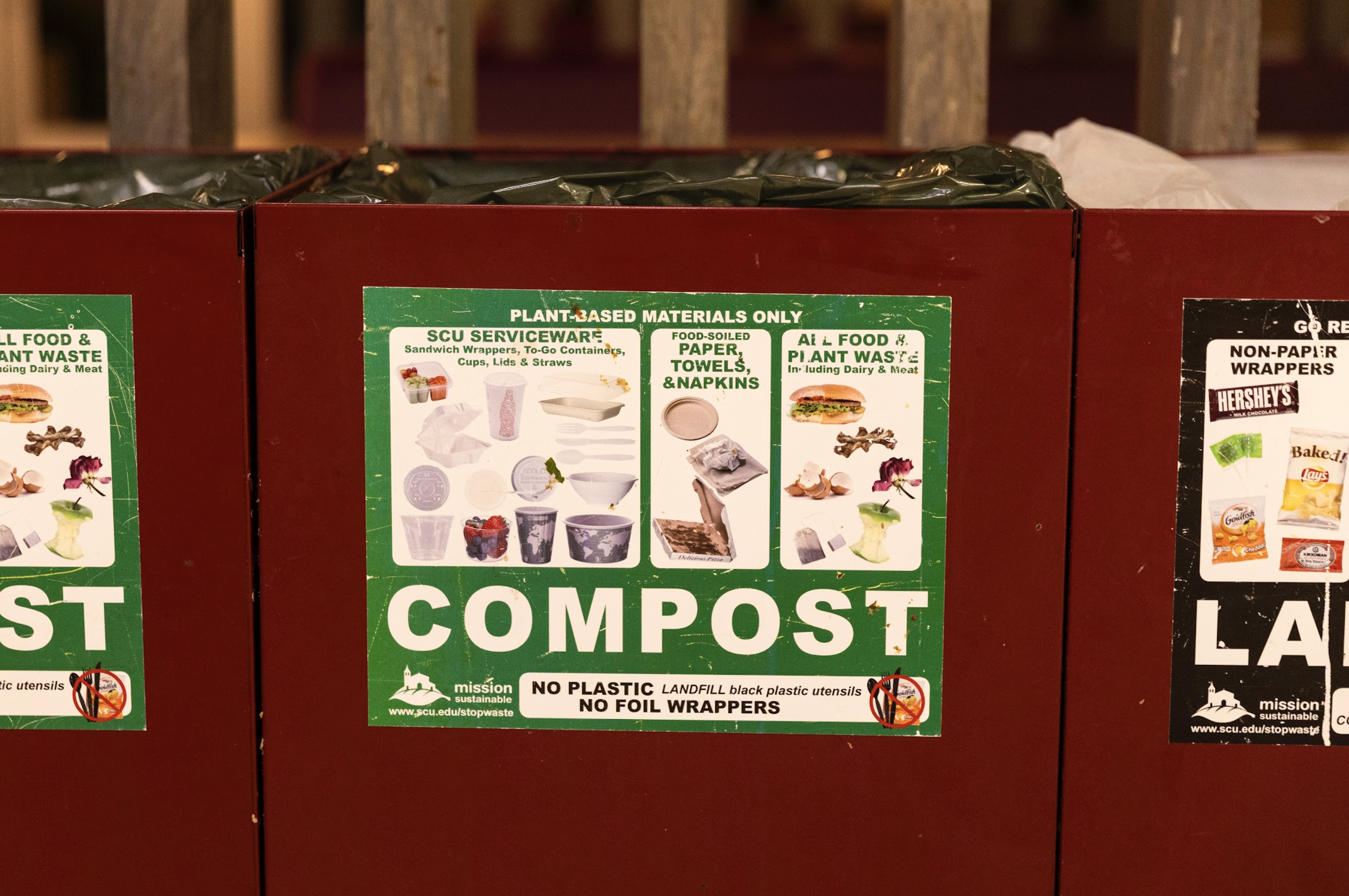
A compost bin in the Benson Memorial Center. (Nina Glick/The Santa Clara)
Like most people, I’ve come to believe that compostable materials are the most sustainable option available for dishes and utensils in dining halls. Items like bioplastics and paper products are an easy alternative to single-use plastics, and are often marketed as the most environmentally friendly choice.
But is this really the case? As businesses move towards single-use compostable materials as a quick way to boost sustainability, it’s becoming apparent that compostables should not be the material of the future.
Santa Clara University prides itself on its sustainability efforts. The Center for Sustainability and campus dining services have partnered to phase in sustainable alternatives like bioplastic utensils and biodegradable plates. As of now, all the “to-go” serviceware options offered in Benson Memorial Center are labeled “compostable.”
As impressive as that sounds, it poses a host of problems. Items like bioplastics are marketed as a sustainable option, but have a huge environmental impact. This false advertising is called greenwashing.
Marketing tactics such as green packaging, floral prints and use of target words like “sustainable” and “earth friendly” are common greenwashing methods. Unfortunately, Santa Clara University has fallen for the compostable serviceware scam.
What does this mean for the average student here on campus? While the University gets to market itself as “more sustainable” by purchasing compostables, it must be losing them money. The University has to pay for each single-use compostable item twice—first to purchase and again to dispose of it.
Students’ tuition money feeds into this economic sink hole that has little positive return for the student or the University. On top of that, the University’s waste goes to Mission Trails, which has specifically requested customers stop sending bioplastics. This means that certain products offered on campus labeled compostable—such as iced coffee cups, forks and straws—aren’t actually getting composted, even when students properly sort their waste.
I don’t say this to demonize the compostable option. Compared to conventional plastic, compostable serviceware is a step in the right direction. But it is not the solution. While bioplastics use renewable starch-based materials like corn and soy, the production and breakdown of these materials is water and energy intensive.
Harsh pesticides and chemicals are used in the production process, and the items cannot be naturally composted. Instead, items must be sent to a commercial composting facility, where they are treated at extreme temperatures and specific humidities for months in order to properly break down.
It is a very costly and energy intensive process that most facilities don’t have the funds, time or resources for. Most composting companies sort out the bioplastics and send it to the landfill, where it breaks down very slowly while releasing methane, a greenhouse gas 28 times more potent than CO2.
A real solution to the single-use issue is stopping the whole cycle by using reusable dishware. Reusable options directly stop the stream of “compostable” waste that enters our landfill in mass amounts daily. And it’s much more water, energy and resource efficient. Reusable items only have to be produced and purchased once, and then can be used indefinitely.
Washing your ceramic plate takes less water than what it takes to produce the stack of compostable plates you would otherwise use, and it’s much more cost effective. UC Santa Cruz has adopted a “for-here” dining system that heavily encourages students to eat on reusable plates by banning conventional to-go containers.
So, what can we as students do about this issue? Turns out, a lot. Currently, Santa Clara University has a whole system of reusable serviceware that is egregiously underutilized. Many students are unaware of the ceramic plates and bowls, as well as the metal utensils, that are available at Benson Memorial Hall.
Students can request the “for here” option when ordering food either in-person or via mobile order. Dining staff often default to offering the compostable “to-go” serviceware, but if student behavior changes and the demand for the “for here” reusable option increases, dining staff’s behavior will change.
All it takes to reset the Benson Memorial Center default from “to-go” to “for here” is enough brave students calling for action by consistently requesting the reusables.