ASG Candidates Vie for Student Votes
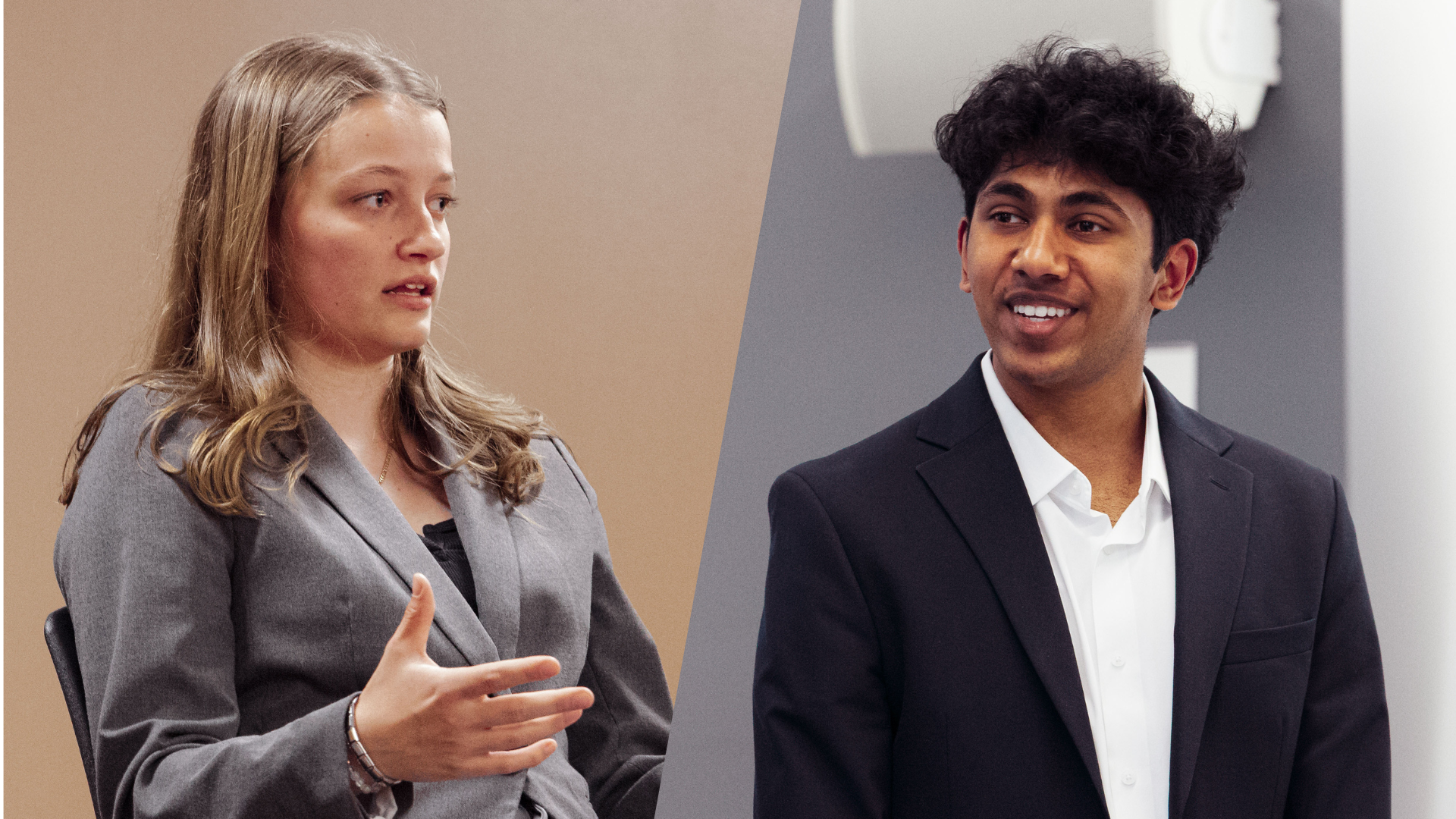
ASG presidential candidates Claire Krebs (left) and Ryan Rani (right) present their platforms during the student government meet the candidates and election debate events at Santa Clara University. Photos by Dylan Ryu.
Santa Clara University’s Associated Student Government hosted two events this week allowing students to meet the candidates running for key positions including sophomore senator, president and vice president. The event featured candidate introductions and responses to both prepared questions and audience inquiries.
Claire Krebs ’26, the current senate chair, is running for student body president with vice-presidential candidate Sophia Standard ’26, the current public relations vice president. Krebs highlighted issues she aims to address if elected.
“A huge issue that I see on campus is apathy,” said Krebs during the Meet the Candidate event Monday night. “Students don’t seem to care about what’s going on. It results in a culture where people don’t show up to things; they don’t support each other.”
Krebs and Standard emphasized improving internal accountability within ASG, advocating for increased transparency and focusing on the organization’s internal operations. Additionally, Krebs underscored the need for enhanced women’s resources, proposing expanded access to contraceptives and strengthened sexual assault resources.
Current Student Body President Ryan Rani, seeking re-election alongside new running mate Taara Khan ’27 who currently serves as a sophomore senator, reflected on his tenure’s accomplishments, such as digitizing campus reimbursement processes. Khan addressed critical issues related to off-campus Greek life, particularly sexual assault incidents at fraternity events, proposing mandatory educational resources for Greek organizations as a preventive measure.
Historically, there has been a lack of involvement from the student body with ASG events and the organization in general, leading students to wonder about what the organization actually does. Candidates had different answers as to how they might make their impact clearer to students.
“If we were able to produce and show what we were doing, that might be helpful,” said Tiago Moreno ’28, a candidate running for re-election as a senator.
During his time presenting, Moreno also made it very clear that if re-elected, he would continue to support ASG’s acknowledgement of President Donald Trump and his administration’s hostility towards higher education. The Trump administration also seems to be in Santa Clara University student voters’ minds as they decide who to cast their vote for in the ASG election.
“I’d want them to be conscious of how our educational experience is being impacted by the current presidential administration,” said Holly Burns ’27.
As well as concern for external issues, students want to see more general impact when thinking about the next ASG staff. “Bring the students together,” said Calyx Klein ’27. “More community, more school spirit.”
Presidential Debate
Tuesday night’s debate featured the Krebs-Standard and Rani-Khan tickets addressing specific questions from the ASG election committee and audience members.
The Krebs-Standard ticket elaborated on their three-pillar platform focusing on proactive advocacy, community engagement and internal accountability.
Krebs said: “Sophia and I meet with every single ASG member, every single quarter, to establish trust and direct line of communication.”
Standard emphasized concerns about ASG member retention during her closing statement.
“This is the issue of accountability,” Standard said. “We have three senators who would like to return to ASG.” Standard elaborated later, remarking: “It makes me really sad and disheartened to hear that so many of our senators will not be returning next year, despite the fact that I know they all have incredible ambition, goals, and passion about the work that they do.”
With only sophomore senator positions being contested in the election, the incoming senate chair will face the responsibility of appointing senators for all other class years.
This contrasted with Rani’s assessment of his leadership effectiveness. “In the three years that I spent in ASG, we have had the least turnover this year,” said Rani. “Last year, we had multiple exec members quitting or dropping out. This year, we had zero exec members leave mid-term.”
The Rani-Khan ticket highlighted their record of improvements to student financial systems and relationships with University administration.
“We’ve successfully implemented a fully-digitized reimbursement process, significantly cutting down processing and ensuring students no longer wait,” Rani said. “In the past, if you bought something for a club you would get your money back in two or three months.” With the new digital reimbursement system, students can submit reimbursements online and apply for digital credit cards to avoid paying expenses pocket.
Khan emphasized Rani’s experience working with the University’s administration on concrete initiatives.
“Ryan has already established an amazing relationship with admin, and with his continued presidency, we can work to combat more ambitious issues through his incumbency,” Khan said. “It’s not about handing out sticky notes for students to write on them or a Google form that reaches a small percentage of the student body. It’s about being able to speak to others and actually make physical changes.”
Challenges on Platform Priorities
Krebs questioned Rani and Khan’s decision to prioritize a new dismount zone policy. The dismount zone policy is meant to prohibit the usage of bikes, skate-boards, electric scooters and other similar modes of transportation between the Mission Church and Benson Memorial Center, according to Rani. The policy is planned to be rolled out within the coming weeks.
“I really admire you guys having student safety as a cornerstone of your campaign. I've been working on this issue since the very beginning with my freshman year. There are several huge issues on this campus in terms of safety,” Krebs said. “What made you decide to choose the dismount zone policy as one of your main safety areas when in our perspective, there are much more serious safety issues?”
Rani defended the initiative, explaining his approach to building administrative relationships: “I know this isn’t one of the top concerns,” said Rani. “But when I saw Phil was very excited to talk about this, I thought ‘ASG can help with this.’ This doesn’t seem like it should be impossible.” Rani noted how building success through smaller projects will allow ASG to gain the trust of the community to then pursue larger issues.
Multicultural Center Relations
Olivia Alleyne ’26, the at-large senator for diversity & inclusion, also challenged Rani about ASG’s relationship with other campus organizations: “You talk a lot about your past roles in the MCC and so as like ASG’s performative activism and I guess our relationships with other CSOs are being examined as not the best,” said Alleyne. “Why hasn’t your experience with the MCC led to a better relationship this year, and what would change next year to make it a better relationship?”
Rani acknowledged he does not consider himself close with the current Multicultural Centerdirector and associate director. He highlighted past initiatives and looked to the future on building a relationship back with the MCC: “We had diversity forums and that was super successful.” Rani hoped, if re-elected, that he and Khan could meet with the incoming Multicultural Center director and associate director for next year over the summer to begin rebuilding the two organizations’ relationships.
Khan suggested a more direct approach: “I feel as though ASG and MCC haven't had a sit-down conversation to talk about the elephant in the room. I think having those one-on-one conversations with the MCC being like: Why is it this way, what started it? How can we fix it? We need to be straight up with each other.”
Matthew Van Dyke ’26, web development chair on ASG, asked if Rani would only work with student leaders he was friendly with. “So is it your perspective, that as student body president, that you will only work with student leaders you already have a close relationship with?” said Van Dyke. “When All Comm happens, and we bring a CSO in, they all have a problem with ASG it seems like, and I think that’s because the relationships aren’t there.”
Rani responded that he hears these student groups that “shit talk” him and ASG. “You hear these things from people that you trust and people that you respect,” said Rani, referring to tensions between the Multicultural Center and ASG. Rani emphasized that he has better relations with the current candidates for the next MCC director and associate director, and expects that future relations between the center and ASG to be improved.
Kenneth Park ’25, the associate director of the Multicultural Center, responded to these comments after the debate: “The MCC is always open to conversation.”
Greek Life Relations
When asked about ASG’s relationship with Greek Life, Krebs emphasized that ASG should serve as a bridge rather than a decision-maker regarding Greek Life’s status with the University.
“I think that it’s not ASG’s place, quite frankly, to say Greek Life needs to reaffiliate or that Greek Life needs to be unaffiliated,” Krebs said. “I think what ASG can do, though, is a better job of helping the University to recognize that: Yes, we’re unaffiliated, but these are still students, and they should have a right to access resources on campus.”
Khan highlighted issues with Greek Life in her comments: “I have a few policies that I wanted to push on admin in regards to prioritizing student safety. One of them would be working with admin to have a training program for Greek chapters.”
Under Rani, ASG started the “Greek Forum” this year. The forum has allowed ASG to meet directly with leadership from off-campus fraternities and sororities to hear their experiences at the University.
Standard, who served as a recruitment counselor for a sorority, addressed racial disparities in Greek Life.
“I did hear from a lot from women of color who felt that it may not be the place for them, simply because they were women of color,” Standard said.
“I think it also starts with the culture of accountability,” she said further. “So when things that are blatantly or even slightly racist have been said, calling them out and those girls are not welcome in that environment if they’re going to make those derogatory comments.”
Election Timeline
Voting opened Wednesday from 8 a.m. until midnight, with the election committee tabling from 8 a.m. to 11:59 p.m. The winning ticket will lead ASG for the 2024-25 academic year, facing challenges of student engagement and organizational effectiveness that candidates acknowledged throughout both campaign events.