Async-or-Swim
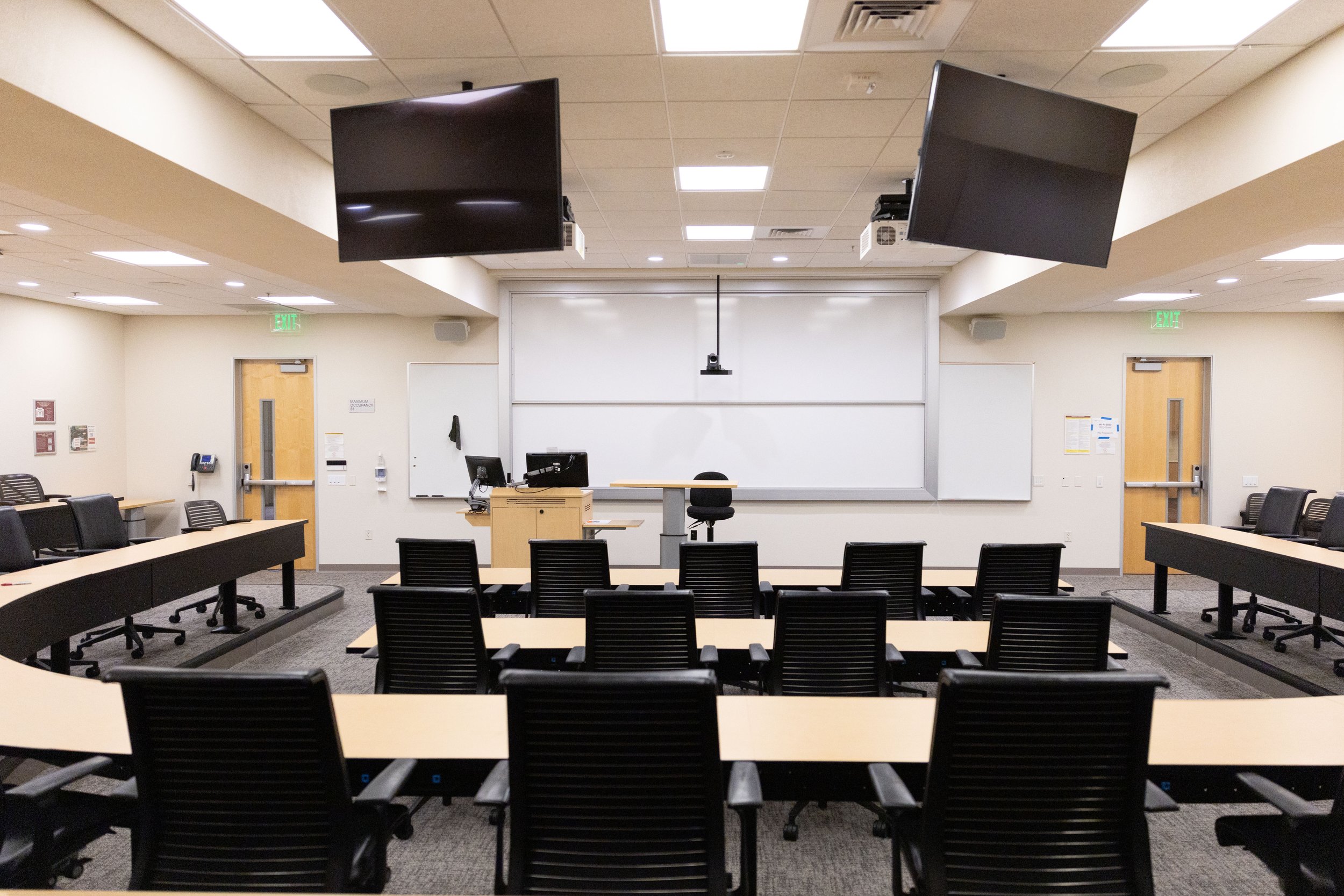
Asynchronous classes leave classrooms empty and students lonely. (Elaine Zhang/The Santa Clara)
Five years ago, Covid forced us into exclusively online learning. This isolation—classes held on Zoom and work to be completed individually—provided us with ways to learn effectively at home. But, despite being back on campus, Santa Clara University is still overly reliant on these methods. In an increasingly isolated and screen-based society, face-to-face exchange of ideas is more valuable than ever. We need to get back to the classroom.
Outside of purely online instruction, many Santa Clara University professors take advantage of asynchronous instruction as part of their in-person courses. According to the University’s teaching expectations, professors are required to conduct at least 70% of course-contact time—or class time—in person, but they might include project work time, small group work or asynchronous assignments in place of the other 30% of instruction time.
Research shows there can be benefits to asynchronous instruction. “The two major physiological benefits of asynchronous learning are more sleep and less stress,” according to Lynne N. Kennette and Phoebe S. Lin for the Society for the Teaching of Philosophy. “First, because the class work can be completed at any time, there is no need to wake up early to get to class, or earlier to have enough time for a potentially long commute. Second, asynchronous learning affords students benefits that can help lower stress. For example, saving money on parking and commuting costs.”
And, there can be benefits for actual learning, not just mental health. “Asynchronous learning kickstarts in-course conversation,” says the Massachusetts Institute of Technology, and, “Asynchronous learning makes learning more digestible.”
A professor might replace a class with instruction to watch a film, take notes and come to class ready to discuss.
Other professors may split the class up into smaller groups to facilitate learning in a way that encourages participation—its harder to get lost in the back of the class in a five-person group.
Gabrielle Pitre ’26 discussed some of her experiences with asynchronous courses, and specifically her experience with small, discussion based meetings in place of class, referred to as “learning communities.”
“It was a chance to get to know other students and have a more in-depth conversation about our readings for that week, in a more intimate setting,” said Pitre. “I don’t know, it was fun. It was a different way of doing discussions, which I liked.”
Certainly, there will be times when a professor will not be able to conduct class in person, and perhaps these solutions are more beneficial than a full-group Zoom class.
“Zoom can just be so passive…you can turn off your camera…you can be muted,” Pitre says. “It feels… more like passive learning than doing an assignment, like a short discussion post or discussing with people in our class, outside of the classroom.”
But what happens when asynchronous goes too far? Penny Flores ’28 talked about her experience of a course her freshman year that was almost entirely online.
“I never saw the teacher…we just had a weekly assignment and a discussion thing. That was literally the class,” said Flores.
Little to no learning happened, according to Flores, let alone conversation and connection among her classmates. “I didn’t even meet anyone in the class because we never met…I didn’t meet the teacher, I didn’t even know what she looks like,” said Flores. She said the class didn’t even meet in-person on the first day of class, and that on Zoom her professor had the camera off.
We have the resources to learn online, but this doesn’t mean we always should. “In a student’s daily scramble to meet their many obligations, meeting in a classroom with peers and professors rarely pops up at the top of their list of priorities,” Robert Zaretsky, professor of history at the University of Houston, said about this phenomenon. “But it is also perfectly ethical to question the motivations of some other students who take these courses as well as administrators who make them available.”
“In a classroom, students and professors engage with one another not just in real time, but in real space—a privileged moment during which we are, well, in sync with one another. The ping-pong of questions and answers, the exchange of interpretations, the spontaneity of reactions, and, if you are lucky, the suddenness of an insight all happen when a group finds itself in sync,” he says. “In an asynchronous setting, however, students and instructors are out of sync. While the term literally means that teaching and learning occur at different times, it practically means that neither teaching nor learning truly occur.”
Zaretsky also references this 2022 study published in the Journal of Science Education and Technology noting the negative learning outcomes of asynchronous online learning compared to in-person. The study offers some hypotheses for why, saying “there are some aspects of in-person classes that cannot be easily replicated in an asynchronous online course. These include the addition of faculty-student interactions, peer-peer interaction, on-demand instructor scaffolding, and personal accountability encouraged by face-to-face interactions.”
Online course offerings are important, and can be a way to guarantee a sense of flexibility for busy students and faculty. But as we all know post-Covid, technology can be very isolating.
A survey from the Harvard Graduate School of Education in 2024 found that 24% of 18-29 year olds “had serious feelings of loneliness.” Further, 73% of the group surveyed said that technology contributes to loneliness in the United States.
It makes sense that attending a class via Zoom, or watching a video instead of attending class might promote loneliness and decrease feelings of belonging on a college campus, and this reality is backed by research. A 2014 study published in Instructional Science showed that supportive classroom environments have a positive impact on students’ feelings of belonging, as well as motivation. These benefits came from both instructor interaction and positive group work experiences.
This aligns with Pitre’s positive experience with her learning community. Not every class will be a full-class, lecture-style operation; it’s simply not realistic. But even when we can’t all be together, connection should still be prioritized.
The evidence is clear. While we now have ample technology and ability to conduct class asynchronously, what young people really need is in-person, face-to-face instruction—now more than ever.
Santa Clara University boasts its No. 23 rank for best undergraduate teaching to the whole community, and innovative teaching is something to be proud of. But this must happen together.
We need connection—students, faculty, the whole community—why not start in the classroom?