Black History Is Not Past Tense
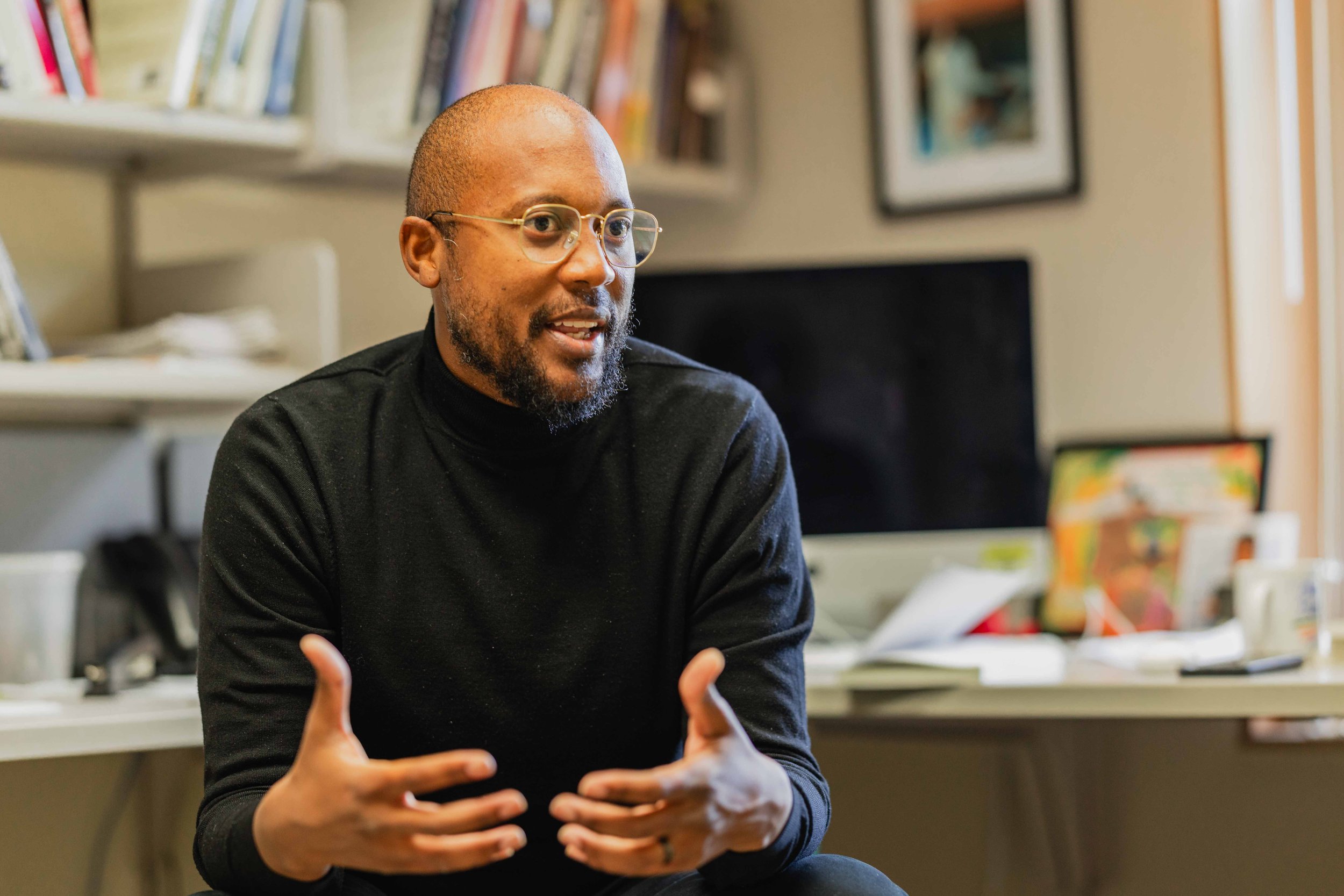
Professor Bryson White discusses the rationale behind his teaching, grounded in his preaching background. (Dylan Ryu/The Santa Clara)
On the heels of Black History Month, I sat down with Professor Bryson White—a 43-year-old Fresno native—whose course on religion and mass incarceration challenges students to face uncomfortable truths about justice and faith. For White, the month is not simply a retrospective celebration of Black Excellence, but also a reminder of the unfinished work of dismantling a carceral system that continues to shape—and too often confine—many Black Americans.
Can you tell me a bit about your background?
PROF. WHITE: After undergrad, I moved back home to Fresno and joined the staff at St. Rest Baptist Church, where I was doing social justice ministry. I was the pastor of outreach, doing adult ministry, but I also wanted an even deeper way to engage my own faith tradition.
By circumstance and happenstance, I became a faith-based community organizer, working for something that is now called Faith in the Valley—part of a larger national faith-based network.
So I did a lot of work on how our sacred texts, particularly in the Christian tradition, approach social justice. I mobilized faith communities around issues like violence reduction in our communities and improving the conditions in which people are living their lives.
What first drew you to teaching about mass incarceration?
PROF. WHITE: Growing up in the Central Valley between 1982 and 2000, they built 23 prisons but only one university. So I grew up in an era of major cultural construction.
Then, one of my older brothers was incarcerated for a while, and a friend of mine, whom I grew up with, I saw getting arrested or going to jail. But I saw folks from other communities—wealthier communities—not going to jail for similar circumstances. So I began to wonder, when I was in pastoral ministry, why it was difficult for clergypersons to robustly think about punishment differently.
Later, when I was organizing, seeing the bars of reentry into society that only incarcerated persons were facing, as well as the difficulty faith communities had thinking outside of punitive logic, began to draw me into the conversation about what is theological about mass incarceration.
Coming off Black History Month, how do you see the relationship between Black history, religion and the modern carceral system?
PROF. WHITE: I try not to think in binaries; I think human life is very complicated and mixed together. I think religion, particularly, has fueled Black communities in a positive way about identification and fortification against white supremacist systems bent on dehumanizing Black persons.
However, I think due to some of the colonial delivery systems of the Christian tradition, Black faith communities have also ingested some of the very same anti-Black, homophobic and classist logics that exist side by side in the Black faith community.
But I think the best of the history and tradition, as exemplified by Martin Luther King Jr., Howard Thurman, or Malcolm X—who is Muslim—orient our traditions toward Black freedom and the deconstruction and dissolution of the supremacy.
I think Black History month should include incarcerated persons, especially incarcerated; authors, political activists and artists. There is genius locked behind bars and they should be honored as well. We can’t look them over as if they don’t exist and have not contributed to black freedom dreams.
How do you address common misconceptions about crime and punishment?
PROF. WHITE: I center Black and Latinx theologies, along with some liberal and anti-colonial theologies, to navigate through the Christian tradition’s past—collapsing the assumption that Christian tradition is inherently tied to white supremacy, or using that tradition to help students think beyond the logics of anti-Blackness embedded squarely within it. This allows them to engage alternative voices that are seeking to challenge or abolish that part of the tradition. That’s what we do inside the classroom.
Outside of the classroom, I’ve lectured in faith communities, exploring the connections between religion and mass incarceration, Christianity, and anti-Blackness. After my career as an organizer, I returned to organizing spaces to help other organizers think about these connections, because I don’t want to leave faith to conservative voices—to let them hijack it, hold it and define it on their terms.
Both in and outside the classroom, I’m an ordained minister, so I preach—and I preach from a liberation standpoint.
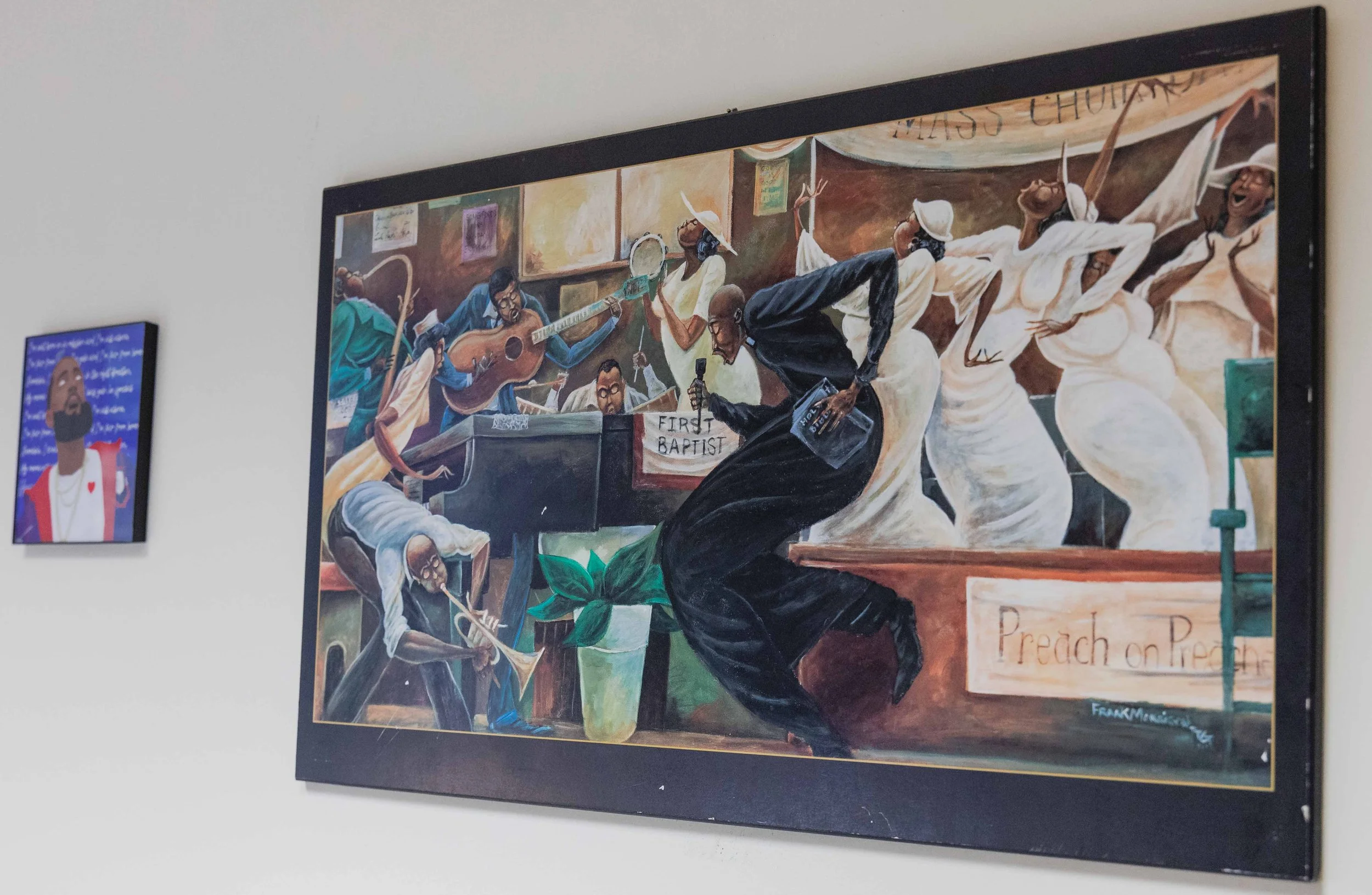
A copy of Frank Morrison’s “Preach on Preacher” hangs on White’s wall in his office. (Dylan Ryu/The Santa Clara)
Do you see teaching this subject as a form of activism?
PROF. WHITE: Absolutely.
It’s interesting because when I was an organizer, I was in spaces that were critical of the way universities sometimes capture activists and organizers in the role of being a professor. Even so, I worked directly with professors who were deeply engaged with communities, and they offered me another model—showing how you can think about theory while also being active in the pursuit of freedom.
I do think teaching students is a form of activism, because you’re helping to shape the perspectives of people who are going into workforces, organizations, nonprofits or corporate spaces—wherever they may find themselves. Hopefully, they carry these social justice-oriented ideas not only into their own interior lives but also into how they engage with and impact the world.
How has your understanding of mass incarceration evolved since you first began studying it? Has teaching mass incarceration changed how you define justice?
PROF. WHITE: Yeah, absolutely.
When I first started studying it, I was exposed to it on a personal level, but when I began thinking about it theoretically, it was mostly through police violence and analyses of conversations—not the prison system as a whole. When I was in my early organizing career, it was definitely more reformist-oriented, focusing on things like bail and ankle monitors. Those are very reformist approaches.
As I began to read and study more—especially the work of Georgia Gilmore, Angela Davis and many others—I started to see how those are short-sighted interventions that don’t really create long-term transformation.
So I’ve definitely moved from a reformist background toward an abolitionist perspective, based on study and conversations with folks.
By next Black History Month, what do you hope will have changed? What do you hope students walk away with—knowledge, urgency, empathy, policy awareness?
PROF. WHITE: I hope students walk away with an understanding of the times we live in, and that it’s critical. We live in a critical moment—not just in national history, but in world history.
I hope they can see themselves as necessary participants in saving our collective humanity, saving the planet and saving ourselves. We all essentially need one another to move forward. I hope they understand that this moment is critical and that they have a role to play.
I have a six-year-old, and I want the world to be safer for him at 40 than it is for us right now. I want the world to be safer for his children.
I am definitely invested in students converting to a way of thinking that isn’t reducible to their desires for capital accumulation. Instead, I hope they can be expanded to see a broader circle of human concern—alleviating vulnerability, death and destruction.