The Hidden Engine of Club Sports
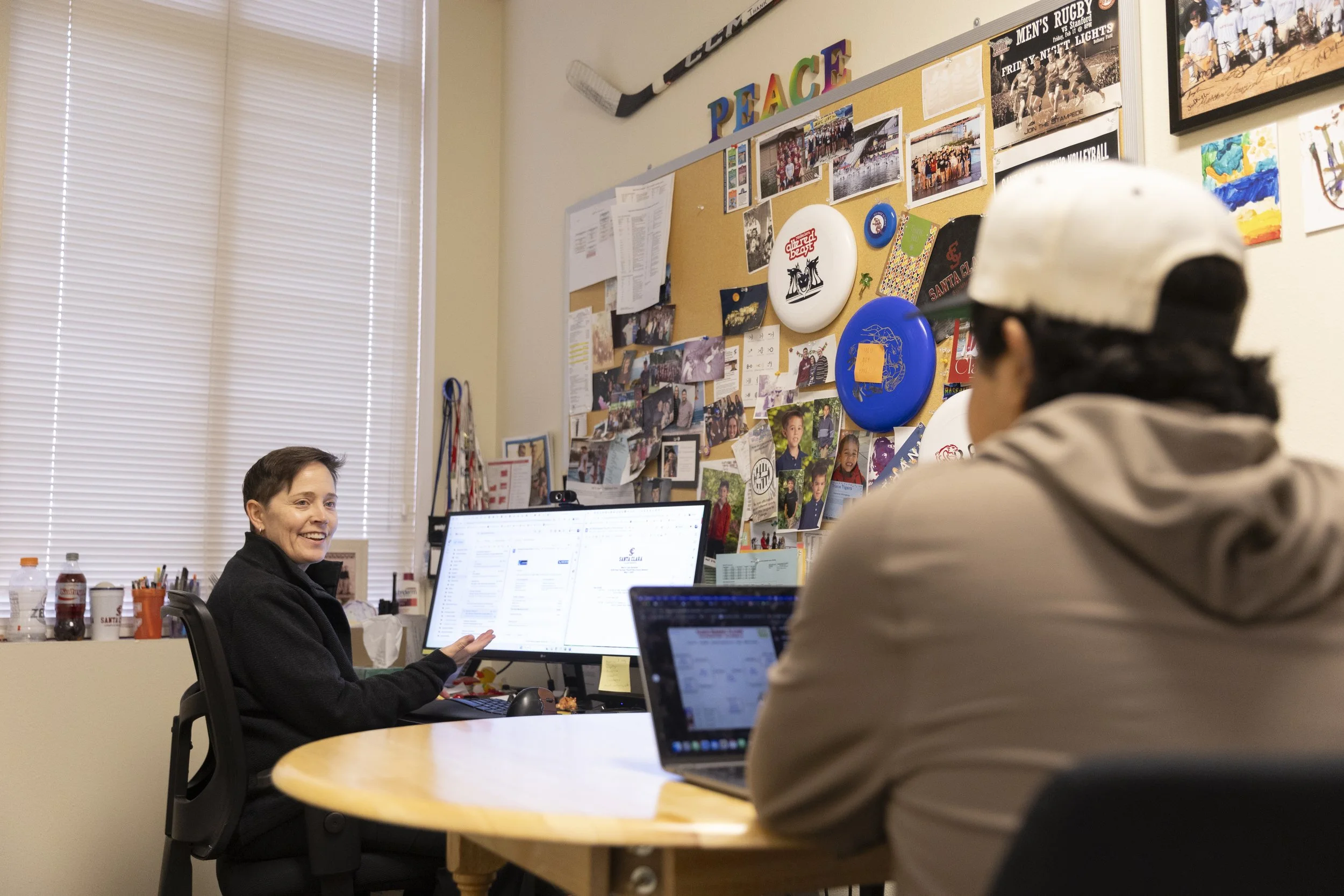
Santa Clara University Director of Club Sports Kathryn Hutchings meets with Santa Clara club baseball to prepare for regional playoffs in the Malley Center on Wednesday, April 22, 2026. (Nina Glick/The Santa Clara)
Santa Clara University’s club sports program is an intricate system, populated with 21 active teams and 754 students competing on the national level. These are not Division I programs—they do not have the depth of staff, the coaches or the infrastructure that those teams do. Instead, they are run by student leaders, volunteer coaches, but most notably, a sole administrator holding it all together.
For the past 15 years, that person has been Kathryn Hutchings.
“I am an advisor, accountant, a travel agent, sports information director, event supervisor—you name it,” Hutchings said.
That’s not an exaggeration.
On any given day, she will be meeting with student leaders, resolving conflicts, booking travel, approving merchandise, or addressing compliance issues—often all at once. Maybe even solving a last-minute travel issue for a team heading to playoffs.
“Okay, we’re gonna make it to playoffs so we need to buy $15,000 in airline tickets,” she said. “Do we have enough money to do it? Let’s figure out what we have and what we can do to make it work.”
Behind every practice, tournament, away trip, there is a web of logistics—budgets, contracts, athletic trainers, Bellomy Field schedules—that Hutchings manages largely on her own, with the help of a few student coordinators.
“It’s just the volume,” Hutchings said of her job’s biggest challenge. “The volume and the limited resources.”
That combination defines club sports programs across the country. They are often built on student demand, without always having the infrastructure to support them.
“If students want to do something, people will just say ‘okay,’ without making sure there’s the infrastructure to make it successful,” Hutchings said. “Why would you set something up to fail?”
Hutchings has spent her career trying to make sure that doesn’t happen at Santa Clara University.
Part of what makes club sports so unique is also what makes them difficult—teams operate independently, with leadership turning over every year. Resources are limited. Yet expectations remain high. Hutchings has found ways to help programs not just stay afloat, but grow.
Take the sailing team, which has recently expanded from just a handful of members to more than 25. Under student leadership, the team has acquired new boats and is working to secure a permanent storage space.
“We make things work,” Hutchings said. “And that’s what I love to do.”
That mindset extends across all 21 teams, from highly-ranked ones like club baseball to smaller, more niche sports like shotokan karate. Hutchings takes pride in understanding each one, even when their needs differ dramatically.
“I’m proud of myself for understanding so many different sports and that I am able to advise for what you need,” she said. “They all need different things.”
Her role is not just administrative, but personal. She mentors student leaders and helps them navigate everything from budgeting to conflict resolution, stepping in when teams don’t know where to start.
For Hutchings, club sports has always been about more than just competition. This philosophy has shaped how she approaches her work. Her goal isn’t just to keep teams running, but to prepare students for life beyond college.
“Our club sports program would not be successful without each team’s student leaders or our amazing four student coordinator employees,” she said. “By the time they leave here, they’ve learned skills for business management, accounting, communication and more—many of them transferable skills.”
Club leaders manage budgets, coordinate travel, organize events and lead large groups, often with minimal experience. Mistakes happen, Hutchings admits, but they’re part of the process.
“That’s what we’re all about in campus rec,” she said.
Yet, despite its scale and impact, club sports often fly under the radar. For many students, it is a major defining piece of their college experience. Athletes commit hours each week to training and games. Teams raise their own funds. Leaders take on responsibilities that mirror full-time jobs. And through it all, Hutchings works behind the scenes to keep everything moving.
“I’m very proud of what our students are capable of doing with the limited resources that we have,” she said.
Yet, the challenges persist. Balancing budgets, supporting student leaders and maintaining competitive teams requires a lot of careful planning and flexibility. From her early days in the role, Hutchings has focused on helping teams build sustainability.
“When I first started here, that was trying to advise all programs how to be financially stable in the future and what are your goals with the program,” she said. “But also, how can we afford to do what we do?”
Her goal remains mostly the same today—equip students and teams with the tools they need to succeed without becoming overwhelmed.
“I want to make sure I am giving them the tools they need to be able to run their team successfully and not be too stressful,” Hutchings said.
As club sports at the University continue to grow—gaining more traction through initiatives like Day of Giving—the program is also looking ahead. An external review is set to occur early next month to evaluate the program’s long-term trajectory.
“They’re going to go through the finances, program funding, everything, from inception to today,” Hutchings said. “They’re coming to tell us what’s working well, where there is room for improvement.”
For Hutchings, the future of club sports at Santa Clara University will depend on the same thing that has sustained it for years: the students.
“It really depends on how much the students are willing to put in. There’s good years and bad years.”
If Hutchings were to step away, the system wouldn’t collapse, but only because she’s built it that way. Detailed ‘how-to’ guides, student coordinators, and leadership structures ensure continuity. Her presence is felt in every corner of the program.
And while club sports may not always get the recognition they deserve, their impact is undeniable—for the hundreds of students who rely on them, and for the one person making it all possible behind the scenes.