Chants, Chapters and Choices
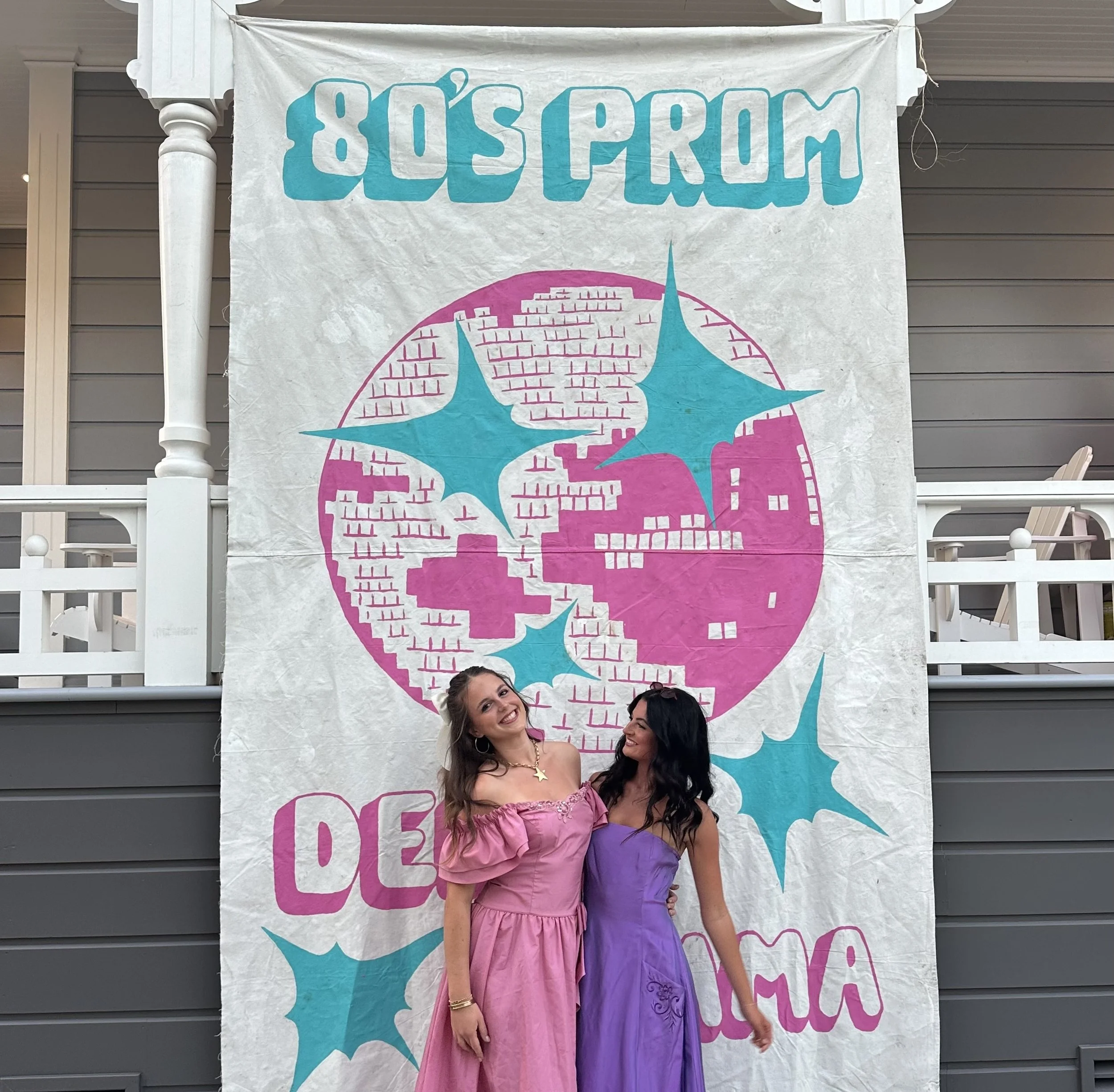
President of Delta Gamma, Charlie Johnson ’26, and President of Kappa Kappa Gamma, Kealy Cummins ’26, pose under Delta Gamma’s “80s Prom” themed night. Photo provided by Charlie Johnson ’26.
Chants echoing through Santa Clara streets; sorority chapter houses buzzing with activity; throngs of girls running through campus in matching outfits and heels; phones lighting up with Fizz notifications of the latest anonymous gossip. Yep, sorority recruitment season is back in full force.
Since their inception in 1851, sororities have been a lively—and frequently perplexing—part of college social life for over six million women. The National Panhellenic Conference, which oversees all things Greek, consists of 26 sororities, five of which are available for Santa Clara University students to join: Alpha Delta Pi, Alpha Phi, Delta Gamma, Kappa Alpha Theta and Kappa Kappa Gamma.
Santa Clara University disaffiliated Greek life in 2000, following instances of hazing, racism and sexism by the men’s fraternities throughout the 1990s. But there are still 75 to 175 members of each now off-campus sorority, meaning the Greek presence radiates across campus during the high point of the sorority year: recruitment, commonly known as “rush.”
This year, from Saturday, Oct. 4, until Tuesday Sept. 7, the streets of Santa Clara will be alive with “active,” or current, sorority members and potential new members. Santa Clara’s five sororities accept an average of 25 to 40 potential new members, according to the Vice President of Recruitment for Santa Clara Panhellenic, Valerie Guadian ’27.
Following that brief history, let’s get to the good stuff. Here are answers to some of the most asked questions surrounding recruitment as Santa Clara’s sororities gear up to welcome their newest members.
What makes Santa Clara sororities different from social media stereotypes?
Sorority stereotypes are often seen circulating popular social media apps like TikTok and Fizz, an anonymous app available for only students attending the university. “There's a lot of propaganda,” said Guadian.
A prime example is the dress code for rush: posts with required lengths of dresses and so-called “appropriate” outfits are sometimes hard to ignore. But, rather than splurging on outfits for the weekend or worrying about trends, Guadian hopes potential new members “prioritize comfort and confidence over flashy.”
“Here, the process of rush is very genuine,” said President of Alpha Phi, Naina Singh ’26. “I’m literally a sorority president but I myself even feel like, sometimes, I’m not that much of a sorority girl.”
The lack of cascading balloon arches and displays typically seen carefully strung across southern sorority houses is intentional to further drive home this message of a more relaxed style of rush. According to Guadian, sororities at Santa Clara “want to attract based off of our authenticity and our genuine community.”
“I truly believe if you just be yourself, the right house will find you,” said Charlie Johnson ’26, President of Delta Gamma. “On the other side of it, we want to get to know the girls for who they are.”
Social pressure prohibiting cross-sorority friendships is another common stereotype that is not true here, the Santa Clara Presidents all agree. “I’ve never felt constrained to being friends with only my sorority,” said Johnson. President of Kappa Kappa Gamma, Kealy Cummins ’26, even attended Delta Gamma’s recent “80s Prom” themed event with Johnson just last week.
“We all know a million people in every other sorority,” said Molly Kister ’26, President of Kappa Alpha Theta. “There's definitely good panhellenic love.”
“Here, your sorority does not define who you are,” says Guadian. “Whatever chapter you end up in, it does not matter because we are such a small community that everyone is friends with everyone.”
What exactly is rush?
Potential new members must complete an application and submit a $45 fee before they are registered to meet their Recruitment Counselor, a sorority member who disaffiliated from her sorority over the summer to remain unbiased while assisting potential new members during rush.
350 Santa Clara students have registered for rush as of today, according to Santa Clara Panhellenic’s Instagram. Recruitment counselors will be paired with small groups on Oct. 3 to provide moral support on a more individual level, complete with a group chat for questions, concerns and support. Rather than base their expectations of rush on social media gossip, Guadian says that it’s better to hear from recruitment counselors who have all participated in sorority recruitment and can answer specific questions.
However, recruitment counselors do have some limitations on the questions they’ll take. None will provide answers about their sorority affiliation, fraternity parities or night life—to further emphasize the community aspect of rush.
Rush officially kicks off at the American Legion on Friday. Located just across the street from Nobili, the building transforms into a hub of sorority activity, serving as the meeting place for rushees between every event.
Sisterhood Day, at 10 hours the longest day of rush, is dedicated to emphasizing the values of, well, sisterhood. Potential new members attend five separate hour-long events at each of the five chapters to meet active members and begin to form bonds.
There are built-in breaks for everyone, but Guadian warns of the considerable walking and encourages "comfort and confidence” with sundresses and sneakers over painful heels and uncomfy formal wear. At the end of the long day, rushees must rank the top four sororities they would be willing to join, which means accepting a “bid,” the name for a formal invitation into a sorority.
Returning to the American Legion the afternoon of Oct. 5 is the next step in a potential member’s journey. Each member privately receives their schedule for the day, which includes the one to four chapters they were invited back to for Philanthropy Day.
The second day of rush is dedicated to the unique service organizations and issues Santa Clara sororities fundraise for. Sororities give presentations on their specific fundraising events and potential new members are encouraged to ask questions on how each charity shapes the sorority before ranking their top four choices.
Rounding out the recruitment experience is Preference Night on Oct. 6, where participants make their final visit to either one or two sorority chapters. For Singh, Preference Night was the best part of her recruitment as a first year. After having connected with an Alpha Phi active during the previous days of recruitment, the longer conversation during “Pref Night“ allowed for what she described as “genuine bonding” with the active member.
Johnson similarly recalled her Preference Night discussions with nostalgia: she had straightened her usually curly hair—“which I never do,” she asserted—only for one of the Delta Gamma women she met during a previous recruitment day to tell her “us girly girls got to stay together.”
As the most formal—and least amount of required walking—day, heels and formal attire are encouraged. After attending their final parties, potential new members must sign a ‘Membership Recruitment Acceptance Binding Agreement’ agreeing they will adhere to the final decision: meaning whatever they write down on Preference Night is what they will have to accept come Bid Day, the big reveal.
Done in privacy, participants are able to “intentional single preference” via writing down only one sorority, or choose to rank both of their final two selections, indicating they would like to be in either sorority. There are slight risks to both, as with the former there is an opportunity to be “dropped,” or not invited to return, to the only sorority a potential member chose. As with the latter, there is a possibility to get their second, rather than first, choice.
Bid Day takes place on Oct. 7, where once again potential new members converge at the Legion to receive a small, sealed envelope containing their future sorority. All new members rip open their bids at the same time before sprinting—yes, actually running—to their new chapter houses. The event is called “running home” for a reason. Met with countless hugs, screaming, a sign with their name on it and dozens of new sisters, the potential new members have finally transformed into sorority members.
What’s with the chants?
The most commonly asked question surrounding sorority requirement for those not involved in Greek life is: “What is with the chants?” As the most traditional and nationally-performed aspect of recruitment, some people might think the singing is weird, according to Singh.
“The point of the songs is to bring a hype energy for potential new members and show our spirit for our sororities,” said Kister. “To anyone else, it might look like it's like pretty easy: you just sing, dance and talk to people. But in reality, there's a lot more effort that goes on behind the scenes you don’t see.”
All Santa Clara sorority members return to campus a week early to practice for recruitment and, according to Kister, each executive team and Panhellenic work tirelessly in the several weeks leading up to the big event.
“Santa Clara does a really, really, really good job of making sure that rush goes smoothly for the potential new members,” agrees Singh. “It’s not like the school is organizing it, it's the members of each sorority and Panhellenic organizing it.
The two Presidents agree wholeheartedly: while the specific songs might change year to year, the essence of why they’re a part of sorority recruitment stays the same. They are not meant to be strange, but rather indicative of the dedication sorority women have to their chapters and overall time put towards recruitment. Plus, it’s a lot of fun.
What advice does sorority leadership have for potential new members?
The voting process is often the most stressful part of recruitment, according to Guadian. “But, ‘if I put a sorority number three or number four, they're gonna drop me,’ is not the way the math works,” she stated.
Santa Clara Panhellenic—along with Panhellenic organizations nationally, according to Guadian—use a “mutual-mutual” selection process aimed to standardize recruitment across all sorority chapters. Each potential new member receives multiple scores from every sorority, which are then plugged into an algorithm along with their own rankings.
The algorithm then determines each member’s schedule for the following day or, for Preference Night, which sorority they will become a part of. This way, Guadian stressed, the process truly is a mutual agreement and selection between individual new members and active sorority members.
“Trust your instincts and stay true to who you are,” said Gabrielle Ruhnke ’26, President of Alpha Delta Pi. “It can be overwhelming at times, but remember that everything happens for a reason. You will find the chapter where you can be unapologetically yourself and continue to grow.”
“The whole recruitment experience is supposed to be centered around community, sisterhood and philanthropy,” said Guadian. Keeping the topic of conversations centered around sisterhood and service, instead of fraternity parties and night life; “that’s really what we try to emphasize not only to the potential new members, but for actives too.”
Santa Clara “Panhel Love”
“I have met so many amazing women, not only in [Alpha Delta Pi] but across the entire Panhellenic community, who continue to challenge and inspire me,” said Ruhnke. “The connections I have made here at Santa Clara have shaped my time here in the most meaningful way.”
No one will bat an eye at cross-sorority friendships, according to Johnson. The west-coast, “Panhellenic love” style of rush is "definitely unique to Santa Clara,” she said.
“Without one sorority, the Panhellenic community wouldn't be complete,” agrees Kister. It’s clear the sentiment among sorority leadership that you can’t go wrong with Santa Clara Panhellenic. So, if you plan to rush this weekend, as the character Jessie famously said, “Enjoy it; it feels like a party every day.”
For more resources regarding fall 2025 sorority recruitment for students enrolled in Santa Clara University, visit Santa Clara Panhellenic's PNM resource packet and Instagram containing exact times, dates, conflict disclosures and personalized advice.
The President Kappa Kappa Gamma was unavailable for comment. MJ Kaspura is a member of Kappa Alpha Theta.
