The Problem of Political Discourse
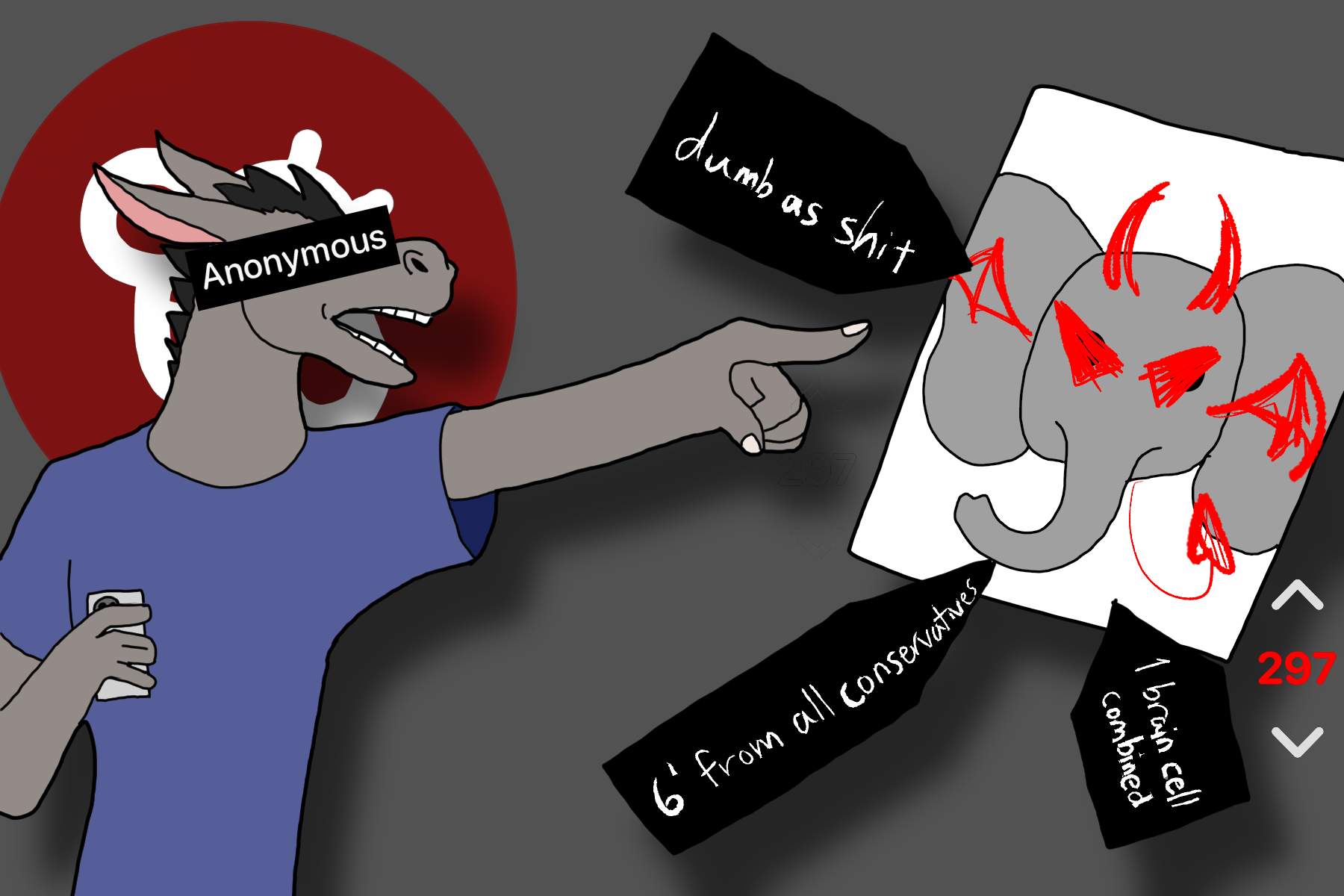
(Graphic by Jenell Theobald)
In my time at Santa Clara University, I have heard the same sentiment from multiple people: conservative voices are stifled. Whether it be by grades, by social ostracization, by cancel culture or by the prevailing liberal voices on campus, people with opinions other than the majority feel as though they will be punished in some way for voicing them.
Colleges should be places of intellectual discourse, and this includes worldly and political ideas. Of course, this should not extend to bigotry; racism, sexism, homophobia and other radically hateful ideas should not be tolerated. Despite certain prevailing notions, these ideas are not core parts of either conservative or progressive ideologies. But the reduction of political discussion and the cancel culture that makes people fear exploring beliefs on both sides of the political spectrum must not have a place at our university.
Data on this issue is mixed, with some sources saying that conservative opinions are inhibited on college campuses. Smith College found, in comparing studies from 2000 to 2016, that “there has been a significant rise in support for censorship of right-wing views, and a decrease in support for reciprocal or content-neutral principles of free expression.”
On the other hand, a 2026 Gallup report written in collaboration with the Lumina Foundation found that “Between 64% and 74% of Democratic, Republican and independent students say all or most of their professors encourage students to share their views and support speakers and audiences alike during controversial discussions.”
It is my impression, based on these studies, my own experiences and stories from peers, that professors may be open to differing opinions, but students may be more hostile to less popular ideas.
I discussed the issue of political division on college campuses with Provost James M. Glaser. He noted how the prevailing campus culture is largely liberal, and how this single-sidedness can be problematic. “This is a challenging problem for a lot of universities and colleges. We tend to be progressive institutions filled with progressive people,” he said. “In my opinion, that's an issue. We want students to be exposed to all ideas. It’s partly our responsibility that they be exposed to all ideas, the whole spectrum of ideas. The conversation doesn't have to be about embracing them or rejecting them, but just understanding them.”
Interestingly, two posts that circulated on Fizz a few months ago capture this air of animosity. One post read: “I need at least 6 feet from all conservatives,” which had 424 upvotes, and the other read, “I need at least 6 feet from all liberals,” and had 203 downvotes. Then a student posted a screenshot of both posts and wrote: “I made the top post just to show the double standards. Not on either side just why don’t we stop hating people for political beliefs. Promote real face to face conversations and stop hating on fizz.”
I largely agree with this idea, and I think one reason these conversations do not happen is because of commentary on platforms like Fizz and gossip that circulates around campus.
“The republicans at this school are genuinely dumb as shit maybe we would have more discourse if yall had more than one brain cell combined.” 297 upvotes.
“Yay! Prop 50 passed, not sure what it does but fuck the Republicans!” 315 upvotes.
There is certainly animosity on both sides. One post reads: “71 million people voted red for a reason. The democrats have lost touch with the American people plain and simple. Smug fucks like u make it worse.” This post has 42 downvotes.
These votes may just represent a larger Democrat population at Santa Clara University, as the campus culture has been known to be more liberal. Additionally, those with a college education do tend to lean liberal or Democrat in our nation today, according to Pew Research Center. But having so many upvotes on largely hateful posts signals a greater problem in our community.
“I don't think that's a forum for positive civil debate and discussion,” Glaser said about Fizz. “I think the anonymous nature of it makes it possible for people to name-call or shame or take extreme points of view, to be provocative. Not healthy.”
On its mission and values page, Santa Clara University lists “Community and Diversity” as a fundamental value, stating: “We cherish our diverse and inclusive community … that is enriched by people of different backgrounds, respectful of the dignity of all its members, enlivened by open communication, and caring and just toward others.” We should strive for this open communication, not division and assumptions.
A student body more open to political discourse would not only benefit those who identify as staunchly Democrat or Republican. Exploration of political ideas would make all of us more educated and civically-engaged citizens. This also means exploring and questioning our own beliefs. On every side, this requires empathy and vulnerability, two traits we must cultivate on our campus. Conversation is one way to foster these, and college classrooms are the perfect place to start.
Glaser offered an important suggestion for fostering conversation. “We should be heeding the Jesuit principle of presupposition, which is required for open dialogue. With presupposition, when you enter into a conversation, you assume the best in the person you are talking to,” Glaser said. “You want to walk into the conversation with an open ear. With at least an assumption that the other person is coming from a place of goodwill. That's what the Jesuits tell us. I see that here. And that should help, but it doesn't solve the problem completely.”
Ultimately, dialogue is essential to our education, and this includes the conversations that are with people of different beliefs. Glaser noted how social bubbling is common, and universities ought to challenge this. “It’s our responsibility to prepare people for the world and help them fight against this natural inclination just to be with people like themselves, or think like themselves,” Glaser said. “If we're preparing students well for the world, we're helping them think about how to engage people who have different views, and to be comfortable in expressing their own views.”
As students, we must embrace this connection and dialogue that our professors and administrators are striving toward, and reject blind hate and assumptions, especially online.