MLB’s ‘ABS’ is a Huge Success
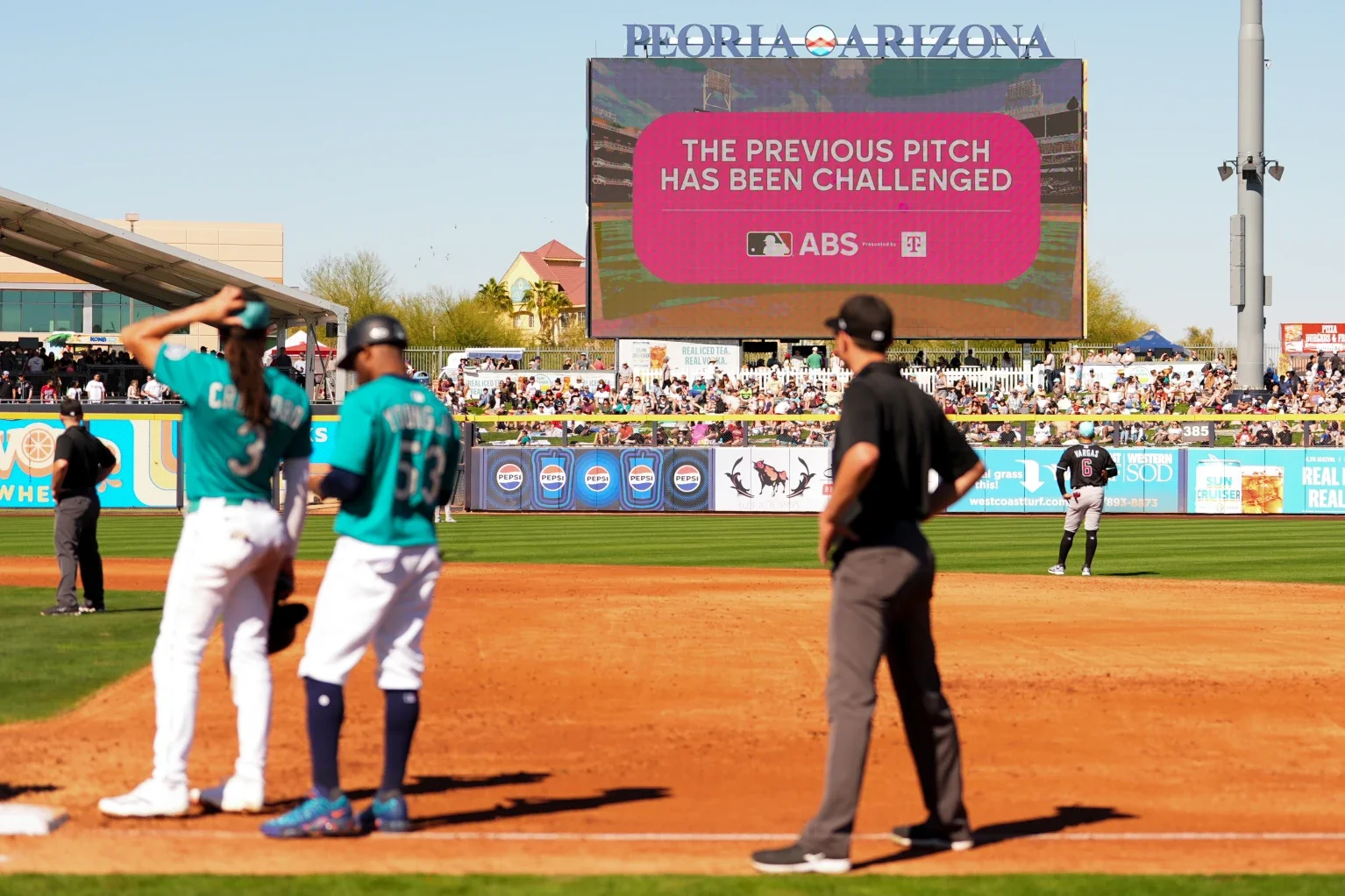
An outfield screen shows a graphic indicating Seattle Mariners' Julio Rodriguez challenged a pitch call, initiating a review with the automated ball-strike challenge system, in the third inning against the Arizona Diamondbacks during a spring training baseball game Sunday, Feb. 23, 2025, in Peoria, Ariz. (AP Photo/Lindsey Wasson, file)
The 2026 Major League Baseball season, now close to a month underway, has brought with it a massive change to the game: the Automated Ball-Strike system, or ABS. Having been in development for the better part of the last decade, ABS has been a frequent source of debate long before its implementation. Now it’s officially here, and it’s having a major impact.
Per the new rule, both teams begin each baseball game with two ‘challenges’ that can be used by a hitter, pitcher or catcher to appeal a ball or strike call made by the umpire. They do this by tapping their head within two seconds of the pitch, which prompts the ABS tracker to display its verdict—a ball or a strike—on the big screen at the ballpark.
Baseball fans, of course, have different thoughts and opinions about the new system. Some traditionalists lament any ounce of automation or technology that’s introduced into the game. Even a rule change like the pitch clock, which has now seemingly faded into the background of the game, originally concerned people when it was introduced in 2023. In general, though, most people—including the players themselves—seem receptive to ABS. From my perspective, they have every reason to be.
ABS has done quite the opposite of roboticizing baseball—it has served as a new source of engagement for fans: they can make their own predictions, erupt when their team overturns a call in a crucial moment, and jeer at opposing players whose appeals are unsuccessful. In other words, ABS augments typical ballpark excitement and banter. Its effects are very ‘human.’
The tangible improvements ABS has delivered can’t be ignored, either. ABS has executed on its primary goal: increasing accuracy in ball and strike calls. Early reporting by CBS Sports indicates that around 54% of challenges are successful, meaning the new system is resulting in more accurate calls than there would be without it. Davis Martin, a pitcher for the Chicago White Sox, told ESPN that he appreciates the strike-zone consistency provided by ABS.
“It’s really nice, some consistency you can work towards, and it’s not going to change from umpire to umpire,” Martin said. As fans, we should celebrate an increase in fairness. ABS is doing this, meanwhile, without eradicating a classic part of the game: the mistakes made by umpires. There still exists plenty of natural variation in ball and strike calls, because teams only use their challenges selectively.
A common gripe from the purist crowd was that the implementation of ABS would devalue the catcher’s skillset, namely their framing abilities—their effort to catch a pitch in a way that makes it look like more of a strike to the umpire than it really is. ABS, at least under its current iteration, seems to be having the opposite effect on the importance of player skill-level. It’s rewarding catchers, and players in general, who possess a superior feel for the strikezone.
Beyond simply signalling which players understand the zone the best, knowing how to strategically use ABS is a skill in and of itself. Players are tasked with more than just having a good eye; they need to balance risk and reward depending on the circumstances of the game.
Adley Rutschman, catcher for the Baltimore Orioles, emphasized this component of ABS. “It has provided a new aspect in the game,” Rutschman told ESPN. “You have to think about right times to challenge. How confident are you? All of that.”
In this sense, ABS is a game within the game. This is precisely what makes sports appealing to the non-casual observer. Avid fans can point out how deeply mult-dimensional their sport is, whether they’re watching a pitcher hold a runner on, a quarterback call an audible at the line of scrimmage, or a basketball player set a screen. This is what makes sports so rich, and why there often exist increasing marginal returns to watching them; as you learn more and begin to observe with a keener eye, it’s more enjoyable.
We should applaud a development in baseball, like ABS, that expands this frontier. Similar to the way that the introduction of a new line of business stimulates the economy, ABS has ripple effects for the entire baseball world. Not only does it dynamize competition itself, but it gives everyone involved in baseball something more to do. Fans have something new to keep track of during the game, TV announcers can theorize about the best strategies, and statisticians can build models to show which players are best at using the new technology.
Nevertheless, I understand the instinctual aversion some baseball fans have to ABS. Many people have a nostalgic vision of how baseball—as well as other sports—used to be played in the past, whether they are observing changes in the rules, the playstyle or the way the game is analyzed by experts.
Change, in all arenas of life, can be distressing. This development in baseball is not a separate phenomenon from general trends in automation that have either already taken place or are predictably looming in the future. Even if newer practices—whether in baseball or in other areas of society—are objectively ‘better’ than our older ways of doing things, it’s understandable why they upset people. We cherish the jobs we’ve always worked, the routines we’ve always had, and the way we’ve always experienced sports, regardless of their practicality.
Technological advancements—something like ABS only being the tip of the iceberg—are primed to continue to shake up our way of living in the coming years. The MLB has done a great job with ABS so far, taking advantage of the fruits of technological progress while largely preserving the beloved status-quo. If we can’t be sure that this thoughtful style of integration will be replicated in the ways other technologies are introduced, at least our sports world seems to be doing a good job.