Gold Medals, Stolen Moments
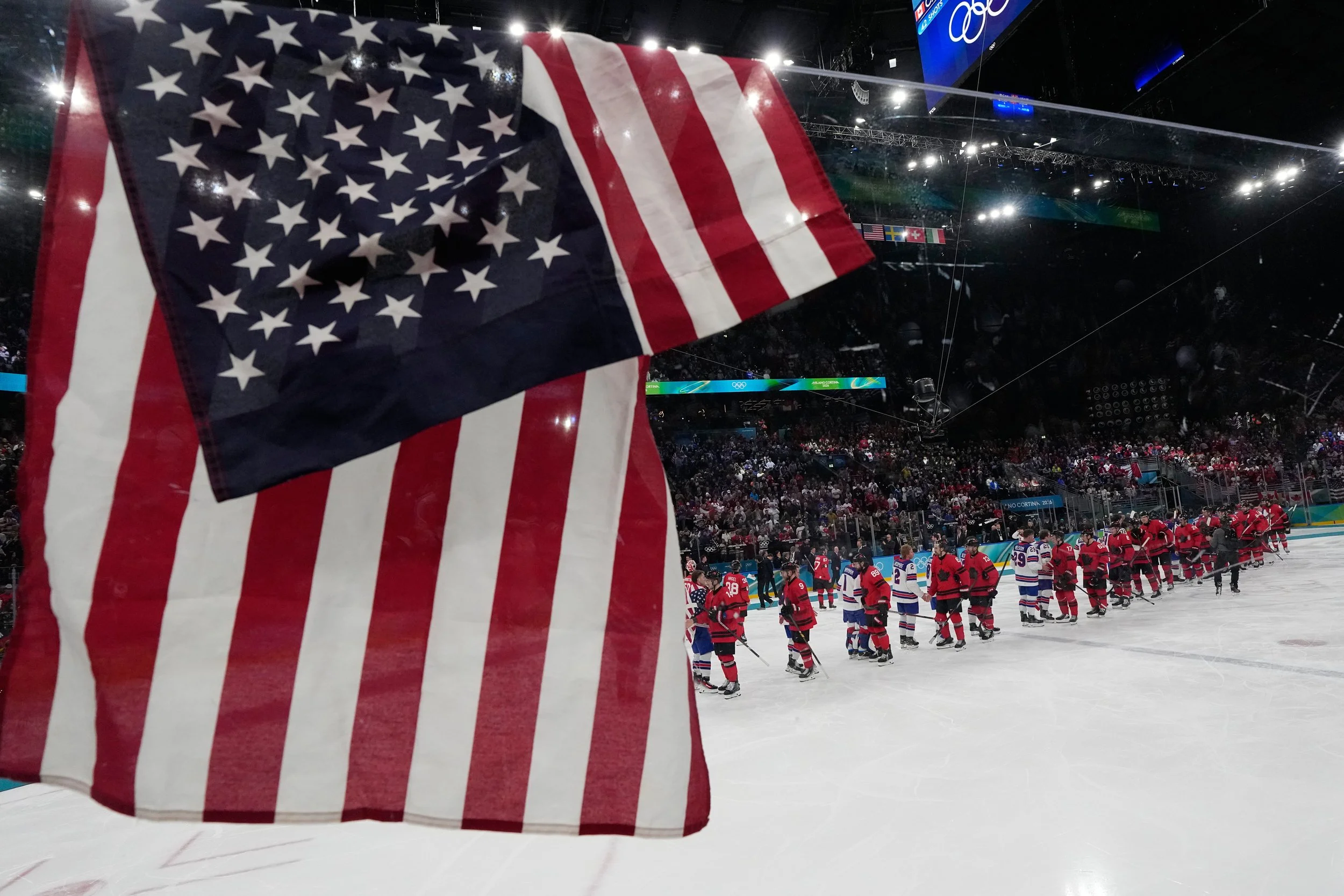
United States and Canada players shake hands after a men’s ice hockey gold medal game between Canada and the United States at the 2026 Winter Olympics, in Milan, Italy, Sunday, Feb. 22, 2026. (AP Photo/Petr David Josek)
When the Winter Olympics kicked off in Milan, Italy a few weeks ago, the first snapshot many saw had nothing to do with sport. Rather, what fans witnessed was a chorus of boos that greeted the vice president of the United States, JD Vance, during the opening ceremony.
This marked the beginning of a lingering political theme that stayed evident throughout the games. Many, like myself, had hoped America could use these games as an excuse to let the political noise die down a bit and rally behind the country’s athletes.
Days later, the political tone sharpened further. In an opening press conference, American freestyle skier Hunter Hess had some sour words for America, saying, “Just because I’m wearing the flag doesn’t mean I represent everything that’s going on in the US. I’m representing all the things that I believe are good about the US.”
President Donald Trump responded by calling Hess “a real loser” in a Truth Social post. Maybe Hess’s comments were ill-advised and hurt his image as an athletic representative of America. But for the president to publicly ridicule and call him names is absurd—Hess never even referred to Trump or the U.S. government in his quotes.
And then, the games actually began and viewers could sit back and watch without having to worry about political baggage. Right?
Nope. This saga was far from over.
On Friday, Feb. 20, the United States women’s hockey team won the gold medal, defeating Canada 2-1 in overtime to cap an unbelievable run in which they gave up just two goals in the entire tournament.
Two days later, the men’s team followed suit, capturing their gold medal while besting Canada 2-1 in overtime and going undefeated in the tournament. This was their first gold medal win in 46 years, marking the exact anniversary of the famed win over the Soviet Union in the “Miracle on Ice” in Lake Placid, New York.
What should be a celebration of these terrific athletes and their nation-uniting performances has turned into a political mess. Gold medals are not political statements. The “Miracle on Ice” victory was undeniably political, shaped by Cold War symbolism. These wins were not. And yet, as with so much else in modern America, these victories were almost immediately swallowed by political theater and sexism.
After mentioning an invite to the White House via phone call, President Trump was filmed telling members of the men’s team, “I must tell you, we’re going to have to bring the women’s team … I do believe I’d probably be impeached if I didn’t.” Meant as humor—and a bad attempt at that—Trump’s comment instead reduced the women’s achievement to an obligation rather than something worthy of celebration on its own terms. The women’s squad has since declined the Trump administration’s invitation to the White House and the president’s State of the Union address.
The spectacle didn’t end there.
By Monday morning, attention had shifted from the athletes to the actions of FBI Director Kash Patel, who—at great expense to the American taxpayer—traveled to Milan to watch the men’s final. He cited security meetings as the reason for his trip.
Patel made his way into the locker room after the victory and was seen chugging a beer with the team in a widely shared clip. If this were a celebrity or former player, it may have been objectively cool, but this is the director of the FBI.
Sports do not exist in a vacuum, and it would be naive to pretend otherwise. But there is a difference between recognizing politics and hijacking athletic success for partisan purposes. The actions and discourse of the president and FBI director cross that line.
What is lost in this is the meaning of sport itself. The Olympics are meant to showcase individuals doing something larger than themselves—they are representing their home. The joy that many Americans—myself included—felt watching these two teams achieve their dreams was incredible.
If we are serious about valuing sports as a unifying force, then we must be willing to let athletes have their moments without immediately forcing them into political narratives or diminishing their achievements based on gender. Both hockey teams did something extraordinary. They earned their victories, their celebration and the right to be remembered for what they did on the ice, not the noise that followed.