Corporate Greed and a Broken Playoff Selection Process Have Doomed College Football
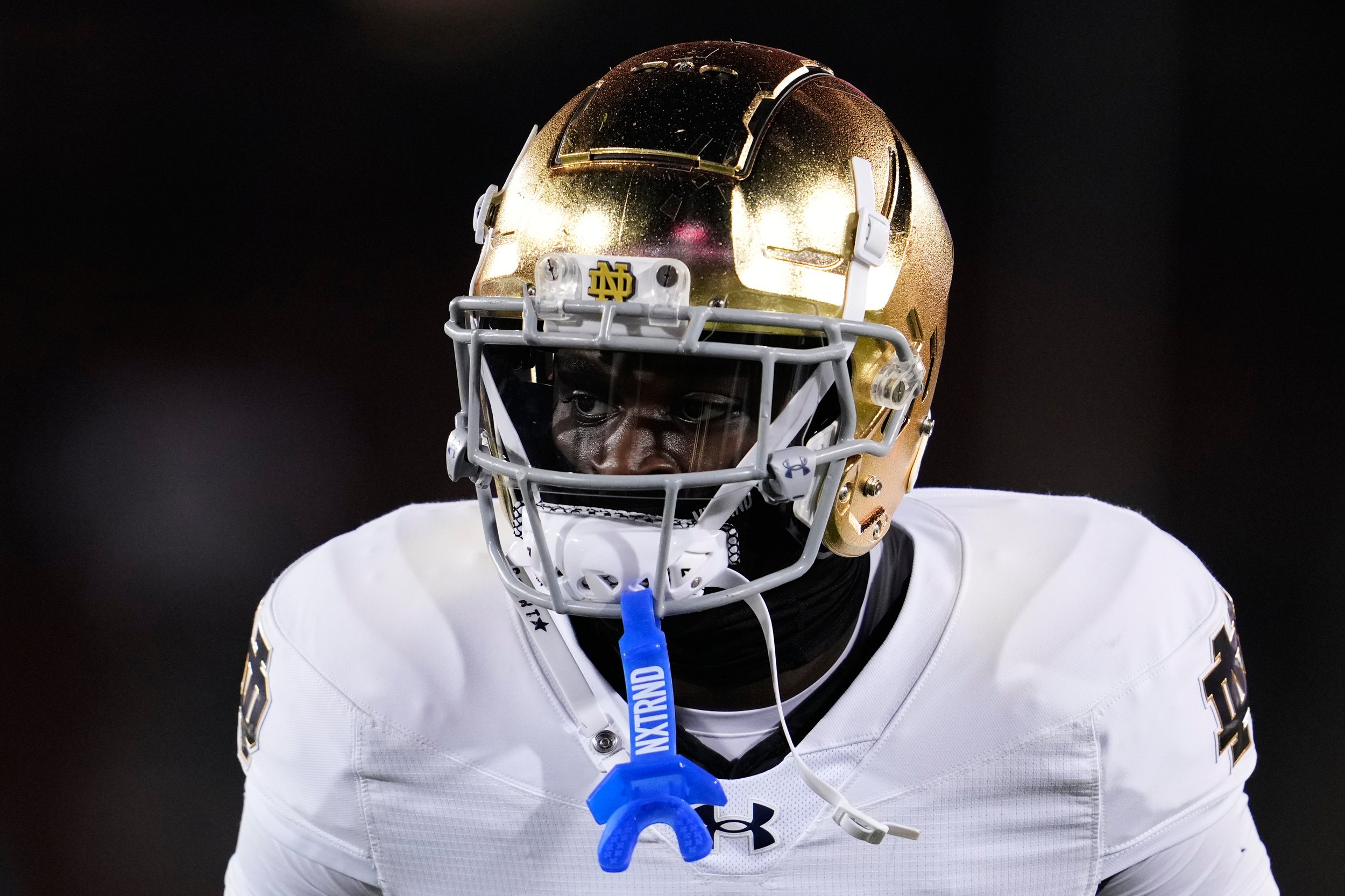
Notre Dame was left out of the College Football Playoff on Sunday. (AP Photo/Godofredo A. Vásquez)
College football has always survived chaos. Scandals, controversies, split national champions, computer formulas—whatever mess the sport created, fans put up with it because the game itself was worth it. Saturdays meant that, even if imperfect, results were earned on the gridiron.
But the events of this year’s College Football Playoff selection have made it obvious those days are gone. The chaos is still here, but I am less and less convinced that the sport can survive.
Tradition is getting bulldozed by corporate greed and a rotten selection process built to serve the networks, not the fans. The soul of college football has been sold off, piece by piece, to the highest bidder. This year is just the most blatant proof.
The 12-team playoff is chosen not by formula, but by a 13-member committee whose weekly votes—beginning in the first week of November—decide the rankings. Their decisions determine who gets in and who doesn’t. And their reasoning has, unfortunately, never been fully transparent.
Faced with choosing from three teams—Alabama, Notre Dame and Miami—for two remaining spots, this year’s selection committee made its motives painfully obvious. Though ranking Notre Dame either No. 9 or No. 10 every week since the start of November—just inside the cut line—on Sunday, the Irish suddenly fell to No. 11 and out of the field, despite no results that would directly impact where they were in the pecking order.
“Nothing hurts worse than expecting logic from a system that doesn’t use any, ”
Since narrowly losing the first two games of the season—both to teams in the playoff—the Fighting Irish reeled off 10 straight victories by double-digit margins. Yet, Alabama and Miami rounded out the playoff, which begins on Dec. 19.
“There is no explanation that could possibly be given to explain the outcome,” said Notre Dame Athletic Director Pete Bevacqua. “We feel like the Playoff was stolen from our student-athletes.”
Make no mistake, this was a political decision: the committee was staring down backlash regardless of which teams it chose, so it picked the easiest way out. If it was dropping Alabama for its 28-7 humiliation in Saturday’s SEC championship game, the committee would have endured nine months of ire from the SEC, a very outspoken conference and one that committee partner ESPN paid $3 billion to broadcast. If it was Miami, the ACC—another ESPN partner—would have had no representation in the 12-team field after 8-5 Duke upset Virginia in the conference’s championship game. That would have been an absolute embarrassment for not only the ACC, but for this system designed for power conference champions to waltz into the field.
So, out was Notre Dame. For the committee, making one school mad was better than alienating an entire conference. Notre Dame became the sacrificial lamb for the sake of politics and convenience.
And remember: ESPN owns the broadcast rights to the College Football Playoff in a new, $7.8 billion deal signed last year.
The fix was in long before Sunday. In last week’s rankings show, the committee mysteriously swapped Alabama and Notre Dame, even though the Irish crushed Stanford 49-20 while the Crimson Tide scraped past rival Auburn 27-20. This was an insurance policy. If Alabama now lost its championship game, as it ultimately did, it wouldn’t have to fall below Notre Dame. Presto! Problem avoided. But precedent shattered.
So, for some reason, 10-3 Alabama became the only team—in the 11-year history of the College Football Playoff—to not drop even a single ranking spot after losing a conference championship. And they did so in disgraceful fashion, losing by three touchdowns and accruing a grand total of minus-3 rush yards. The best part? They have zero consequence for all of it and gain the chance to compete for a national title as a result.
If that sounds absurd, that’s because it is.
Let me be perfectly clear: there was no good answer for this situation. Someone was going to feel wronged. But the committee decided to take an already bad problem and make it exponentially worse. It torched its already minimal credibility by reordering teams that didn’t play and creating a series of unattractive first-round matchups in the process. That’s a failure.
Meanwhile, Tulane and James Madison, two Group of Five teams guaranteed automatic bids, slipped quietly into the field. Both open as double-digit underdogs for their first round matchups against Ole Miss and Oregon, respectively. How in the world are these two teams—who Vegas sees as noncompetitive—guaranteed bids when Notre Dame, BYU, Texas and Vanderbilt are left out to dry?
The expanded playoff’s goal was clarity. Growing to 12 teams was the correct answer a few years ago. Now? It looks like even further expansion is needed.
College football is no longer being run by the people who love it: the coaches, the players, even the fans. It’s being run by the people who own it.
But where can the line be drawn? How much is too much? It is clear that something needs to change, and quickly, before the sanctity of college football is compromised.
We can see the consequences already. Just hours after Sunday’s playoff announcement, Notre Dame revealed it would opt out of participating in a bowl game. This is a seismic decision. Maybe it was only a matter of time, but in all likelihood this will end college football’s iconic bowl system.
These games no longer matter to teams like Notre Dame, and why would they? In this playoff era, everything else becomes hollow. And that is wrong, but it’s been trending this way for a while.
Maybe that was always the goal. Maybe the corporations reshaping the sport’s future, especially ABC/ESPN/Disney and conferences chasing bigger checks, have been steering us towards this for a decade. Realignment chaos? Driven by TV deals. A playoff format guaranteeing mismatches but maximizing game inventory? TV contracts.
College football is no longer being run by the people who love it: the coaches, the players, even the fans. It’s being run by the people who own it.
I hope those who have made these decisions and forced the hands of schools, coaches and players feel good about themselves and the money they have pocketed. Because they’ve ruined the future of the sport in the process.
There’s no way to sugarcoat it: Sunday was an absolute disaster for college football.
Not just because a deserving team was left out, but because the process revealed how little the sport’s stewards care about integrity. Money talks, and everything else—tradition, fairness and legitimacy—now sits silently in the backseat.
College football has always belonged to the teams. To the fans. To the campuses, to the traditions it’s built. But if we continue down this path, it will belong exclusively to the media conglomerates and corporations that see the sport not as an important part of American culture but as a source of revenue.
That is how a sport dies, not from a single playoff snub, but from a thousand corporate cuts. This Sunday made the bleeding impossible to ignore.
The future of college football is no longer uncertain. It’s endangered.
“Nothing hurts worse than expecting logic from a system that doesn’t use any,” said CBS Sports anchor Aaron Taylor.
A sport that has already been ruled by money and greed is about to get much, much worse unless we collectively demand better, from everyone and everything that has chipped away at the traditions that make college football special.