Santa Clara University’s Investment Office Details Endowment Returns
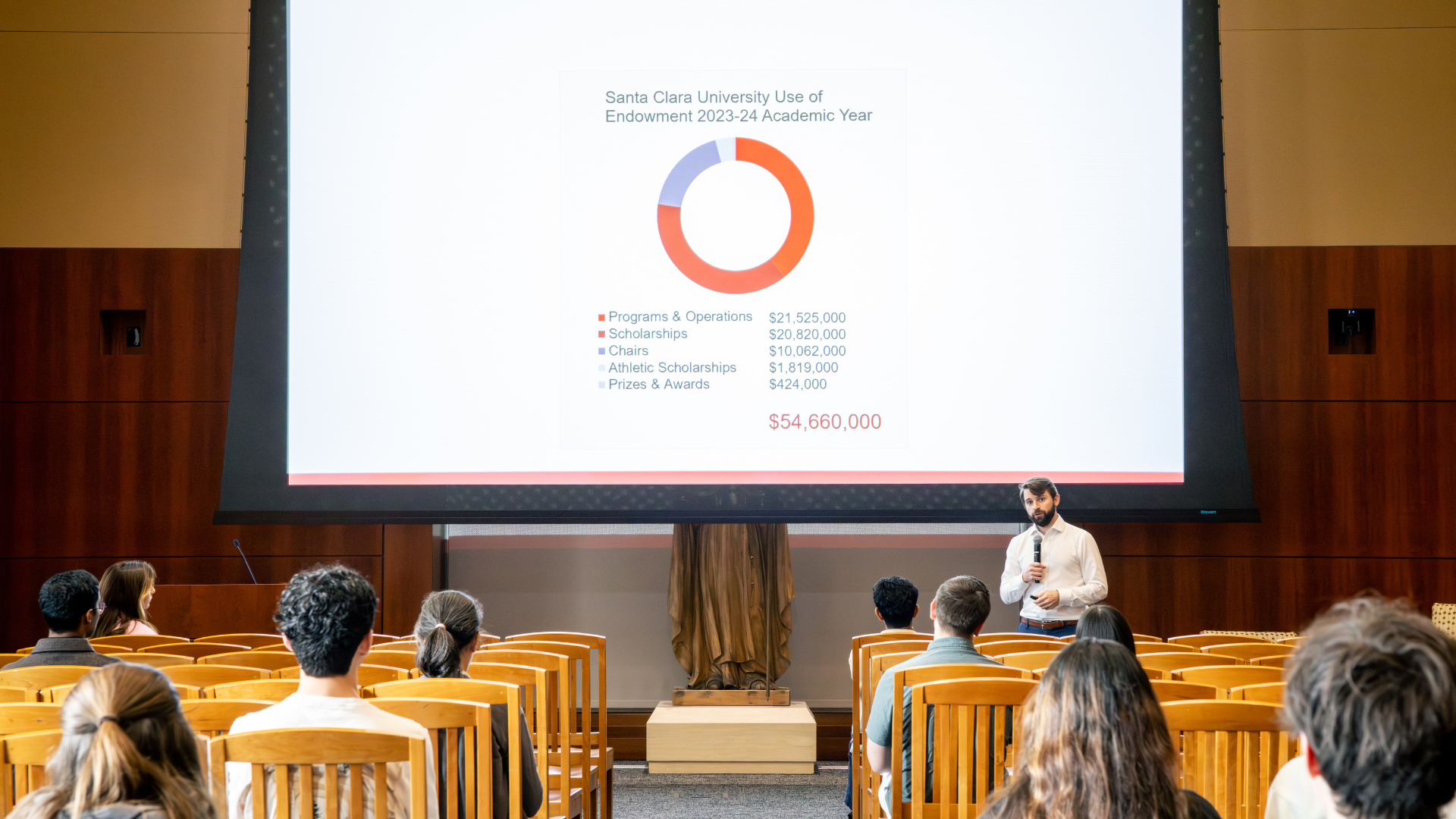
Santa Clara University's Chief Endowment Officer Frank Tessier speaks to students about the university's endowment in the St. Clare Room on Oct. 15, 2025. (Elaine Zhang/The Santa Clara)
Santa Clara University’s Investment Office hosted its annual Endowment Information Session for students, faculty and staff on Oct. 15, sharing information on how the endowment is funded and where the University invests.
At the peak of the Israel-Hamas war last spring, students around the country began demanding for their universities to disclose their endowment investors and to divest from Israel-associated ventures. Campuses were alight with protests, from hunger strikes at Stanford University to an eight-hour teach-in on Santa Clara University’s own campus.
In light of these conversations, Frank Tessier, the University’s chief investment officer, gave a presentation on what the Investment Office does, what the University’s investments are composed of, what the endowment contributes to and how “successful” the endowment has been.
This is Tessier’s first year as the chief investment officer. He was appointed in January 2025 after serving in the Investment Office since 2021. Prior to joining Santa Clara University, he was a senior portfolio manager with Radar Partners and at Makena Capital Management.
An endowment, Tessier explained, is the legal structure for managing a pool of investments. Endowed gifts are contractual between the University and the donor, who agree to give the University money for a specific purpose for the donors and the school. Endowment gifts start at $250,000 with 4.5% spent each year, and the rest stay in the endowment for perpetuity.
While the Board of Trustees is ultimately responsible for the endowment, it “delegates the day-to-day management of the endowment to the Investment Office,” according to the Investment Office website. The role of the Investment Office is to choose outside managers to maximize the greatest long-term risk-adjusted returns on University finances.
“We’re trying to steward the endowment,” Tessier said. “We’re trying to have superior returns.”
Ultimately, this means the Investment Office is trying to maximize the money generated from the initial gift given by placing that principal money into various investments. In parallel to making returns, the office also prioritizes having a consistent annual payout, maintaining intergenerational equity for the University’s community and investing with the University’s values.
Having a consistent annual payout is critical for the University to be able to forecast its budget so that it can hire professors and plan for the future, according to Tessier.
In 2023-24, the endowment returned $54,660,000 into student programs and University functions, financing scholarships, student travel programs and research, as well as professorships, facility costs and upgrades.
Programs and Operations received the most money from the endowment at $21,525,000, followed by $20,820,000 in scholarships for students and $1,819,000 in athletic scholarships. The remaining money was divided amongst chairs, prizes and awards.
The presentation also included an emphasis on the University’s commitment to “Impact Investment,” as Tessier called it. The three main “Impact Investment” areas the school focuses on are sustainable investments, value-based care and decarbonizing the economy.
The median 10-year return for National Association of College and University Business Officers, or NACUBO, schools is 6.7%. Santa Clara University’s, however, is 8.7%, which translates to $320 million more in the endowment. According to NACUBO, Santa Clara University has higher returns than Stanford University, Duke University, Vanderbilt University and Cornell University, while lower than that of the Massachusetts Institute of Technology, Yale University, Dartmouth College, Princeton University and the University of Pennsylvania.
The event closed with a Q&A portion where students and participants asked the Investment Office representatives a variety of questions, including about where the money goes to.
“Yes, the Investment Office and endowment is still invested in fossil fuels,” Tessier said when asked about the status of the school’s investment in natural gas. “Going down the road of divestments has not been very impactful in terms of carbon emissions.”
Tessier explained that in the school’s strategy and philosophy, divestment from fossil fuels is not the best strategy to help reduce fossil fuel emissions. When good actors or investors, like the University, who care about fossil fuel emissions divest from fossil fuel companies, the groups are left with no investors to hold them accountable. Tessier says the best asset managers “will actually go invest in companies like Exxon, go get the board seat and go fight proxy fights,” which he claims have greater positive impact divestment itself.
When asked about the University’s investment in Israeli-backed industries, Tessier said that they did not have the information on the specific funding sources of all of their investments but they do not get involved in geopolitical investments, nor is it practice for them to comment on specific investments.