Scaling Mountains, Shaping Minds
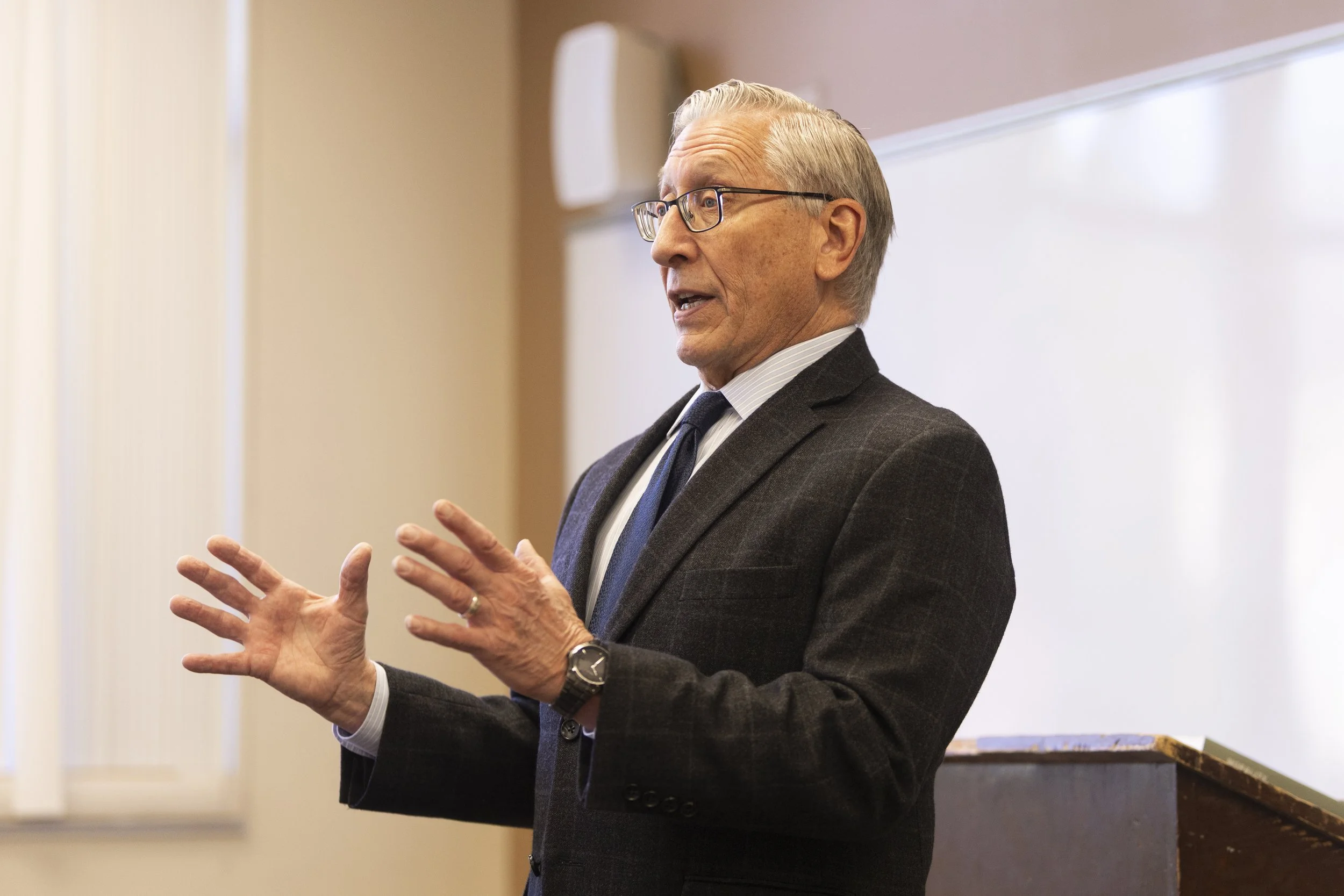
Professor Kulp teaching his course “Ethics and Adulthood”. Photo by Nina Glick
My friend told me multiple times during the winter academic quarter, “you have to write a profile on my ethics professor.” Eventually, I obliged and scheduled an interview with Professor Christopher Kulp, excited to hear the moral ponderings and tales of virtue from the popular professor.
I was a bit nervous entering the philosophy department, a slightly out-of-the-way alcove on the second floor of Kenna Hall. Shelves of books filled the space, reflecting the scholastic nature of his field, but when I got to his office, I quickly learned that he is far more than the philosopher I expected.
Kulp grew up in Pennsylvania, went to school with a member of rock duo Daryl Hall & John Oates and earned his Ph.D. from Vanderbilt University. “I’ve always been interested in morality and deep fundamental questions,” he told me. “Morality was strongly emphasized by my family, and we took it very seriously.” These early interests led him to specialize in epistemology, the theory of knowledge; metaethics, the nature of ethics; and moral epistemology, the theory of moral knowledge.
Kulp joined the Santa Clara University faculty in 1986 and has remained in California ever since. Students rave about his ability to lasso their attention while lecturing on difficult subjects. In the opinion of his students, Kulp is such a sought-after professor because of his genuine enthusiasm for the material and his deep love for his profession. Kulp remarked, “I love young peoples’ vigor and their curiosity, and I empathize with a lot of their struggles and the things that they confront. I really enjoy being in the classroom. I never get bored of my students.”
When asked about why he loves teaching philosophy at SCU specifically he said, “This is a Jesuit institution and we approach education from a Jesuit point of view. At least that’s a big influence and it treats the whole person. Meaning we understand, the way I put it to my students, we are multifaceted, everybody is somebody's son or daughter, husband or wife, brother or sister, boyfriend or girlfriend, co-worker, we’ve got these multiple facets of us. We aren’t just these disembodied intellects, we are people with emotions, our own character struggles and stresses and strains, and goals that we are pursuing, we have our ups and downs, successes and failures. The Jesuit tradition tries to address the multifacetedness of our being. That’s important. This isn’t a narrow training for a vocation, although we certainly do that, but that isn’t all we do here. I think that philosophy very much fits in with addressing the education of the whole person and also in a Jesuit tradition, moral matters, character formation that’s also been an important matter and the study of ethics is important to that.”
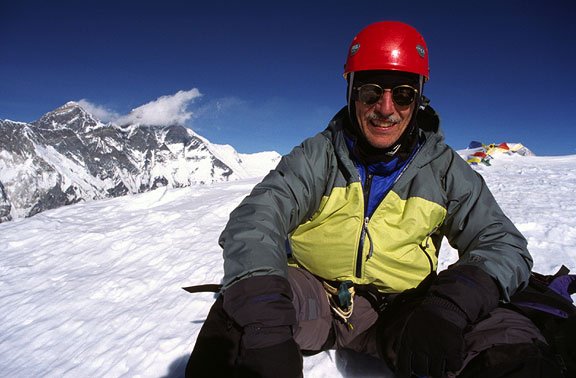
Professor Christopher Kulp on the Ama Dablam Summit with Mount Everest behind him. Photo provided by Christopher Kulp
Students are also drawn in by his personal stories. With an intense mountain climbing past, Kulp spent 12 consecutive summers climbing in the Alps. He has climbed in the Andes, Himalayas, Canadian Rockies, and the peak next to Mount Everest. In 2011, he shifted his focus to CrossFit and placed 2nd at CrossFit Games—the world championships.
“I got a little too old to be competing in CrossFit, so then I started to move over to Olympic weightlifting,” said Kulp. In 2019, he won a world Olympic weightlifting title for his weight class, and in 2022, he made Team USA for the world championships.
With all of these accomplishments, he wanted to clarify, “I don’t like to bring too much attention to myself” said Kulp. “I really do not like boastful people, and I do not want to be anything like that. The only thing less attractive than a boastful kid is a boastful man.”
At this point in our conversation, I wanted to know what advice he would give to college students. He told me, “Take your personal integrity very seriously. As I’d like to put it: If you don’t have your own integrity, you don’t have much in life. In my humble opinion, good character is more important than just about anything. And try to develop a sense of resilience or durability so you can take the knocks, and they won’t be able to wreck you. I didn’t talk so much about knowledge or any fancy intellectual things, and that’s the world in which I live, but I really think these matters of character are important for everybody, but especially for you folks in what we’re calling now, emerging adults—this is 18 to 25.” These traits take years to develop, but if Kulp’s life is any indicator, honing in on them seems to yield a whole lot of joy.
Kulp made it a point to praise the people in his life throughout our interview. Of his co-workers, he said, “My colleagues are terrific. They are some really fine teachers, and with that kind of pedagogical horsepower, I’m sure it contributes to students’ desire to study philosophy.” When a text message from his wife, Maryam, lit up his phone, he instantly picked it up with a boyish smile. In his many mentions of her, he said, “Maryam is an enormous inspiration for me. I love that girl; what can I say?”
He also believes that role models are necessary for all. “We can provide a certain kind of model here of sincerity, integrity, dedication, constancy, mastery of profession. These are important things for people to see.” With clear admiration, he discussed one of his own mentors, the late John Lachs: “I want to thank Professor John Lachs. He was a major professor for me at Vanderbilt and a model of what to be as a professor. He was a brilliant intellect; he was a deeply caring man; he was very humorous; very, very dedicated; inspiring; completely decent. I wrote my doctoral dissertation under him, and he has been a model for me to aspire to.”
Kulp is currently working on the fourth and final book in his series on metaethics and moral epistemology, which focuses on two questions. “Is there such a thing as objective moral truth?” Kulp’s answer: Yes. “Do we have any knowledge of these truths?” He again says: “Yes.”