Recent Election Day Signals Tough Political Battles Ahead
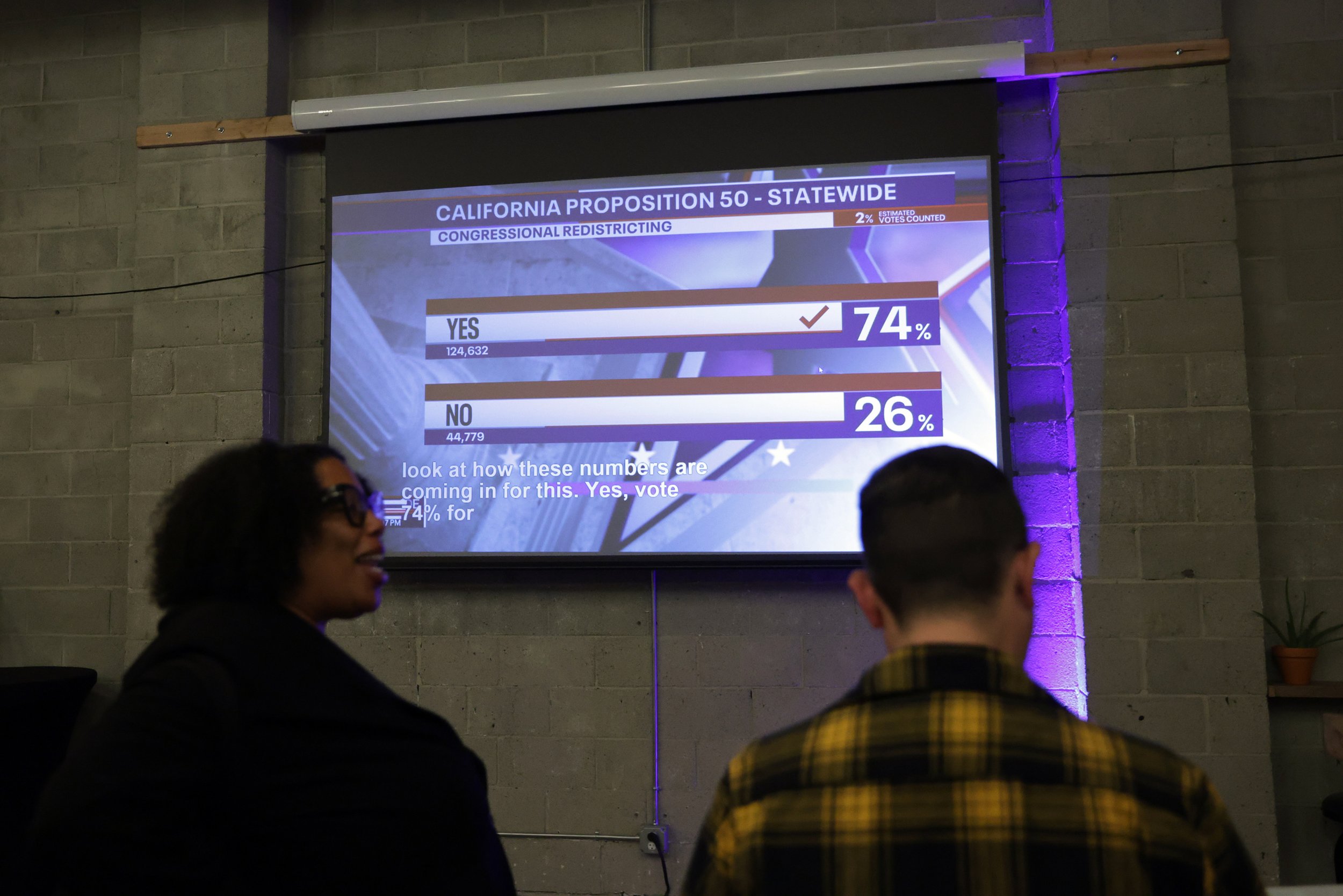
Barisha Spriggs and Rocky Fernandez watch voting results roll in during an election night party hosted by Alameda County Democratic Party at Hella Bees in Oakland, Calif., on Tuesday, Nov. 4, 2025. (Scott Strazzante/San Francisco Chronicle via AP)
The results of the recent election day showed a blue wave across the nation and strong turnout for California’s Prop 50; however, these results do not guarantee smooth sailing into next November for Democrats.
California voters passed Proposition 50 on Nov. 5, which creates a new congressional district map that may add up to five more Democratic seats to the state. Democratic lawmakers have noted that the measure is a “direct response” to tactics used by Texan Republicans, who recently redrew their congressional map to potentially gerrymander five more seats of their own. In Santa Clara County, Proposition 50 passed with 71.1% of the vote.
“Prop 50 is essentially to have most of the seats in California be blue,” said Blaine Fusi ’28, president of Santa Clara University’s chapter of Turning Point USA, a conservative political group that has chapters on college campuses across the country.
Ronin Fife ’27, the co-president of the chapter, argued that Prop 50 wasn’t the only interesting thing on the ballot.
Measure A, a sales tax exclusive to Santa Clara County, also passed last Tuesday. The tax is a 0.625% sales tax to help offset the decrease in funding resulting from Trump’s “Big Beautiful Bill” budget cuts, according to lawmakers. Fife argues Measure A acts as a way for lawmakers to “sneak an extra tax on everybody.”
Fife believes that Prop 50 “seems very interesting,” but when asked, he was clear that he would be voting “no” on the measure.
The goal of this redistricting battle is to give either Republicans or Democrats a leg up ahead of 2026 midterm elections. The midterms will be crucial for Democrats hoping to stop some of President Trump’s initiatives and for Republicans hoping to control the House for the second half of Trump’s term. Republicans currently hold a fragile majority, 219 seats to Democrats 213, which could be easily overtaken via the midterm effect and strong Democratic turnout in 2026.
Winning back the House and flipping seats is considered critical to the Democratic Party. Over the last 50 years, the number of competitive House districts across the country has shrunk.
If the Republicans or Democrats can redraw their maps so that they have safer districts, they can widen the margin of control so that Democrat victories in competitive seats won’t make them lose their majority in the House. The Brookings Institute reported that the 2026 race would feature the fewest competitive seats in the last 52 years. With so few competitive districts, the control of the House of Representatives is dependent on the outcome of these seats.
Article I of the U.S. Constitution states that each state determines the “times, places, and manner” of elections. It also requires states to redraw their congressional districts every ten years after the census, but it does not specify how those lines must be drawn or who is responsible for drawing them. As a result, election law varies widely across states, and these differences can significantly shape political power.
The most contentious of these procedures is redistricting. Through “gerrymandering”—the practice of drawing electoral districts to benefit the party in power—election outcomes can be dramatically altered.
By “packing” voters of one party into a single district or “cracking” them across multiple districts to dilute their influence, lawmakers of the party in power can gain control for a decade or more.
California has now become the first blue state to respond to aggressive redistricting efforts in Texas and other Republican-led states. California Governor Gavin Newsom is urging other Democratic states to take similar action as several red states consider mid-decade map redraws ahead of the 2026 midterms. But because each state’s redistricting laws differ, the emerging conflict has become a patchwork struggle over electoral maps.
Democrats and Republicans may now be entering a nationwide gerrymandering arms race. New Republican-drawn maps in Ohio may give the GOP two additional seats, while similar proposals have emerged in North Carolina, Utah and Missouri. Democrats have discussed potential countermeasures in Virginia, Maryland, Nebraska, Indiana and Florida. With mid-decade redistricting becoming more common, many political scientists are asking whether this will become the new norm.
“It’s easier for Republicans to do it than for Democrats for a few reasons,” said Matthew Harrigan, professor of Political Science at Santa Clara University. “Democrats tend to cluster in urban areas, so it’s easier to gerrymander against Democrats than against Republicans.
Harrigan noted that California’s process is unique due to the state’s direct democracy rules. “In California, we literally had to have the citizens vote to undo a constitutional amendment temporarily,” he said. “Other states have more robust checks by the courts or by other institutions on the maps they put out there.”
Midterm elections—especially the first after a president’s inauguration—are often seen as a referendum on the administration. With Democratic engagement high, Republicans have looked for ways to offset expected midterm losses.
“We almost always see a president’s party lose seats in Congress in midterms,” Harrigan said. “So Democrats walked into this with a pretty good advantage, and then Texas said, ‘No—we’re going to pull five seats away from you.’ There was a lot of pressure on Democrats to ask: Where can we make up for that?”
California answered that question with Prop 50, and Newsom led the push to frame the initiative as a defense of democracy and electoral fairness rather than a partisan power play.
Across the country, Democrats saw sweeping victories in various races. In Virginia, Democrat Abigail Spanberger defeated Lt. Governor Winsome Earle-Sears by roughly 15 points. In New Jersey, Mikie Sherrill won against Republican Jack Ciattarelli. Meanwhile, the New York mayoral race between Zohran Mamdani, Andrew Cuomo and Curtis Sliwa drew national attention, with Mamdani’s victory celebrated by progressives.
Still, Harrigan cautions against reading too much ideological change into a single election. “People say Mamdani’s win signals a new wave of leftism,” he said. “But look at his competition—Cuomo is a disgraced former governor with sexual assault allegations. It’s New York.”
Instead, Harrigan believes Democrats should embrace a flexible strategy.
“The lesson for 2026 is that you can win with different kinds of candidates in different parts of the country,” he said. “Support progressives where they fit the district, and support moderates where that’s what voters want.”
The real test, he says, will come in 2028, when Democrats must unite behind a single presidential nominee. “That’s when it gets hard. That’s when you run the risk of the party being so divided that the primary threatens turnout in the general election.”
Even with strong Democratic performances this cycle, the landscape remains unsettled. Several Republican-controlled states are still pursuing new maps, and the 2026 elections are far from guaranteed.
The California Republican Party has already filed a lawsuit challenging the new districts, arguing they were drawn using race in violation of the 14th Amendment and the Voting Rights Act. Federal courts can no longer strike down partisan gerrymandering, but they can still hear cases involving race-based redistricting. The lawsuit claims California lawmakers considered the number of Latino voters in each district when drafting the maps.
Newsom, whom Harrigan calls “both an anti-Trump crusader and someone clearly making a national name for himself ahead of 2028,” has kept himself in the spotlight. “Newsom’s done a lot to raise his profile—the podcast, going on Fox, the debate with DeSantis,” Harrigan said. “He’s positioning himself as the top anti-Trump figure.”
With Prop 50, Newsom successfully framed California’s redistricting move as a stand for fair elections. But with gerrymandering intensifying in states across the country, the broader battle over democracy is far from over.