The Cape and the Crisis
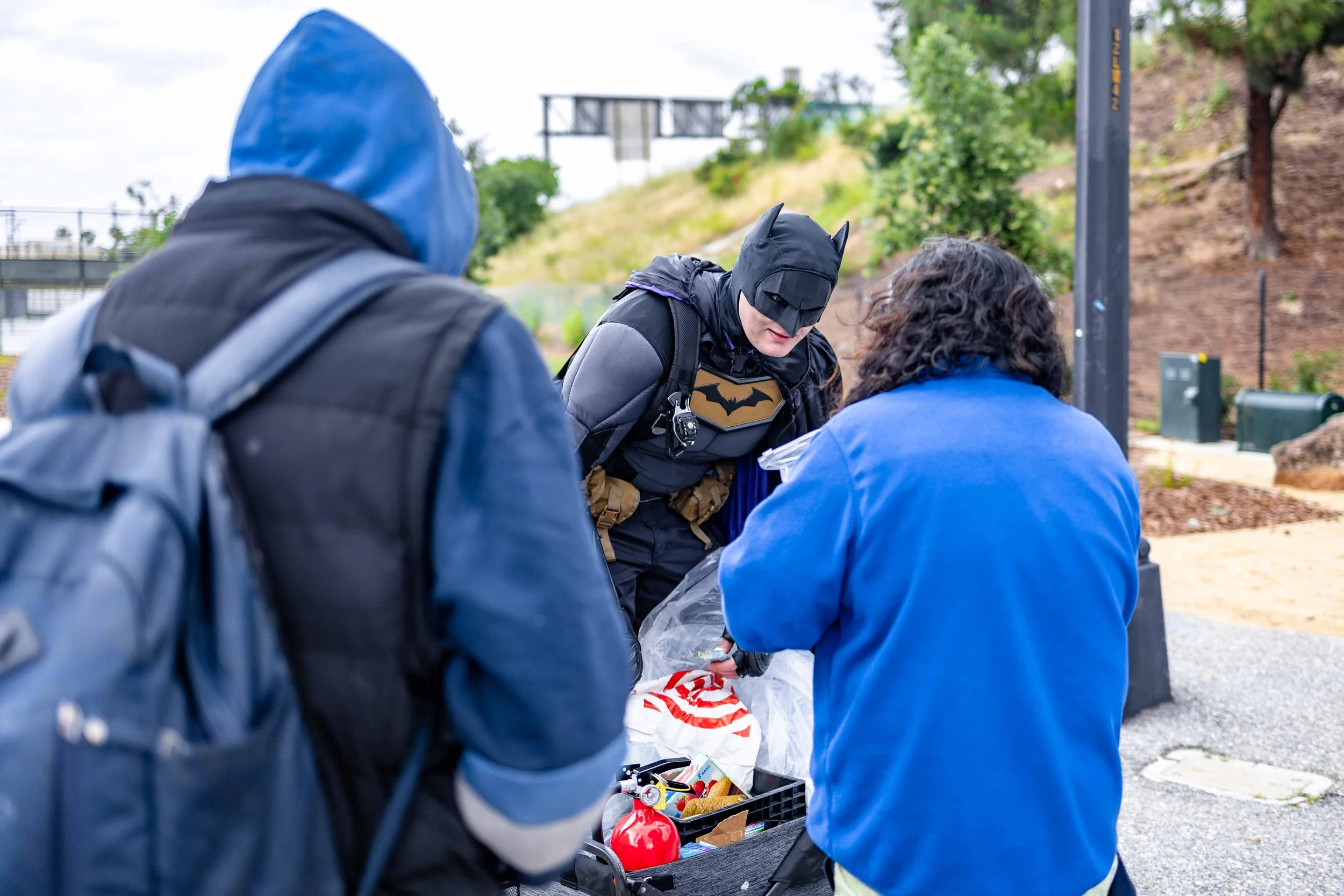
Batman sorts through his “Batwagon” to find supplies like food and water to hand out to two unhoused people in downtown San José. (Dylan Ryu/The Santa Clara)
When we first encountered the Batman of San José, he was standing on the third story of a parking garage and overlooking the city’s downtown.
Batman then showed us the trunk of a car, which was filled with the kind of equipment that does not usually make it into the movies.
He didn’t appear using a grappling hook or a smoke bomb. He didn’t have a black armored car waiting nearby or pockets filled with Batarangs. He had arrived in his grandmother’s car, with a cart full of supplies and a utility belt packed with Narcan, gauze, trauma shears, antibiotic ointment, a CPR respirator, flashlights, “Know Your Rights” cards and tools for fixing tents, bikes and shelters.
He was preparing to walk through San José at night, stopping at benches, underpasses and old encampment sites where people might be sleeping.
This is what the Batman of San José does.
For nearly eight years, the man known publicly only as the Batman of San José has distributed food, water, tents, tarps and first-aid supplies to homeless residents across the Bay Area, mainly in San José, San Francisco and Oakland. His costume may seem like a strange choice at first, even funny. But in a city clearing encampments while thousands of people remain without shelter, the suit has become a way to be recognized, remembered and trusted.
He did not set out to become Batman. The first time he went out, he said, he wore a Batman leather jacket while handing out supplies. When he came back, people recognized him.
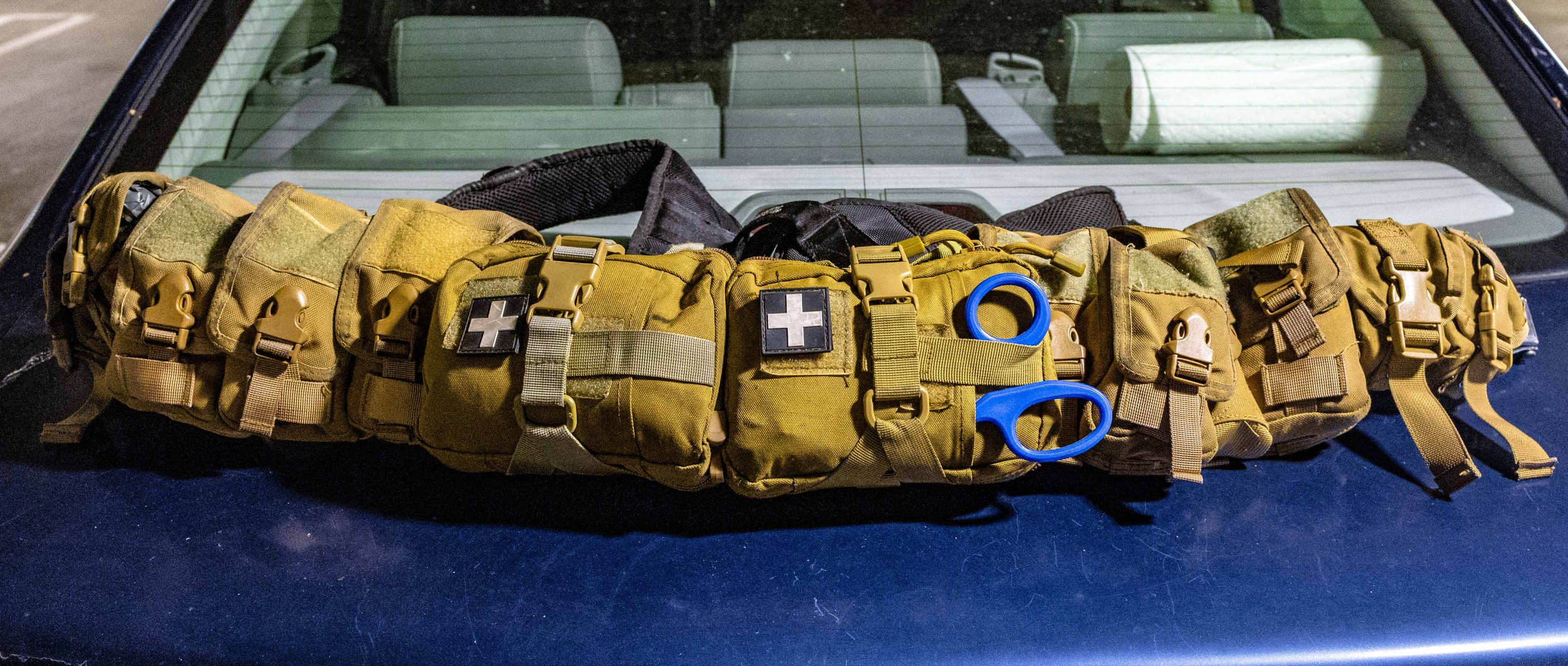
Batman’s utility belt rests on the back of his grandmother’s car. (Dylan Ryu/The Santa Clara)
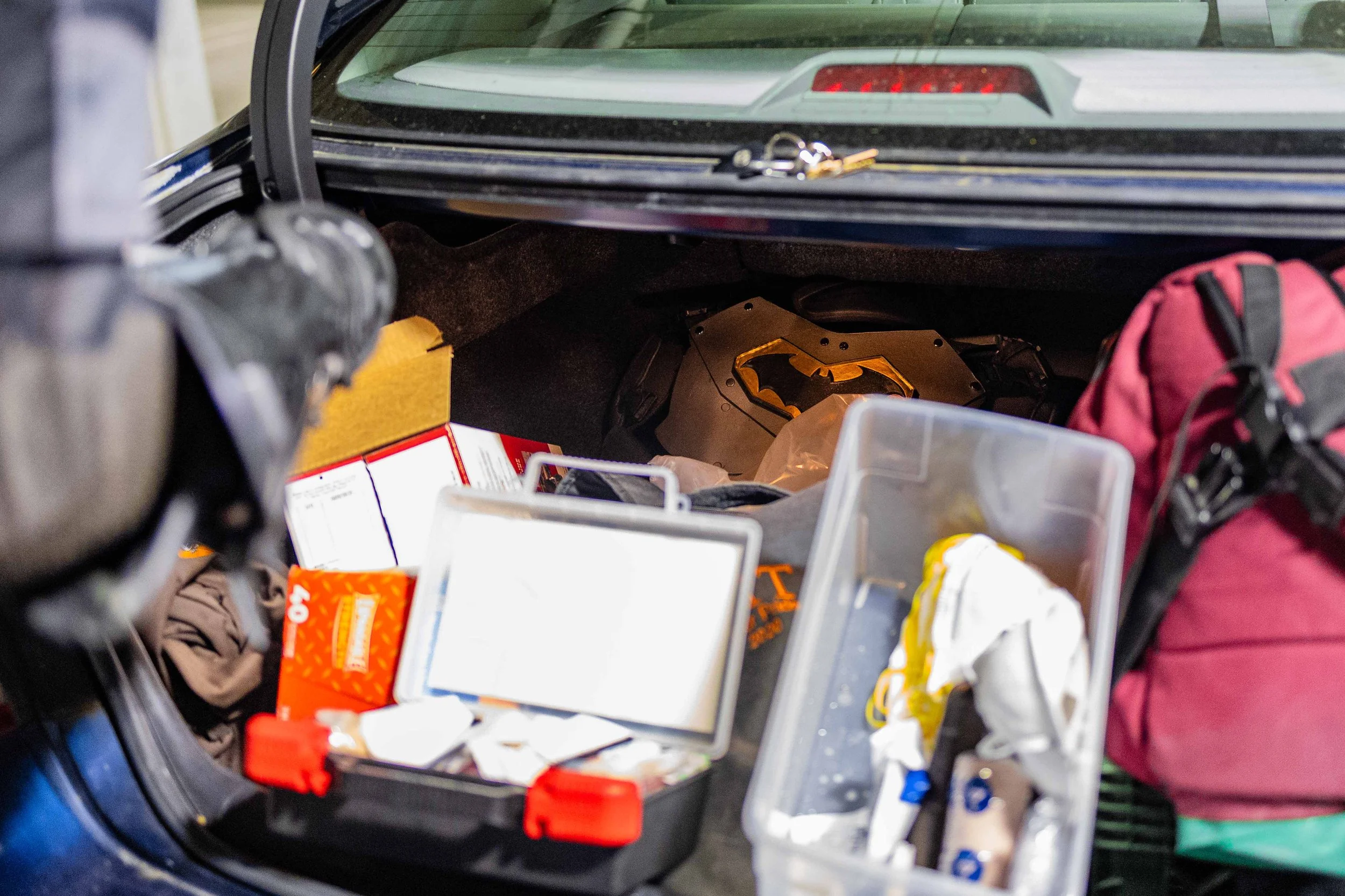
A spare breastplate with the Bat symbol sits in the trunk of Batman’s car surrounded by bandages, food, sleeping bags and other supplies. (Dylan Ryu/The Santa Clara)
“They were like, ‘Oh, you’re that guy. You’re Batman,’” he said.
So he kept it. People who might ignore a stranger sometimes stop for Batman. They’ll wave from across the street, make jokes or ask if he has socks. He calls the costume a communication tool.
“It’s not just a gimmick,” he said.
The mask is also a protective measure. He said he now goes publicly only by Batman after a video of him criticizing the Santa Clara City Council over immigration enforcement went viral, bringing threats against him and his family.
“I don’t care if someone disagrees with me,” he said. “But I’m not about to let them hurt my family.”
On a recent night downtown, he moved slowly through the city, checking places where people used to sleep. Some corners were empty. Some had been cleared. He still looked.
“People do move around a lot,” he said.
Sam Alex Martinez, an unhoused resident in San José, recalled first meeting Batman three or four years ago under a bridge near Discovery Park. At first, Martinez said, the cape and cowl scared him. Now, he recognizes Batman as one of the few people who keeps showing up for him.
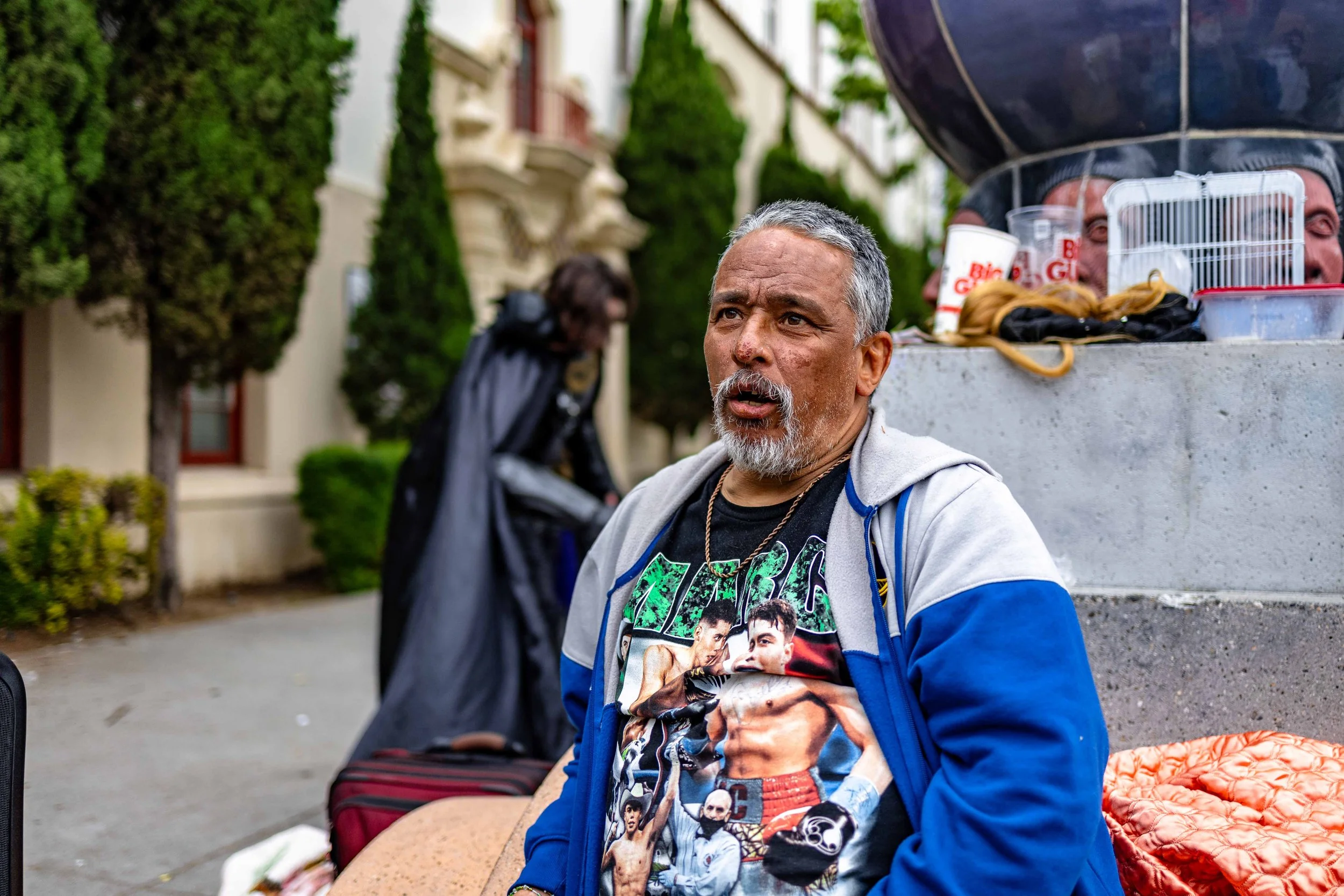
Sam Alex Martinez sits outside Café Hope at 80 S 5th St, San Jose while the Batman of San José hands out socks and water behind him. (Dylan Ryu/The Santa Clara)
“I think it’s cool, because you got a lot of people around here that say they care, and if we need anything, just let them know,” Martinez said. “But then, when you let them know, they disappear.”
Comic book Batman is built upon the promise that he will not kill. The Batman of San Jose holds himself to a similar kind of creed. “The rule number one of doing this sort of work is you never make a promise you cannot keep,” Batman said. “Trust is everything on the streets.”
Batman has learned to make himself useful in small, immediate ways. Sometimes that means handing out socks or water. Other nights, it means helping repair a tent, offering a bandage or watching for signs of an overdose. He said the training helps, but the work depends just as much on not escalating the moment.
“I don’t act like Batman when I’m dressed as Batman,” he said. “I want people to look at me as someone they can trust, they can talk to.”
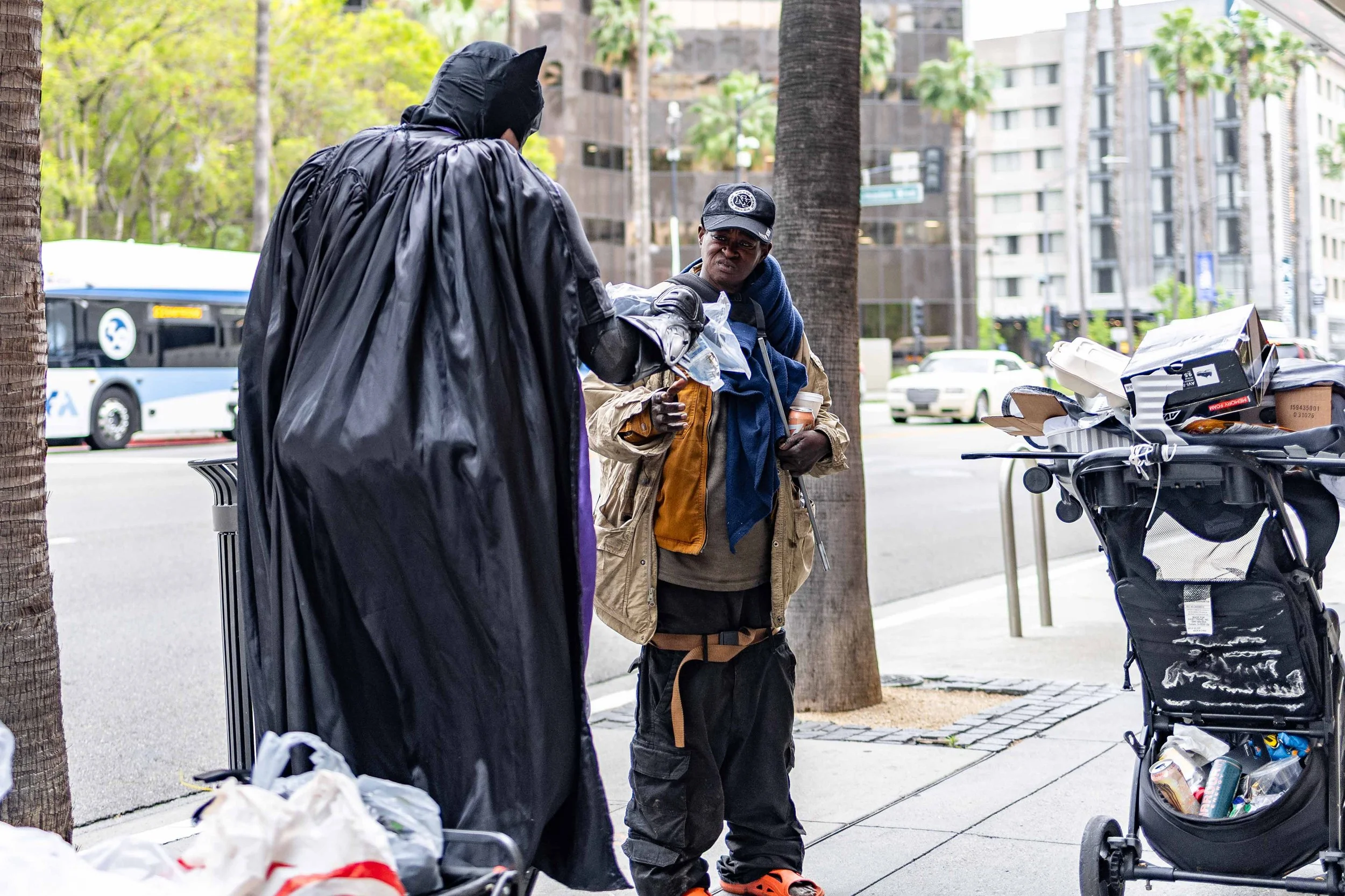
Batman gives socks to an anonymous unhoused woman in downtown San José. (Dylan Ryu/The Santa Clara)
That trust is harder to build when people are being moved by the city.
Sarah Fields, deputy director of the San José Housing Department, said the city does not describe its encampment work as sweeps. The city uses the word abatement, she said, because the process is not sudden.
Before the April 15 abatement at Coyote Meadows, the area also known as “the Jungle,” Fields said the city posted signs in English, Spanish and Vietnamese about six weeks in advance. Outreach workers from the city, PATH and Amigos de Guadalupe visited the site during that period and built a list of more than 100 people interested in moving into noncongregate shelters.
“It is not healthy or safe for someone to be living outdoors,” Fields said.
But she acknowledged the city does not have enough beds for everyone. Fields reports that San Jose has more than 6,000 people experiencing homelessness and just over 2,000 shelter beds under the city’s purview.
The wider San José/Santa Clara City & County Continuum of Care counted 9,903 homeless people in 2023, down 1% from the year before, according to a HUD performance profile. But the same report showed 6,103 people experiencing homelessness for the first time, a 23% increase. Chronically homeless individuals rose 29%, even as emergency shelter beds grew 29%.
San José has also opened more than 1,000 shelter beds over the past year, according to San José Spotlight, but its Taylor Street Navigation Hub, a 56-tent safe sleeping site, is scheduled to close by next January as the city faces a $50 million deficit. The site cost $2.6 million to build and $2.4 million a year to operate.
Fields said many housed residents misunderstand why some homeless people hesitate to accept services. For some, she said, systems have already failed too many times.
“There is reason and logic to a lot of the decisions that are made by unhoused individuals,” Fields said. “They’re just very different based on very different sets of circumstances.”
Batman sees that distrust up close. He said one bad experience with outreach workers, police or city crews can make people less likely to accept help in the future.
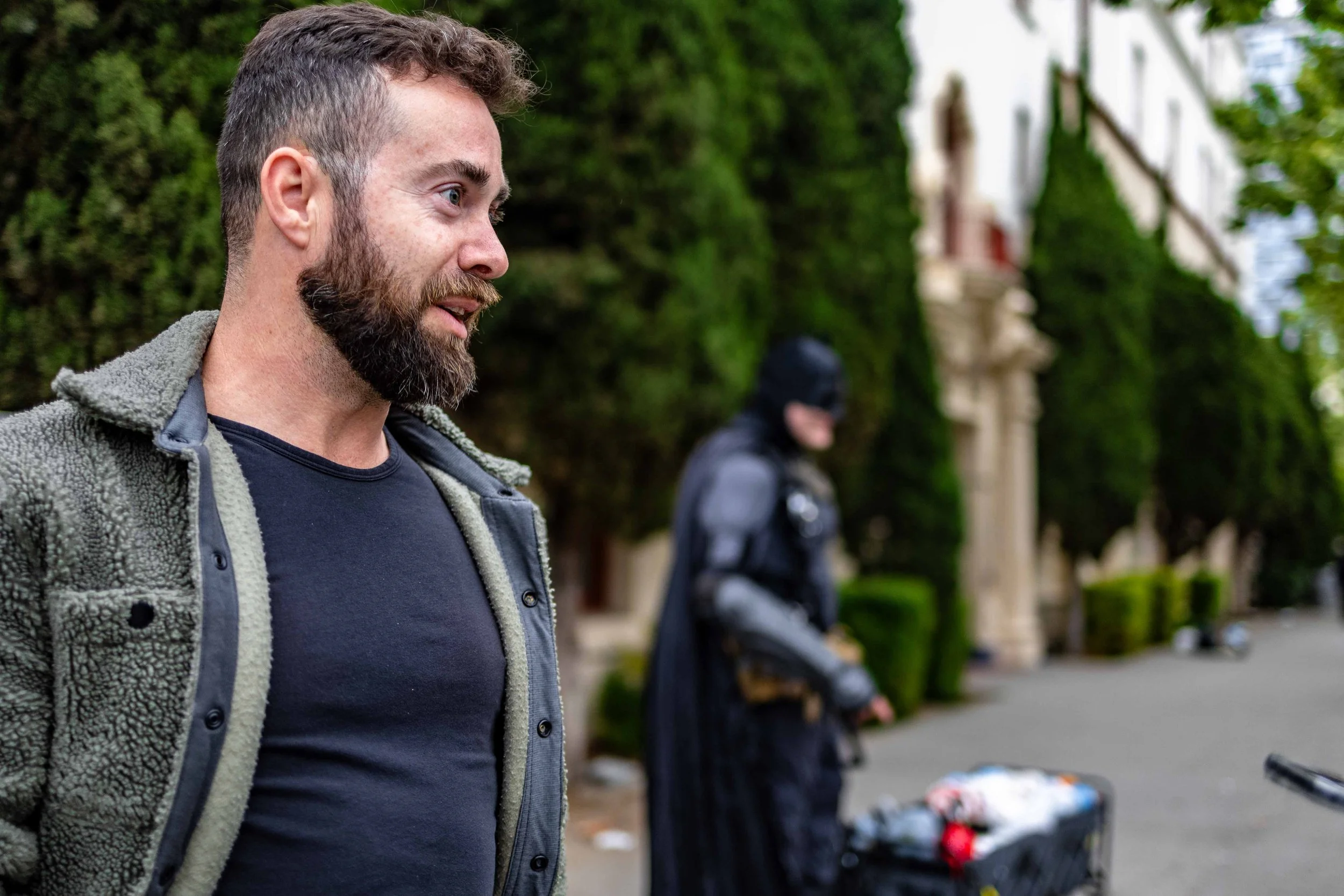
Sean Dollard speaks with people sitting outside of Café Hoppe after chatting with Batman. (Dylan Ryu/The Santa Clara)
San José resident Sean Dollard, who recognized Batman from the viral City Council clip, said his work reflects a kind of mutual aid he wishes were more common in a region marked by wealth and housing inequality.
“If there were more folks like this gentleman out here, I think we’d have a different world,” Dollard said.
Batman made a point of stating that his work will not seriously affect the county’s housing crisis.
“You know, I’m running around solving problems, doing what I can,” said Batman. “I’m not able to fix anything, though, it’s a very reactionary sort of response.”
Despite this, Batman kept walking, even into the night. The cape made him visible from down the block. The supplies made him useful. But the reason people stopped him was simpler than that.
They knew he had come back.