The Cost of Conflict
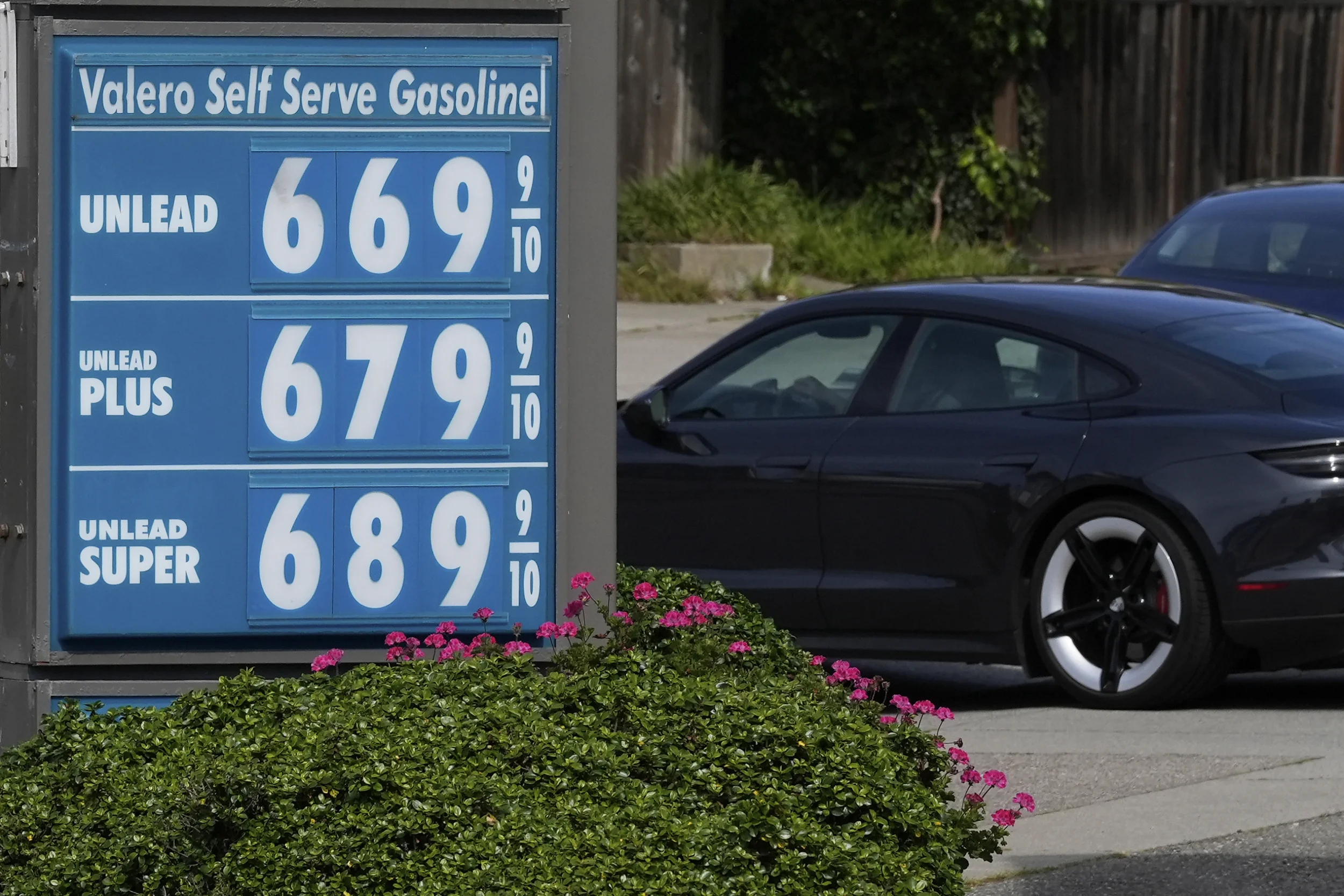
A car drives behind the gasoline price board at a Valero gas station in San Francisco, Saturday, April 4, 2026. (AP Photo/Jeff Chiu)
The geopolitical fallout of the escalating Iran war has officially reached the pumps in Silicon Valley. As of early April, gas prices in Santa Clara County have soared to nearly $6 a gallon, a 30% jump from the average price of $4.62 this past February. This sudden surge compounds an aggressive inflationary trend that has driven domestic prices up by nearly 25% since 2020. With gas prices rising and uncertainty over the conflict looming, many Santa Clara residents and students are feeling squeezed by these steep costs.
What began in late February as military action involving the U.S., Israel and Iran has triggered what the International Energy Agency is calling “the "largest supply disruption in the history of the global oil market." In a coordinated air campaign dubbed “Operation Epic Fury,” the U.S. and Israel led successful airstrikes targeting Iranian leadership and infrastructure. The fallout of these strikes has resulted in Iran’s blockade of the Strait of Hormuz, a key trade route in the Persian Gulf that facilitates over 20% of global oil consumption.
With global oil supplies and vital liquefied natural gas shipments suddenly cut off or severely delayed, global crude oil prices have hovered near $100 a barrel throughout April. It is currently uncertain whether the United States and Iran will be able to successfully reach an agreement and reopen the route. Until then, uncertainty and volatility over oil markets has left many Americans squeezed by the pump.
California drivers are notoriously accustomed to paying a premium for fuel due to state taxes and special clean blend requirements, but the current spike is unprecedented in its velocity. Beyond Santa Clara, in the broader San Francisco Bay Area, the average price for a gallon of regular unleaded has pushed past $5.90—$6.30 in certain neighborhoods. Locally, stations are displaying prices ranging from $4.10 to over $5.17, with industry experts warning that prices could rise up to another 30 cents in the coming weeks.
“The sharp rise in gas prices since the beginning of 2026 amounts to a regional economic stress test, squeezing household budgets, threatening jobs and eroding tax revenues at every level of government,” noted a recent report by Joint Venture Silicon Valley.
Because California’s fuel distribution network is geographically isolated from the rest of the country, the state is uniquely vulnerable. JPMorgan analysts have warned that California could see actual physical shortages of refined fuel products as early as late April or May.
For college students, the timing of these geopolitical shifts could not be worse. Nearly half of all Santa Clara Universitystudents live off campus, and for those students commuting to school or relying heavily on transportation, these prices are only making things more difficult. Commuter Mahathi Adapa ’27 comments that recent surges in gas prices require her to “be more selective about when she should drive to campus.” With a “spaced out” class schedule, Asapa expresses that this market is “unfortunate,” as she feels pressure to stay on campus for longer, more inconvenient times, and to sometimes “pass up extracurricular activities and events” just to avoid extra trips.
However, not all experts foresee a literal dry spell for U.S. gas stations. Alexander J. Field, the Michel and Mary Orradre professor of economics at Santa Clara University, points out that the U.S. now imports very little crude oil.
“I doubt that there are dangers of physical shortages of refined petroleum products within the United States,” Field said. “But oil and gas prices are determined in global markets, which means U.S. consumers will continue to see high and possibly increasing prices at the pump so long as traffic through the Strait of Hormuz remains blocked.”
The true cost of the conflict, Field argues, extends beyond just the energy sector.
“By failing to articulate a consistent and coherent justification and set of objectives for its actions, by indicating a lack of interest in abiding by internationally accepted conventions regarding the conduct of war, and by weakening our ties with allies in the North Atlantic Treaty Organization, the U.S. has squandered more than money in this effort,” Field notes.
This sentiment is further compounded by William Sundstrom, economics professor at Santa Clara University, who stated:
“ The uncertainty created by other chaotic international policy actions, such as fluctuating tariffs, Greenland threats and so forth, have damaged U.S. credibility and reputation (‘soft power’) in global affairs. The retreat of the U.S. from the global economy and international engagement and cooperation, toward autarky, will make us poorer overall, and deprive us of some of the amazing solutions to global problems, such as the green energy revolution, that we might otherwise enjoy.”
Sundstrom further adds that “the U.S. economy is quite resilient and can survive Trump’s mercantilist stupidity. We’ll be rather worse off than we would have been, but still amazingly rich by global/historical standards,” he said. “The damage to our democracy, rule of law and basic human dignity may be more costly and harder to repair.”
For the past 50 years, the relative stability and power of the U.S. dollar has rested in part on the fact that oil is traded in dollars. However, in the midst of this conflict, reports indicate that the Iranian government has begun demanding that oil tankers passing through the Strait of Hormuz pay passage tolls in alternative currencies like the Chinese yuan. Analysts at publications like The Guardian have expressed concerns about the potential long-term political and economic consequences of this blow to the U.S. dollar, warning that this aggressive push for de-dollarization could permanently weaken global demand for the dollar and ultimately drive up domestic borrowing costs.
As graduates enter the workforce, they may be faced with an increasingly constrained economy, far different from the experiences of previous generations. Until the global supply chain stabilizes, Santa Clara residents and University students alike will have to navigate a reality where the daily cost of living in Silicon Valley is dictated by events half a world away.