The Lack of a Sports Science Program Disadvantages Students
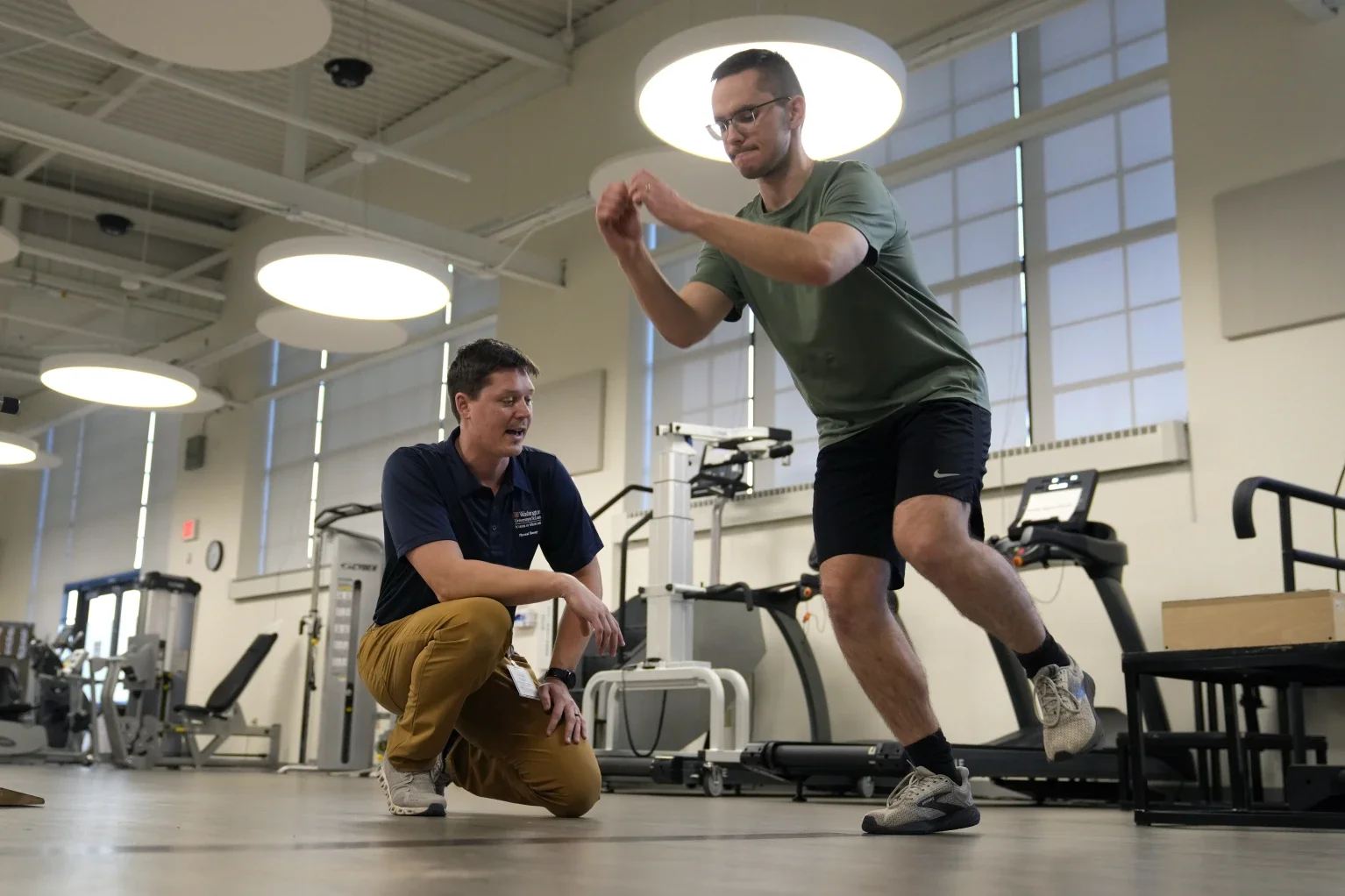
Physical therapist Tyler Detmer, left, works with patient Jacob Bullard at WashU, Monday, Dec. 16, 2024, in St. Louis. (AP Photo/Jeff Roberson)
During week three of this quarter, I was called to the front of my class to participate in a mock career interview. When my professor quizzed me on what I would like to do with my potential degree in management information systems, I replied, “something to do with sports science.”
When the exercise concluded and I was allowed to return to my seat, I couldn’t stop thinking about the fact that I want to enter this field, but there is no specificity or program at the University that addresses my interest.
The field of sports science has been growing at an incredibly fast rate over the past few years. In a report from Grand View Research, the value of the global sports technology market was measured at $18,850,300 in 2025, and is projected to reach over $61,720,600 by 2030.
And yet, the closest thing to a kinesiology or sports science program that we have at Santa Clara University is the bioengineering department, which offers a few classes in physiology and programming that could be applied to the field of exercise science. However, the curriculum is more structured to prepare students either for medical school or a career in medicine rather than sports science.
Santa Clara University is one of the few Bay Area colleges without any sort of kinesiology program. Neighboring schools like Stanford University, Saint Mary’s College and the University of San Francisco all have programs or departments in this field, with Stanford even boasting a multi-million-dollar Human Performance Lab to keep them on the cutting edge of sports technology.
So, it puzzled me to realize that with all of our resources, we aren’t offering a program that many schools around the country do — especially the schools we compete most heavily with for students, resources and opportunities.
The School of Engineering has incredible infrastructure, both in the breadth of course offerings as well as the physical labs and equipment available. The Sobrato Campus for Discovery and Innovation represents a $300 million investment in staying on the cutting edge of technology, so there is no reason why it should not include a sports science department.
Santa Clara University is also uniquely positioned in the Bay Area, maintaining strong relationships with all the major professional sports teams. I’ve personally attended a Career Center event with the San Francisco 49ers at Levi’s Stadium, and know of similar events taking place with the Golden State Warriors and the San Jose Sharks.
As a student-athlete, I can also testify firsthand that we have access to some of the best technology available at the Athletic Excellence Center, or AEC, both in the weight room and in the training room.
The Leavey School of Business recently introduced a master’s of science in sports business, noting an important step towards focusing on career development in the sports industry. The program’s website references the fact that there are about 17,100 Californians employed in spectator sports, so there is an administrative acknowledgement that careers in the sports industry are of importance.
And this doesn’t even begin to address the wide array of careers available in the sports technology industry. Product design, research and physical therapy are all fields that aren’t encompassed by this number and could be addressed given the chance.
But, integral to the introduction of such a program is whether or not students would actually be interested and take classes.
Marcus Mata ’27 is a bioengineering major and is interested in pursuing a career in physical therapy. He spoke about his disappointment in the lack of any kind of physiology program.
“There’s so many medicines that you can go into and not all of them have the same requirements, and I think it’s sometimes just assumed that they do: sometimes we fill one and forget about the rest,” said Mata.
Mata also talked about a biomechanics course that he took while studying abroad in New Zealand that caused him to realize that the curriculum here does not address his interests.
“It fulfilled one of my BioE requirements and that class was by far the coolest thing I’ve ever taken,” said Mata. “I’m curious to see what it looks like here because I can almost guarantee you it’s not going to be at the same scale.”
The infrastructure at our university already provides a viable path to instituting an undergraduate program in exercise science. It would, however, require administrative initiative to convert the already-present resources into a coherent and functioning curriculum.