“We Are Here, Still”: Indigenous Peoples’ Day at Santa Clara University
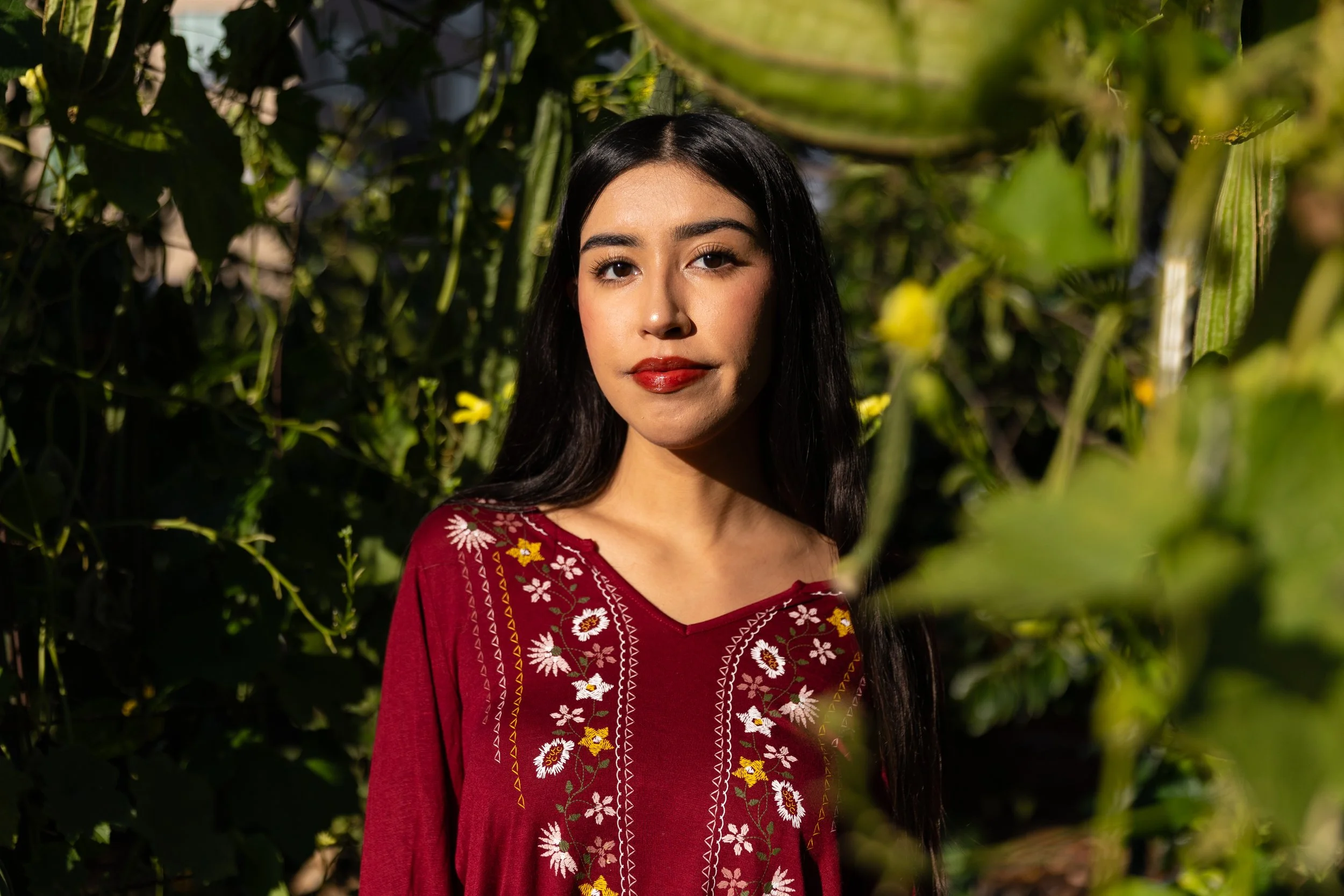
Isabella Gomez photographed at the Forge Garden where she takes Muwekma Ohlone youth during the Ohlone Cultural Youth Camp to visit the Forge's Ohlone Native Plant Garden. Photo by Nina Glick
At the center of Santa Clara University stands the Mission Church—a landmark of the campus where beauty and erasure coexist. For many, this site symbolizes the history of the University; for others, it represents exactly what that history cost. The unmarked graves and unceded territory of the Muwekma Ohlone people—whose lives and presence made the site’s existence possible—lie beneath the sixth iteration of Mission Santa Clara de Asís. On Indigenous Peoples’ Day, it is these people—their stories and their lives—that remind us: they are not relics of the past. They remain here.
The History of Indigenous Peoples’ Day
Indigenous Peoples’ Day was first proposed in 1977 at the United Nations International NGO Conference on Discrimination Against Indigenous Populations in the Americas as a way to honor the histories and cultures of Indigenous peoples, rather than Columbus Day. The latter celebrates Christopher Columbus’ voyage from Spain to what is now North America and the mistaken belief that he “discovered” the continent.
“I always had that discordant note of why him, and not the impact of what he symbolizes, right?” said Professor Jessica Young, an Urban Native from the Bay Area and a member of the Seneca-Cayuga tribe based in Oklahoma.
Despite its proposal in 1977, it was not adopted by any city until the early 1990s. Federal recognition of the holiday came nearly three decades later, in 2021, when former President Joe Biden became the first U.S. president to recognize it officially.
“It always felt like a counter movement; it was like: ‘Let’s celebrate Indigenous people against something else,’” said Young, referring to the holiday before its federal recognition. “But the renaming gave me a sense of freedom, like, this is a day all about Indigenous people.”
President Donald Trump issued a formal proclamation from the White House in recognition of Columbus Day on Oct. 9, 2025, despite changes made in previous years. In the proclamation, he referred to Christopher Columbus as a “true American hero” for whom “every citizen is eternally indebted to his relentless determination.”
Despite this, Santa Clara University continues to recognize the holiday as Indigenous People’s Day. The third annual Native American Symposium will take place today, Oct. 13, 2025, in the Recital Hall.
“Indigenous People’s Day, for me personally, is a way to really appreciate and acknowledge Indigenous culture, history, tenacity and strength to the public,” said Isabella Gomez ’27, a California Native and member of the Muwekma Ohlone Tribe—the first from her tribe to attend the University and the inaugural recipient of the Ohlone and Muwekma Ohlone Scholarship. “It shouldn’t only be a one-day thing. It should be throughout the year, where we appreciate that history and culture.”
Built upon mission land where layers of beauty and loss coexist, the campus continues to navigate its complex relationship with Indigenous Peoples’ Day.
Being Indigenous on Mission Ground
The Mission Church was first established in 1777 as one of 21 Franciscan Missions spread throughout Alta California with the intent of bringing Roman Catholicism to the so-called “New World” and its Indigenous populations.
However, the enforcement of strict and rigid schedules, pervasive sexual violence, the prohibition of Native Californian practices, and extremely laborious work directly contributed to the nearly 7,500 Native Californian burials beneath Mission Santa Clara.
“It can definitely be harrowing,” said Gomez. “The idea that I’m getting my education in a space where 230 years ago I probably would’ve been dead at this age.”
“But it also makes me appreciate the tenacity of my community, and the future they’ve made possible for me to even be in a space like this. The reason that I’m here is just years of relationship building that my tribe—and SCU—had to make it comfortable for me to be in a space that is historically filled with injustice and trauma.”
In addition to the church itself, one of the few remaining artifacts from that period, the Mission bells continue to stand—symbols that hold different meanings for different communities.
The bells were placed as an auditory reminder of the schedules that California Natives were subjected to, ringing in the morning, noon, evening and at other times to mark the rotation of labor.
“The call to work, the call to prayer, the call to eat—your whole life was structured by the bells,” said Young, reflecting on the history of the mission bells. She recalled teaching her first Indigenous literature class last year and hearing the noon bells as a signal to pack up and head to class.
“And every time I had to do that—I felt this strange embodiment of the type of punctuated life cycle that revolves around the bells,” continued Young.
When asked what it means to be Indigenous on a Mission campus, both Gomez and Young asserted that this deeply rooted feeling permeates nearly every aspect of life at the University.
“I think that’s hard to escape. You know, it takes on a different embodied meaning for Indigenous people to occupy these types of spaces. And it is lonely, because I don’t think a lot of people have that self-consciousness when they occupy spaces here,” said Young.
Both women view this year’s Indigenous Peoples’ Day with hope—the hope inspired by changes already made and by those still unfolding.
Celebrating Progress, Confronting Gaps
Santa Clara University’s land acknowledgment recognizes the Muwekma Ohlone and seeks to honor their enduring presence on the land. It also acknowledges colonialism as an ongoing process and emphasizes the importance of engaging with this history mindfully and intentionally.
Gomez and Young believe that the University has made progress in this area.
The Ohlone AR Tour—launched on Indigenous Peoples’ Day in 2023—is a collaborative effort among Ohlone cultural bearers and language holders, University faculty and student researchers, inviting anyone to download the OhloneAR app and tour spaces across campus showing the culture and history of the Ohlone.
“It’s hard to do that work without appropriating it,” Young said, praising the work done on OhloneAR. “There is value in the tour and things like that because that work is often relegated to Native people. The idea is that you need to put in the work and learn that history. You need to understand why.”
Similarly, the de Saisset Museum has two active exhibits until Dec. 19, 2025: Monica Rodriguez: Californiana and Flat Files of Curiosity: Shifting Relationships with Land, both of which seek to engage with the Indigenous history and community surrounding the Santa Clara area. The museum also has a permanent exhibition intended to continuously engage with the region’s history: California Stories from Thámien to Santa Clara.
Despite these efforts, Gomez notes the absence of a physical monument as something she would like to see addressed in the future.
“The tribe has been working on putting an actual physical plaque that acknowledges a history where people—even the tourists who come and visit the Mission—understand that the space they’re looking at isn’t only a romanticized version of Catholic or religious history,” said Gomez. “It’s actually a place filled with a lot of pain and trauma.”
Gomez also runs a youth cultural camp for Ohlone students each summer, aiming to encourage other Native Californian students to attend the University and continue building on existing progress.
“When I run that program, I make sure to highlight that I don’t have to be the only one here,” says Gomez. “Even though we are progressing and there are more Natives here, I would love to see more Indigenous students and more Indigenous faculty. That is a necessity.”
Young shared the same sentiment.
“It’s about learning more about Mission history than the facade of the Mission itself. It commemorates other aspects of the people who have passed or are in a cemetery, but really shows us what day-to-day life was like,” said Young.
Both Young and Gomez encourage students to use this Indigenous People’s Day as an opportunity to pause and learn something about Indigenous people. Young notes that it doesn’t have to be “a huge performance or a parade,” but rather a moment of reflection on the implications of Indigeneity at Santa Clara University.
Gomez reminds us to remember their presence:
“Indigenous people are not ancient history; we’re very much still alive. We’re here.”