What’s Up with “Wuthering Heights?”
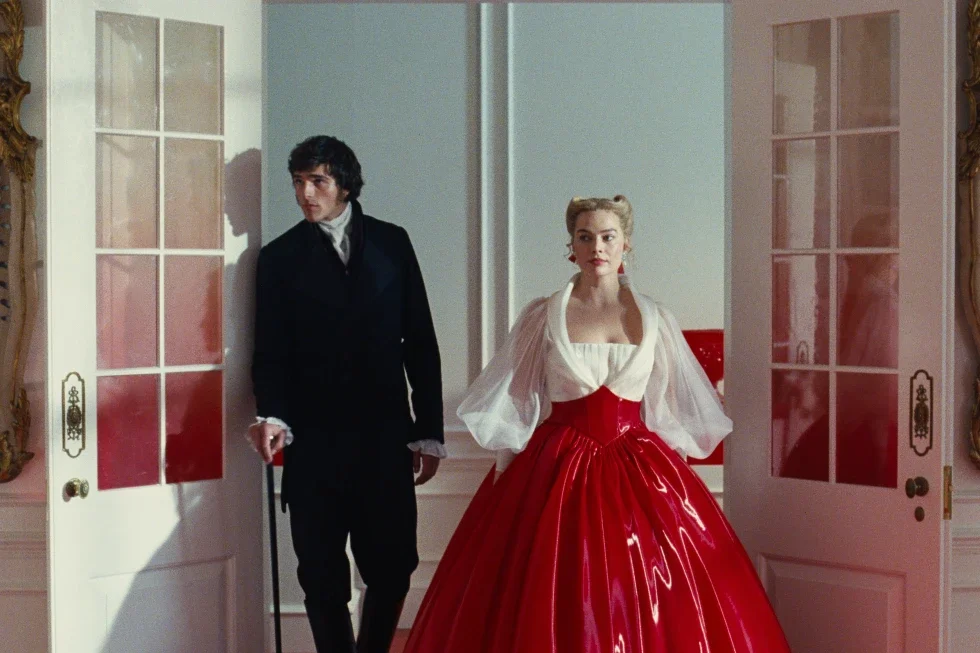
This image released by Warner Bros. Pictures shows Jacob Elordi and Margot Robbie in a scene from “Wuthering Heights.” (Warner Bros. Pictures via AP)
The landscape before the release of “Wuthering Heights” was already fraught. The film, directed by Emerald Fennell, was released in theaters Feb. 13, 2026 to largely mixed commentary from audiences. Articles and opinions circulated before the film’s release criticizing Jacob Elordi’s casting, the over-the-top costuming, and of course, the lack of accuracy to the original novel by Emily Brontë.
Negative opinions online persisted mostly due to the inaccurate depiction of 19th century country life in England. This social media hailstorm failed to consider that this adaptation takes creative liberties. Some criticisms are valid, but these contributed to an avalanche of poor reviews that shaped public opinion somewhat unfairly before people ever watched the film.
All of this controversy came to a head with the actual release of the movie. A scroll through Letterboxd shows an average rating of 2.9 out of 5 stars with no great compliments. The top review—which has itself become the subject of an Instagram post—reads, “Emily Brontë died of tuberculosis 177 years ago yet this adaptation is still the worst thing that has ever happened to her.”
All jokes aside, the movie has seemed to fall flat to literary purists, despite the fact that filmmaker Emerald Fennell has made it clear that this is her interpretation, “inspired by the greatest love story of all time.” Fennell chose to place the title of the film in quotation marks, and she has commented on this choice, saying “The thing for me is that you can’t adapt a book as dense and complicated and difficult as this book.” She notes that the interpretation is somewhat based on her own experience of the novel, not the facts of it. “I can’t say I’m making ‘Wuthering Heights.’ It’s not possible. What I can say is I’m making a version of it. And so it is ‘Wuthering Heights’ and it isn’t.”
Fennell made it clear from the start that she was taking creative control and ended up making a visually stunning film. Charli xcx, famous for her hyperpop and clubbing music, made an album also titled “Wuthering Heights,” with some songs featured in the movie itself. This is just one example of how the film is not trying to look exactly like a 19th century period piece, straying from expectations of a Brontë adaptation.
Any person who has been hurt by a poor adaptation of a beloved novel knows that the short runtime of a film can never capture the fullness of a great story, and it’s clear that Fennell and producer Margot Robbie didn’t prioritize this. Robbie recently said, “I love working with Emerald [Fennell] because she always prioritizes an emotional experience over a heady idea.”
Creating an emotional experience with a film—rather than an intellectual one—is fine, but not if the simplification of the story creates new and important problems—considering the racial realities of this film can’t and shouldn’t be dismissed.
A quote from a New York Times opinion piece by Naveen Kumar on the whitewashing of the film—and the potentially harmful casting of non-white actors in certain roles—notes, “Ms. Fennell’s casting of Asian actors in supporting roles is, at best, oblivious of how they’ll be read onscreen and, at worst, a cheap kind of scapegoating. Either way, the choices tell a confusing story about otherness in the world of the film while pretending that it doesn’t matter in ours.”
This is particularly harmful considering a major tenant of the novel is Healthcliff’s otherness, not Mr. Linton or Nelly’s. Moreover, Kumar notes the unlikability of these particular characters in this adaptation.
Fennell never confronted the controversy of casting a white man for the role of Heathcliff and dodged the question in interviews. If Fennell and other contributors to the film addressed the issues with an explanation, viewers might have felt more satisfied. For example, the character of Heathcliff is both brutalized and brutal, and the casting of a white man could have been a deliberate choice to avoid racial stereotypes that have historically been imparted on men of color often depicted in the Victorian era.
Instead, Fennell focused on how Jacob Elordi “looked exactly like the illustration of Heathcliff on the first book that I read.” Some might find this casting unimportant, but Kumar reminds his audience that Emily Brontë’s father was in fact an abolitionist, and her commentary on race is likely fully intentional.
Despite the intentions of both Robbie and Fennell to prioritize audiences over critics, the movie’s reception has been less than enthusiastic. A poll from our Instagram page @thesantaclara found that of those who said they watched the movie, only 40% said they liked it. Comments from responders included:
“It’s something, but it’s not Wuthering Heights.”
“When microaggression is the whole movie.”
And, “Why is he white.”
Perhaps catering to emotionality and aesthetics instead of authenticity and critics, isn’t doing Fennell as many favors as she hoped. The film may be largely enjoyable on the surface level. We, the authors of this piece, found it a rather good watch. It’s full of bright colors and beautiful sets, emotion and heartbreak.
The stars, Robbie and Elordi, are attractive and very impressive actors—but art is inherently political. Undoubtedly, this film was going to create a stir, especially in our current social and political climate. The film is worth the watch especially for those planning to follow next award season, but the controversy will likely follow it, casting a shadow on any awards it may win.