Keep Religion, Theology and Culture 3 in the Core
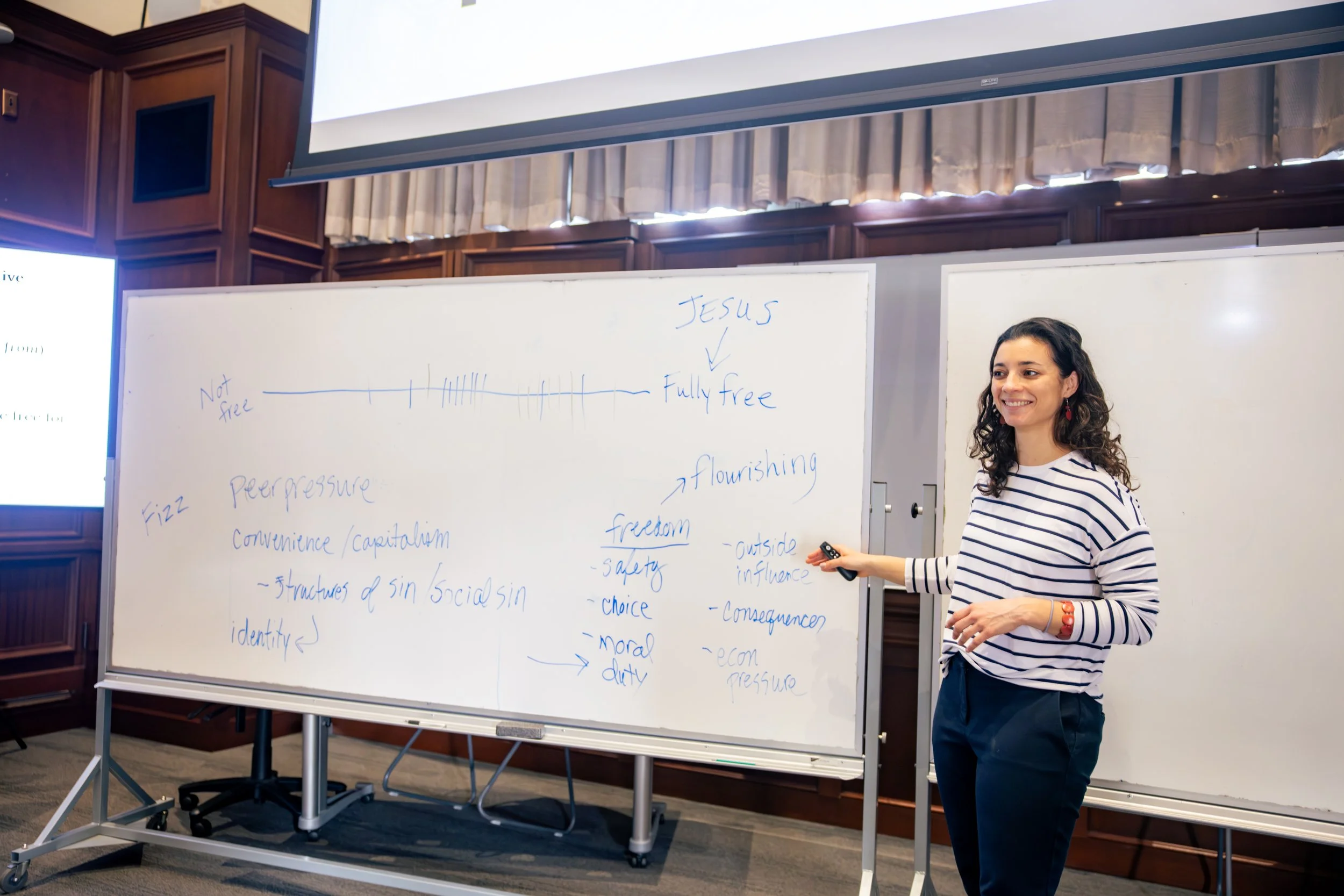
Religious Studies professor Elyse Raby teaches about freedom of indifference and freedom of excellence during her RTC 2 class Being Human. (Elaine Zhang/The Santa Clara)
A recent draft of a proposed core curriculum revision—shared by Santa Clara University’s Core Curriculum Revision Committee on February 6—does not include a third Religion, Theology and Culture, or RTC, requirement. The proposal comes amidst what the CCRC claims is a general consensus within the University community to simplify and streamline the core curriculum.
According to the CCRC’s draft, the new curriculum would include fewer classes overall and predominantly feature an ‘Ignatian Core’ that would mandate 12 core requirements in the College of Arts and Sciences for all students. The CCRC’s main focus is on improving clarity and flexibility.
Many of these proposed changes are sensible and deserve serious consideration. However, it’s not wise to eliminate an RTC requirement. The three-course progression is a highlight within the current core and a staple of the University. The benefit of giving students one less requirement to complete isn’t worth it when you consider how significant of an impact RTC classes can have.
I’m currently enrolled in my first RTC requirement, and speaking from personal experience—as well as what I can gauge from others in my section—the course does not feel dulled down by students looking to check a box. When I reach my seat a few minutes before class starts, I can already hear chatter about the latest reading we completed. The same interest is not always replicated throughout the core curriculum.
My class does not seem to be an outlier. I’ve heard similar experiences noted by others, including those who express particular appreciation for their RTC professors, as well as students outside of the humanities who rave about the fascinating material covered. “Learning religion is very important in seeing different perspectives,” said Jordan Norman ’28, referring to his experience in Jews, Judaism and Film. “I’m very glad I’ve had this opportunity.”
All courses in the University’s core serve a purpose, but there’s undoubtedly something about RTC that makes it appeal to a broader range of students. Norman, an accounting major in the Leavey School of Business, is one example of that. For non-humanities students, there is perhaps less of a barrier to entry to RTC than there is to other core classes.
As my own professor told us at the beginning of the quarter, the fact that spirituality has been such a mainstay throughout the history of civilization indicates that humans are to some degree essentially religious beings. Naturally, thinking about religion is a very human thing to do, regardless of an individual student’s own beliefs or interests.
Studying religion “invites us, as human beings, to reach beyond ourselves, our preconceived notions and our immediate concerns, to consider the mystery of reality itself in all its rich variety,” said Dr. Eugene Schlesinger, professor of religious studies at Santa Clara University. “Whether or not someone belongs to, believes or practices a religion, to spend time seriously and critically exploring these questions serves a vital contribution to their formation.”
Beyond its soulful attributes, studying religion is also a practical addition to a student’s primary areas of interests. It requires a special capacity for complex ideas, as well as a willingness to even consider them in the first place. “Religion deals with questions of ultimate meaning, which offers a unique perspective for considering all fields of inquiry, while also affirming their integrity as disciplines in their own right,” Dr. Schlesinger stated.
Admittedly, these courses are open to anyone who’d like to take them, but keeping a third RTC requirement makes it so students can move towards graduation while also exploring subjects out of their typical realm of study. This is the practical crux of the core curriculum—for students to have room to experiment with a diverse array of topics. RTC is the epitome of that opportunity, especially RTC 3.
“I think that RTC 3 classes are definitely the most enjoyable,” said Dr. Karen Peterson-Iyer, professor of religious studies at Santa Clara University. “They take some of the groundwork from earlier classes and help students use that groundwork to think about real-world issues in a profound and effective way.” RTC 3 is fulfilled by unique courses like The Bible and Ecology, Race and Religion in the United States, and Religions at Silicon Valley, all of which situate the learning that students are doing in important contexts. RTC 3 focuses on the “ethical reach and import of religion,” Dr. Peterson-Iyer stated.
While I think that almost everyone could find a few RTC classes to really dig into, it's true that certain students are more philosophically and spiritually inclined than others. In general, I favor the idea of students having the autonomy to study what they’d like. This is an intriguing aspect of CCRC’s efforts. If we have a core, there should be a lot of room within it to do what you like. But, being a Jesuit university, we can provide students with a unique opportunity. “One of the great gifts of studying at a Jesuit institution like Santa Clara, as opposed to some other institution is that it encourages each student to engage deeply with both themselves and the world,” said Dr. Peterson-Iyer. “The study of religion and theology is absolutely core for considering this deep engagement.”
I admire the CCRC’s efforts to reform the core curriculum, because the core inevitably plays a significant role in a student’s experience at Santa Clara University. We should try to do our best to help students get the most out of it. But RTC should maintain its central position within any new version of the core.
When I visited Santa Clara University a couple years ago as a prospective student, I remember being influenced by the idea that I could obtain a marketable degree in a competitive area while also having a rich experience in the humanities. The university promotes the concept of a Jesuit education in Silicon Valley a lot, and while they may sound like a broken record at times, it’s completely justified.
It would be a shame to lose any small bit of this unique advertisement, not just because it’s effective, but because it genuinely separates Santa Clara University from other institutions.