The Return of the Pencil and Paper Classroom
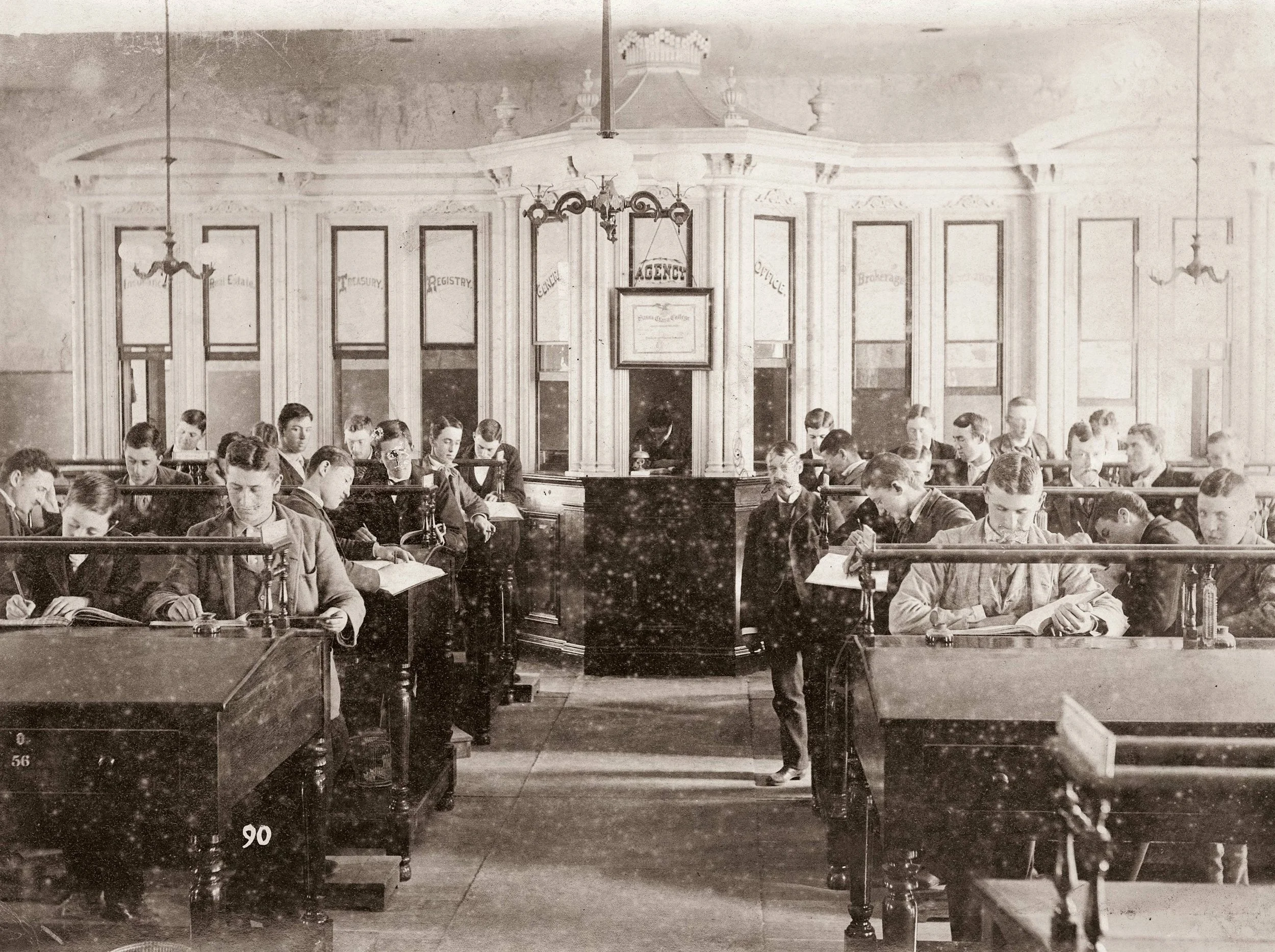
A Santa Clara University business class in 1890. Photo provided by Santa Clara University Library, Archives & Special Collections.
This year, there was one common thread throughout my first day back at college: professors confidently proclaiming, “no devices in class.” True in both my sciences and humanities classes, and even for my friends of various majors, there seems to be a trend back to ye olde paper and pencil classrooms.
While I appreciate the opportunity to be more engaged in the classroom, why is such a change happening now after so much of our learning has become electronic in the last few years? And will it last? I sat down with one of my professors, Dr. Elyse Raby, to discuss her philosophy of device-free classrooms.
“This is new. I’m increasing my own policies on this,” she said. To her, it’s about distraction. “You’re getting notifications all the time.”
Dr. Raby referenced studies regarding focus, attention span and the proximity of your cell phone. One study conducted in 2017 specifically found that even the presence of a cell phone can cause a cognitive deficit, termed “brain drain,” regardless of whether one is actively using the phone.
“You just have more brain space and bandwidth,” she said regarding phone-free classrooms. “We have so few spaces in the world where that is. Students are rarely going to say ‘let’s go for a walk without our phones,’ so if I can create a 60 or 100 minute block of time of experiencing what it’s like to think without being pulled in all these different directions, maybe students will learn more, or better.”
There are other learning benefits as well. Another one of my device-free professors asked us to read an article by a professor, Dr. Ezekiel J. Emmanuel of the University of Pennsylvania, who banned cell-phones and computer note-taking in his class, detailing the benefits of hand-written notes for long-term memory. This article also references the ever-important study on brain drain. Dr. Emmanuel had great results; his students engaged and their reviews of the class were overwhelmingly positive.
And what do Santa Clara University students think? Some students—myself included—agree that it’s hard to stay focused in an environment full of distraction. Liv de Jounge ’26 said, “Even if I am not distracted by my own devices, I find my eye wandering to others’ devices, whether they are watching a baseball game or texting their mom. Even when it’s unintentional, it’s hard to stay on task.”
So with all this evidence, are we throwing in the towel on devices in the classroom? Not so fast. De Jounge ’26 continues, “On the other hand, devices are useful for note-taking and organization, so losing that can feel limiting…When my thoughts are scattered between Google Drive, Camino, notes app, and paper it feels so much more stressful to learn and consolidate.”
Is the distraction worth it? Olivia Alleyne ’26 offers an important perspective on the matter: “If a professor in one of my ethnic studies classes says screens aren’t allowed, it’s not a big deal, but if one of my STEM professors said the same I wouldn’t know what to do.” Applications like Notability allow for the streamlining of written and typed work, especially useful in STEM classes when you may need to draw a molecule and type an equation on the same page, which can be essential for today’s classes.
Our classrooms are at a great crossroads right now. We have more resources than ever, and these can be necessary. But we are also more distracted than ever. It’s unclear what the next quarters and years will bring. But for now, let’s embrace the opportunity to be less distracted and engage on a deeper level—when we can—in device-free classrooms.