The Split over “Abundance”
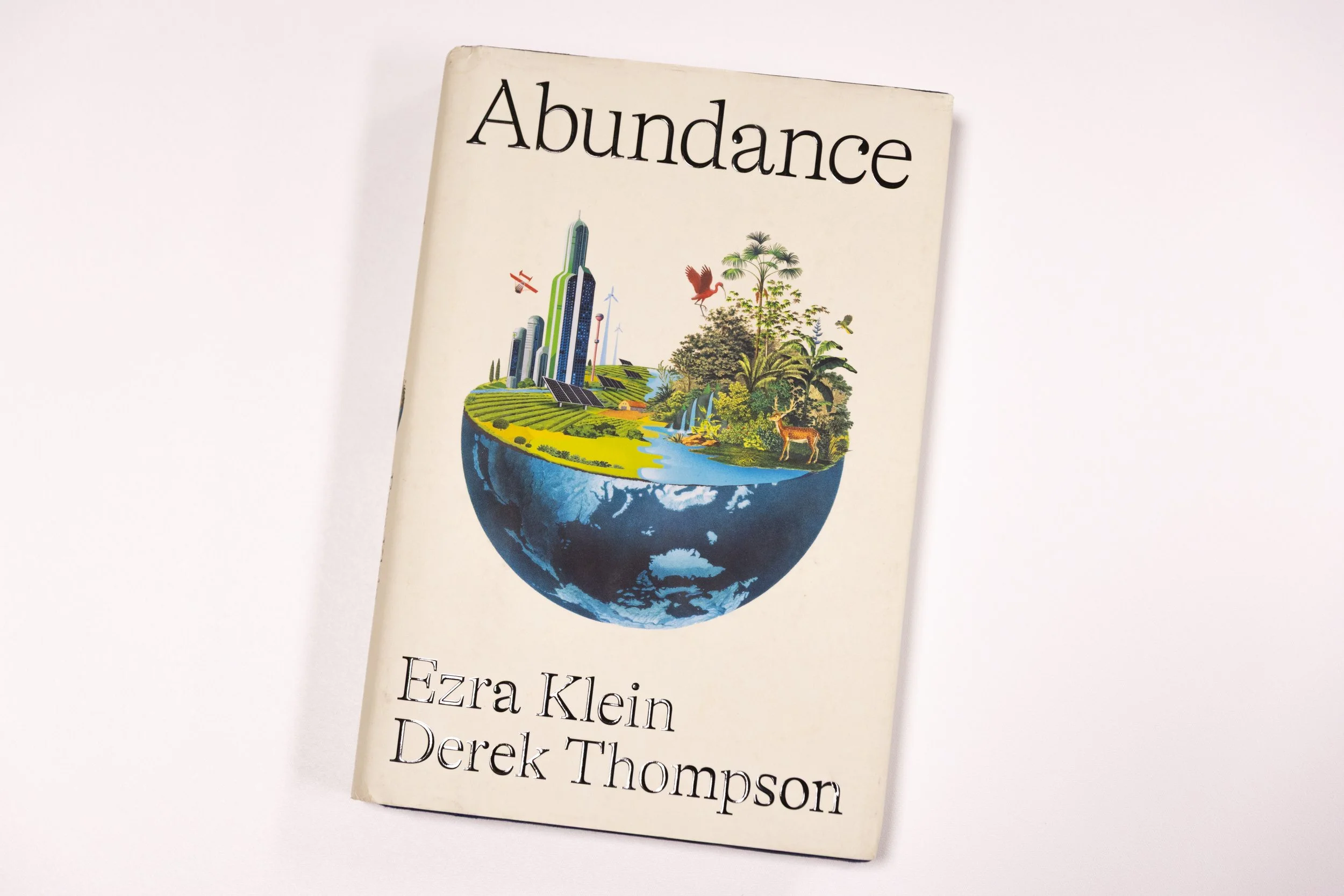
"Abundance" by Ezra Klein and Derick Thompson was originally published on March 18, 2025. Photo by Nina Glick
This summer, former president Barack Obama released his popular bi-annual reading list featuring “Abundance,” a book that’s taken the left side of the political spectrum by storm. Ezra Klein and Derick Thompson, authors of the #1 New York Times bestseller, promote a perspective on liberal politics that has seemingly divided Democratic Party constituencies.
Combining supply-side economics with an eagerness for more affordable housing, clean energy and lifesaving medicine, Klein and Thompson paint a future where government and industry are able to provide more to Americans, contrasted with the inefficiency of modern bureaucracy. They argue that laws and regulations that were necessary at one point in time are now hindering America’s ability to prosper, whether those be outdated environmental standards or the heaps of requirements that can slow important construction to a halt.
Some progressives have disparaged the “Abundance” vision and its advocates for being “neoliberal,” a term that describes fans of free market ideals, and is one of the most derogatory words commonly thrown around on the left. This is likely in reaction to the book’s advocacy for certain types of deregulation and its lack of anti-corporate sentiment. However, this criticism ignores the authors’ emphasis on a strong and productive government. The source of this agitation is consistent with the age of politics we are living in, where radical ideology often negates a common ground that could facilitate progress.
Speaking at a private political fundraiser this summer, Obama touched on the apparent contradictiveness of this leftist criticism. “There’s been, I gather, some argument between the left of the party and people who are promoting the “Abundance agenda,” he said, acknowledging the tension between supporters and certain hardcore progressives. What came next was an important message to anyone who gives themselves that title—“You want to deliver for people and make their lives better? You got to figure out how to do it,” he explained. “...I don’t want to know your ideology, because you can’t build anything. It does not matter.”
Klein himself has echoed a similar sentiment in response to the criticism he and Thompson have received from members of the far left, tweeting in June that he feels people ignore that “Abundance” is about “making the state more, not less, powerful and capable of doing big things.” Large parts of the book are dedicated to pointing out failures within the American government that if reformed could—hopefully—better deliver for Americans. And progressives typically vouch for the government to do more, so why did “Abundance” not garner their support?
Klein put his finger on it with an op-ed he wrote in the wake of the book’s release. “Many of my more leftist friends and antagonists have asked me if ‘Abundance’ has a theory of power,” he writes. “I often say it does—but they’re not going to like it. And that’s in part because its theory of power is liberal rather than populist.” What does he mean? “Abundance” doesn’t concern itself with constructing a simple, dyadic vision of our country’s moral landscape. For example, private corporations aren’t reflexively bashed, and labor unions aren’t automatically revered. Instead, Klein writes, “Corporations can sometimes serve the national interest and sometimes betray it. The same is true for governments, for unions, for churches, for nonprofits.” For Klein and Thompson, it’s about results, not virtue signaling, which is where they may lose some readers.
To be clear, concerns regarding issues like deregulation or the concentration of wealth are not without merit. If you oppose aspects of the “Abundance” theory on practical grounds, such as genuinely and analytically defending zoning laws, fair enough. But a total disregard for it just because it doesn’t fit perfectly into a “eat the rich” slogan is largely counterproductive. A project focused on making the government more robust and healthy is very far from the left’s biggest problem right now.
Certain progressives’ distaste for “Abundance” should serve as a wake up call for our nation’s politics. Facing a crisis of shortage and affordability in its largest cities, America’s focus should be on delivering for its people, and as Klein argued, less emphasis should be placed on how that’s achieved. This tribalism on the left that resorts to epithets like “neoliberal” when their certain vision of politics isn’t totally replicated will only serve to stifle this growth. “I don’t care how much you love working people,” Obama said in his same speech from this summer. “They can’t afford a house because all the rules in your state make it prohibitive to build.” Indeed, if progressives truly care about the everyday American, they will be pragmatic, not political, in serving them.