Don’t Spend Hours ‘Learning’ AI
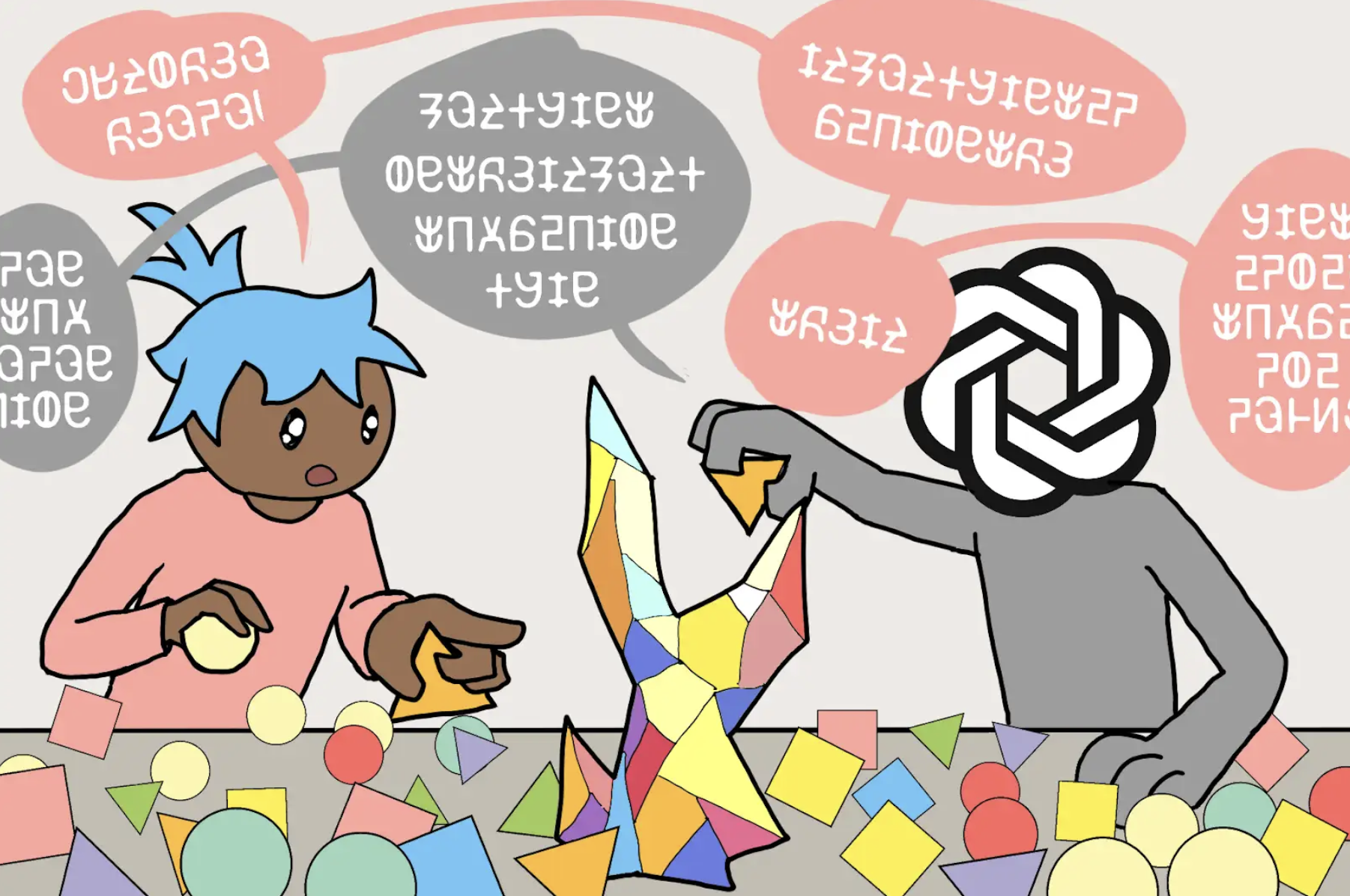
(Illustration by Jenell Theobald)
Those graduating in 2026 are going to see the labor market noticeably shift during their professional careers. The forecast for the impact of artificial intelligence isn’t totally clear, but we know it is going to create a lot of new jobs while making others obsolete.
The World Economic Forum reports that, according to LinkedIn data, AI is already credited with creating 1.3 million new jobs. Over the course of time, though, some jobs—most relevantly, ones that are repetitive and involve a lot of imputation—will assuredly be taken over by AI. The market research company Forrester predicts that 6% of current U.S. jobs—that’s 10.4 million—will be taken over by AI by 2030.
While not all of these chasmic shifts are happening right now, it’s true that much of the work 2026 college graduates will be doing in their early career is a lot different than the work done by those in their position five years ago. AI is currently being used to speed up labor-intensive tasks, many of which being the kind younger professionals would work on.
Ann Chowe, professor of executive education at the Northwestern Kellogg School of Management, writes that in 2026, “you must be able to use AI effectively to the same degree you once needed to be fluent in the Microsoft and Google office suites.” The question, then, is how much extra time students need to devote to learning it.
Despite its usefulness, I’d argue not as much as you might think. Anthropic’s report on AI fluency emphasizes familiar skills of conversation and engagement, not a separate bundle of AI-specific capabilities.
Anthropic lists three habits or skills that, if done more often, could help AI users greatly. These are “staying in the conversation,” “questioning polished outputs” and “setting the terms of the collaboration.” In other words, to elicit the best responses from AI, you need to engage with it thoughtfully and analytically, much like you would with another person whose opinion you value and seek.
Per the Anthropic report—which studied 9,830 conversations—only 51.7% of AI users clarify their goal before asking for help. In other words, if you do this, you separate yourself from almost half of the other people using the technology. Further differentiating yourself isn’t much more difficult. Only 30% specify format and structure, and only 20% pay enough attention to realize when AI is missing context. If you want to use AI in a way that 91.3% of people don’t, inquire about the big claims it makes.
Anthropic’s benchmarks sound mostly like what students practice throughout their academic careers. These are not fancy skills. They’re standards of critical thinking and attention to detail. No one needs a special course to do this—it’s something we’ve all learned how to do, not only during school, but as humans on planet earth.
My theory is that people look at AI as a break from having to do their own thinking. After all, it does do a lot of thinking for you, and this is the exact concern people have about the rate at which it’s being used in higher education. It seems, however, that there are huge gains to be had if people can keep their brains turned on when using AI. Asking the right questions, strategically approaching a conversation, being thorough—these are all places where human thinking can make a big difference.
Many people will also find that they become more effective with AI by just getting hands-on experience with it, as opposed to trying to learn the best ways to use it beforehand. While I do think some of the lowest hanging fruit when it comes to AI fluency is practicing careful communication, it’s a unique format and inevitably not something that people will necessarily thrive at right away.
Our generation of college graduates is in pretty good shape with regards to getting experience with AI. A 2025 survey conducted by CopyLeaks found that nearly 90% of students use AI. In 2026 in Silicon Valley, I’d bet money it’s even higher. “It’s like they’re biking in the Tour de France, and the rest of us still have training wheels,” said Dropbox’s chief people officer Melanie Rosenwasser, referring to the familiarity young workers have with AI. In their time during college, students have certainly figured out how to use AI to their advantage. But this doesn’t mean they’re using it totally efficiently. In a study on AI use among university students, Anthropic found that 47% of inquiries were ‘direct,’ meaning they sought solutions with minimal engagement. Even people comfortable with it are still leaving relatively a lot on the table.
To be fair, it’s difficult to market your AI habits to a hiring manager without some sort of tangible item, like a certificate from a course. For some people—most relevantly those who want careers in AI—learning how to use AI in ways that reach far beyond strategic communication will be imperative. And in general, it wouldn’t hurt for anyone to learn more about what you can do with it. There are free and reputable courses online that can probably help a lot.
But with regards to executing on the daily with AI—and delivering on those difficult tasks in your early years as a professional—it seems like a simple way to improve your odds is by sitting up straight and bringing some energy to the conversation—even if it’s not a person you’re talking to.