The Trap of Supply and Demand Thinking
Economics is a fairly popular major at Santa Clara University, offered both in the Leavey School of Business and the College of Arts and Sciences. In 2024, the University granted 71 economics degrees. As an economics student myself, I often wonder if other students have a similar reaction to our in-class models as I do: they often come up short in explaining something that’s happening in the real world.
For people who it clicks with, economics can be somewhat intuitive. The theory certainly gets more complex as you advance through an undergraduate degree, or pursue graduate studies. It does not always confirm our intuition; sometimes, it does the opposite. Take ‘Intermediate Microeconomics I,’ a course I’m enrolled in right now. It is by no means an easy class, but a lot of the work we do confirms something we could’ve predicted. For example, that in most cases when your income increases, your consumption increases too. A conclusion like this, while necessary to learn the math for, does not exactly give economics students a leg up when it comes to reasoning with the world around them.
I do understand why we are taught this way. Like I said, it provides a foundation for the theories later on that don’t follow conventional wisdom. And while economics majors likely won’t use the proofs for these theories in their jobs, the ability to build a model based on expected human behavior is often useful. Some models may express intuitive concepts, but we can’t understate the importance of putting math to intuition. Our ideas about the world are made much more useful when we can formalize them in a way that allows us to make predictions.
However, learning these frameworks can actually be a bit of a trap when it comes to reasoning about society—at least at first.
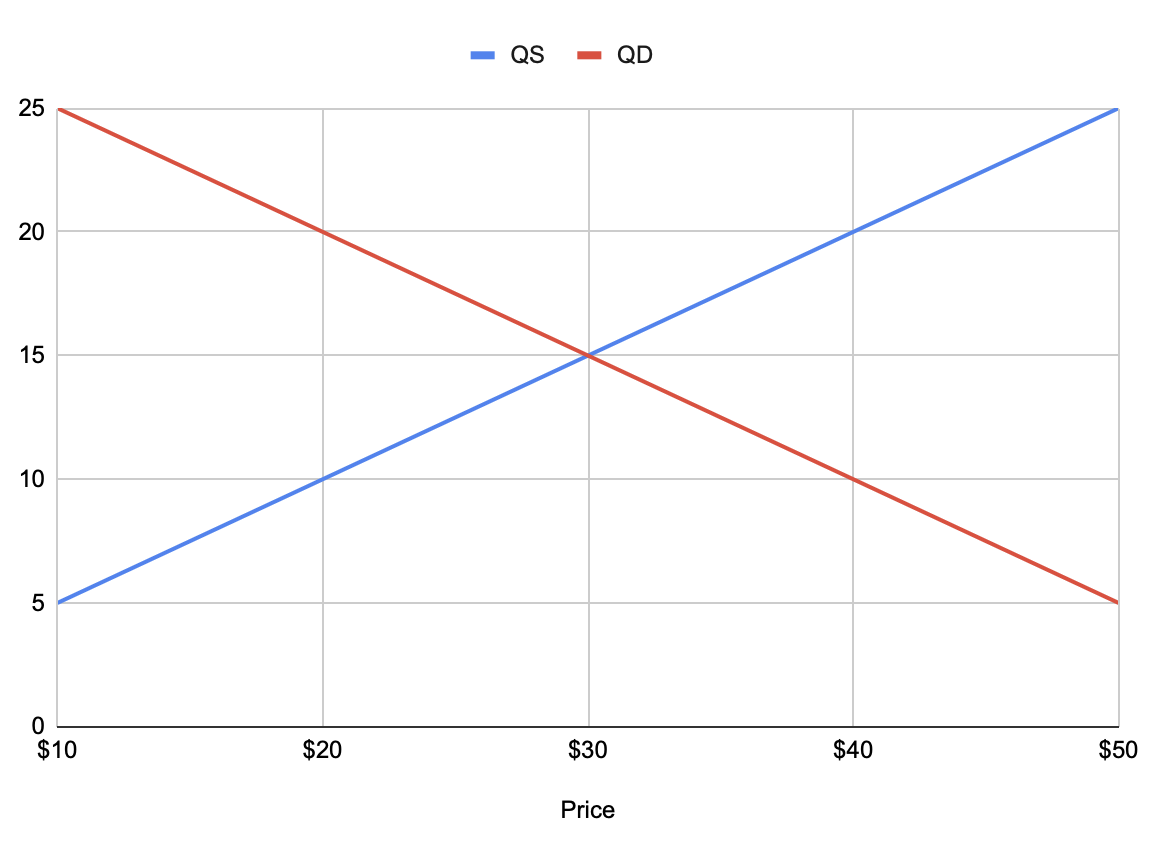
Principles of microeconomics—which perhaps has the most easily applicable models out of the first handful of economics classes taught—provides students with a foundational concept: supply and demand. It’s intuitive that in general, when prices in a market increase, sellers will be more enticed to sell, and buyers will be less enticed to buy. Our experiences buying and selling goods confirms this. But wielding a supply and demand graph allows us to put words and numbers to that intuition.
Immediately, interested students notice that everything around them involves scarcity. There is an instinct to extrapolate the supply and demand graph to each and every situation. This is no doubt exhilarating at the beginning. What students may start to notice, though, is that these models have—to use an economics term—diminishing returns.
The real world is messy. Watching the phenomena of everyday life is much different than doing a homework problem, if you haven’t noticed. There is a lot going on in trades that people, organizations and governments make that can’t be neatly modeled on a graph. I personally began to notice that my supply-and-demand-style explanations were falling short when I was looking at the things going on in front of my eyes.
Now, I don’t think there’s any field of study in the world that would claim to adequately explain the totality of life. That would be absurd. We should give a lot of credit to economics for how incredibly useful theories like supply and demand are, relative to their simplicity. But one thing that at least some other fields of study do, that economics could benefit from adapting, is leaving open some room for interpretation.
I think economics could benefit from being less beholden to its models. As I’ve explained, I recognize the usefulness of graphs and equations. If we never were able to put words to our intuition, we wouldn’t be able to extrapolate it to different people and different situations in order to say something noteworthy about society. But economics prides itself on being one of those ‘practical’ disciplines; one that helps students understand how a society handles its resources. In order to do this, the ambiguity of our world must be significantly grappled with.
As students progress through the economics major at Santa Clara University, and even potentially study economics post-graduation, there is definitely more ‘outside-of-the-box’ thinking. But I wonder if creativity could be more welcomed in some of the classes earlier in the progression, too. We should try to make economics even stronger than it is now by introducing some more uncertainty into the conversation.