The Fall of Cesar Chavez Shows how White Privilege Prevails—Again
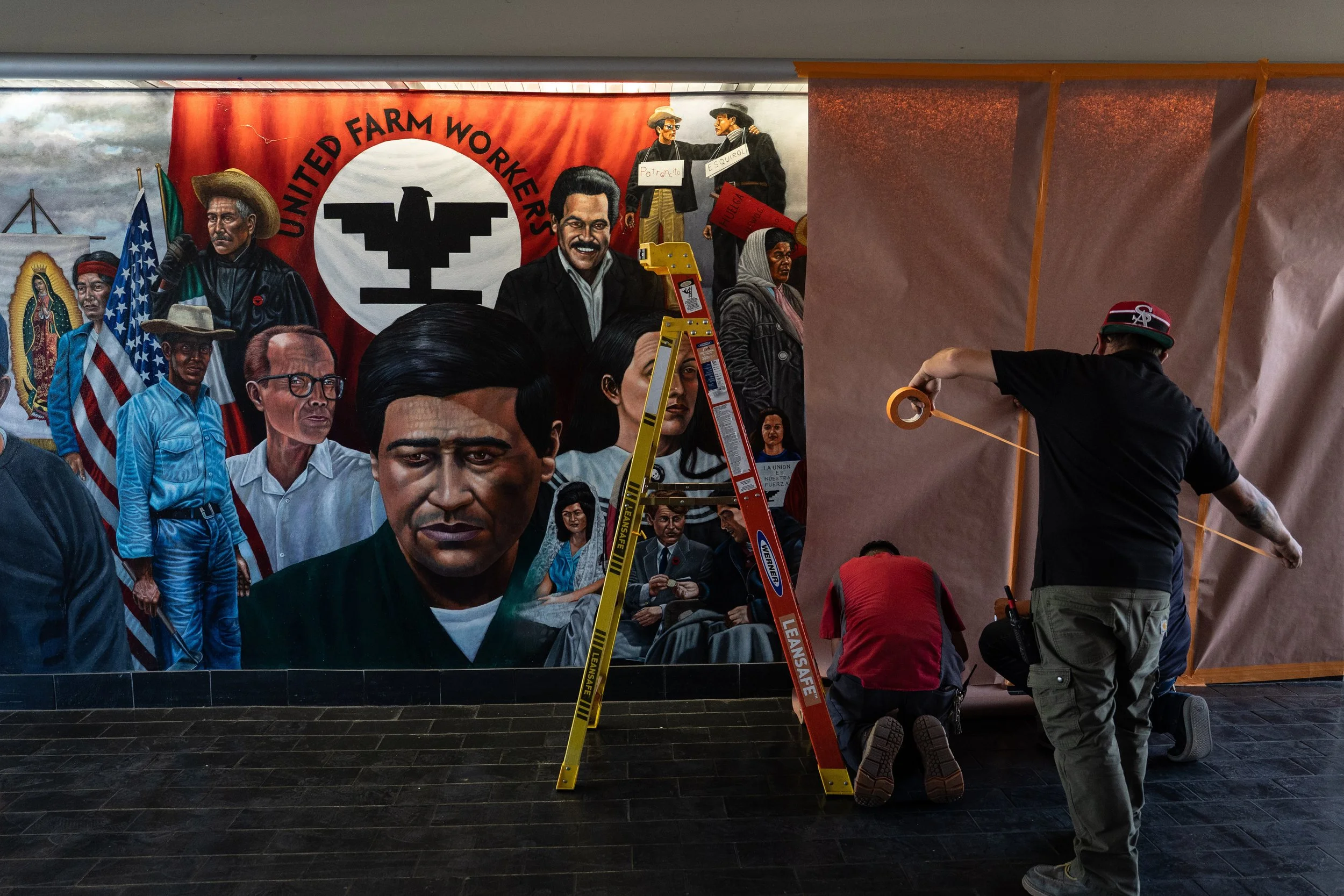
FILE - Workers cover a mural by Emigdio Vasquez featuring Cesar Chavez and other figures at Santa Ana College in Santa Ana, Calif., Thursday, March 19, 2026. (AP Photo/Jae C. Hong,File)
The nation was rocked by news of sexual abuse and misconduct allegations made against Cesar Chavez—a revered labor leader and civil rights activist—on March 18. The public response was immediate, marked by shock and collective disbelief.
The internet has been inundated with responses from political leaders expressing their shock over the allegations that have come to light. Members of the Latino community—including myself—have also been left deeply troubled.
Alongside these emotions, however, it is difficult to ignore the uneven distribution of accountability. Why is it that some allegations provoke immediate outrage, while others are met with hesitation, deflection and silence?
As political activists scramble to alleviate the blow to the movement resulting from the allegations against the civil rights activist, California has moved to rename Cesar Chavez Day to “Farmworkers Day.” While the speed at which the nation is attempting to separate the accusations from the movement is praiseworthy, I can’t help but highlight the hypocrisy at play here.
The elephant in the room—or more specifically, the Oval Office—being the numerous allegations made against President Donald Trump. As of October 2024, the head of state has been accused by at least 24 women of various acts of sexual misconduct. This, of course, does not even begin to account for the very conveniently sidelined legal documents tied to a certain Jeffrey Epstein.
The public response surrounding the allegations against Cesar Chavez reflects a pattern of selective outrage, proving yet again the advantages of being white and rich. This is especially evident when compared to the far more muted response to the similar accusations directed at Donald Trump.
It is by no means my intention to suggest that the allegations against Cesar Chavez should be dismissed or ignored; such accusations demand accountability, investigation and consequences. I am merely positing that accountability, it seems, is not evenly applied.
The current political climate is a stark example of how power, race and status shape public judgment and reaction. Cesar Chavez, a Mexican American labor activist, is met with immediate condemnation—and rightfully so. But a wealthy white politician continues to work under a far more forgiving lens—proving that when you have enough money and power, you are able to get away with having allegations.
There is no difference within the allegations themselves, but instead who the allegations are tied to. It’s as if white privilege has slapped me and every other woman and person of color right in the face.
Just over 24 hours after the accusations against Chavez came out, Los Angeles Mayor Karen Bass signed a proclamation renaming the city's Cesar Chavez holiday to “Farmworkers Day.” As of March 19, 2026, Donald Trump has been in office for 1,519 days, counting both his first and second terms, yet accountability for his actions seems to be moving at the pace of molasses.
White privilege yet again wins in this scenario. The occupant in the White House remains, and the victims of his actions do not receive any form of justice.
Narratives do not emerge naturally—they are greatly influenced by identity. It is incontrovertibly evident that one's racial identity plays a role in shaping public response. When you consider the situation at hand, and strip away the titles and public personas, what remains is a clear example of how deeply-rooted racial biases continue to influence who is condemned, who is defended and who is given the benefit of the doubt. We have seen it before and we will continue to see it again.
It is of the utmost importance to treat these scenarios with the proper rage and accountability. However, I firmly believe that if we applied the same level of urgency to the oaf in office, maybe justice would not seem so unattainable. If we can create this level of urgency for one individual, it must be applied consistently to all individuals.
Justice must be consistent. Outrage cannot be dependent on who the accused is. The same urgency, the same intensity and the same demand for accountability must extend to all—especially to those in positions of the greatest power.