Santa Clara University Community Seeks Answers Following Departure of OAE Director and Assistant Director
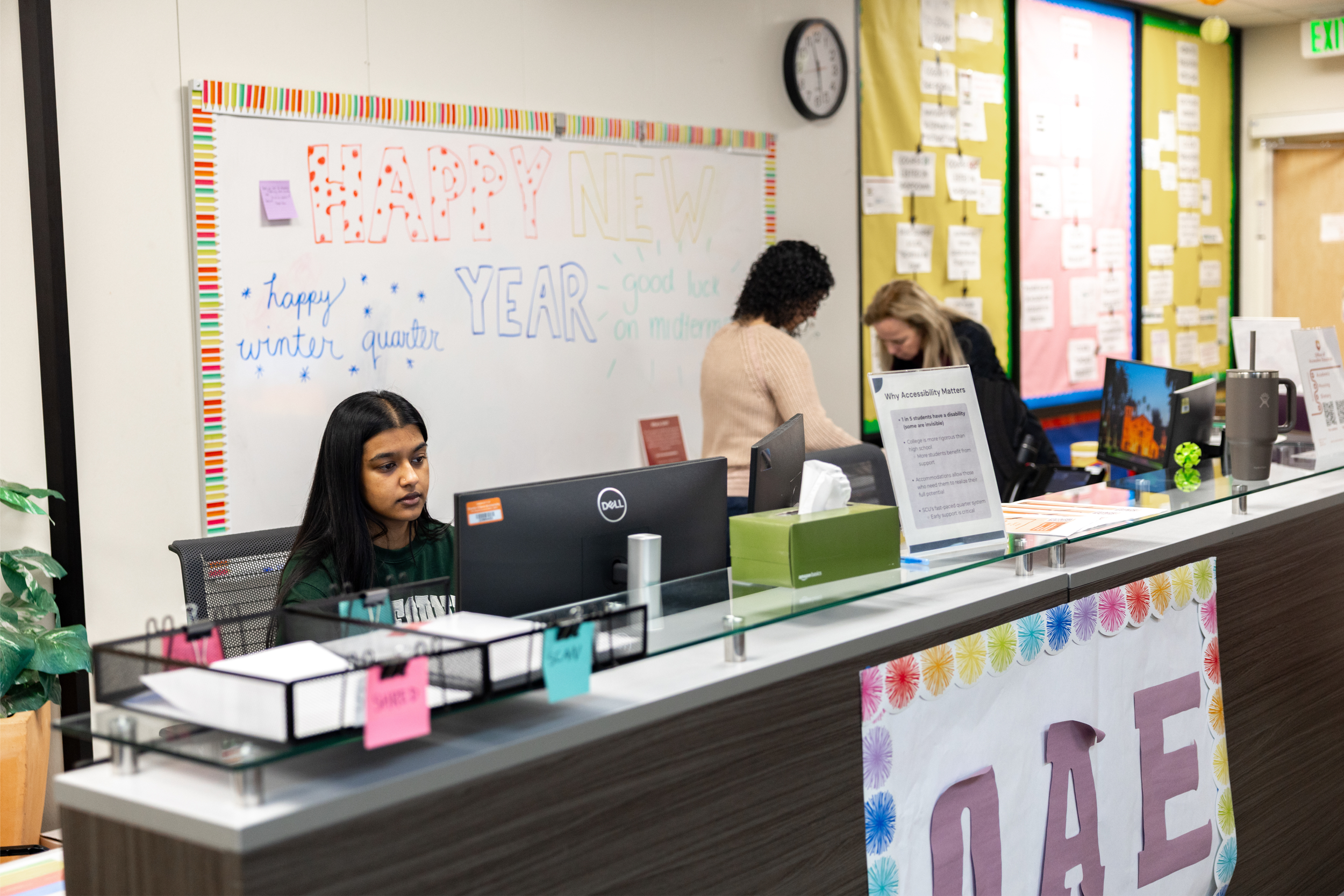
From left to right: Office of Accessible Education student desk worker Ishaani Dayal ’26, executive function coach staff for the OAE Heidi Qandah, and economics professor Helen Popper in the Office of Accessible Education on Tuesday, Feb. 10, 2026. (Elaine Zhang/The Santa Clara)
Mid-quarter leadership changes at Santa Clara University’s Office of Accessible Education have raised concerns among the campus community following the departures of Director James Marik and Assistant Director Heather Stephan.
Following the initial announcement in an Inclusive Excellence Division newsletter sent on Feb. 6, students and staff raised concerns of transparency between the vital student resource department and the University community, with many questioning whether accommodation services would experience change during the transition.
Shá Duncan Smith, vice president of the Inclusive Excellence Division at Santa Clara University, said she and Assistant Vice President Mo Lotif would be helming the office in the interim, and that they expect services to students will remain unabated. An email sent by the OAE on Tuesday, Feb. 10 included the update that Aniya Sutton Ward, an ADA/504 consultant, will serve as the office’s operations lead during this transitional period.
The circumstances surrounding Marik and Stephan’s departure remain unclear. In her statement, Duncan Smith expressed appreciation for the leaders’ contributions to the department but declined to comment on the manner of the exit, citing personnel matters.
Duncan Smith confirmed that proceedings are in motion to fill the vacant positions, stating that the office has “established an internal timeline for the search process and position openings, which will include engagement with key stakeholders across campus.”
Concerns remain, however, as several other familiar OAE staff members have departed or taken leave of their positions. The office, which was fully staffed with seven professional employees prior to Jan. 20, 2026, has since lost its director, assistant director, and access specialist Michael Crump.
Office manager Chris Smead is currently working full-time from home to support the transition, but will be on parental leave beginning March 2, during which he will be unavailable until June. Second access specialist Amy Yasukawa has taken leave until Feb. 17.
Digital access specialist Cam Coulter and executive function coach Heidi Qandah remain currently in-office.
According to Smead, as of Wednesday morning, there is “no confirmed timeline for filling these roles,” but Duncan Smith and Lotif are working to secure temporary staffing to fill necessary gaps.
Athena Li ’26, a student receiving academic accommodations through the OAE, said Marik’s and Stephan’s support was central to her ability to succeed at the University. A student from Hong Kong, Li emphasized the office’s vital role in her ability to adapt to an unfamiliar system.
“Me standing here being able to graduate with a double degree and being able to graduate on time in the spring, really I do owe it to the office and especially to James and Heather, especially James,” Li said, adding later that the former OAE director, whose last day was Jan. 21, had been “an immense source of stability, comfort, familiarity and of affirmation.”
“I came to college as a headless chicken,” Li said. She credits Marik in particular with pushing her to advocate for herself. “It wasn’t like therapy,” she said. “It was rather like ‘take initiative, Athena.’ He was sort of that push.”
Tay Grett ’25, who served as ASG Senator at Large for Student Health last year at Santa Clara University, said their reaction to the news was extremely saddening.
“I cried. I was sobbing,” Grett said. “James and Heather are the reason I was able to graduate.”
Grett, who utilized OAE services throughout their time at the University, relied on accommodations—including a specific housing placement, private testing accommodations and support for their service dog—to support their success in academics and ability to live on campus. “I don’t know any other staff member or department at the University that cares most about the students,” they said.
Grett and Li both raised practical concerns about what the departure of the two leaders means for the OAE’s current operations.
Marik and Stephan conducted intake assessments for new students seeking accommodations, a process that the Feb. 10 email assures will be continued by appointment on the OAE portal. But with midterms and finals approaching, Li worries about what happens when professors push back on a student’s accommodations without familiar OAE leadership to advocate for them.
“When professors contact the OAE to clarify a student’s accommodation or to push back on a student’s accommodation, which they have done, without that voice of authority, that’s something I’m worried about,” she said.
“This loss is not only on a personal level, losing that connection to this group of people that have helped me hold my hand through my darkest times. It reveals weaknesses and questions about institutional knowledge, about what works and what doesn’t work for students with disabilities. This is such a vulnerable population, and it raises questions on whether or not the decision by the University is reflected in students’ best interests,” Li emphasized.
Both Li and Grett said what they want most right now is communication from the University.
“I want to understand how, despite these changes, what measures are going to be made to ensure that these students are being protected and provided services that they have the right to,” Li said.
“I am honestly terrified for the current and future students of SCU who need accommodations; in no way do I see this going in a positive light,” said Grett. “I don’t see anything coming into fruition as a result of this.”