Family of Santa Clara University Student Killed in Traffic Accident Files Wrongful Death Lawsuit
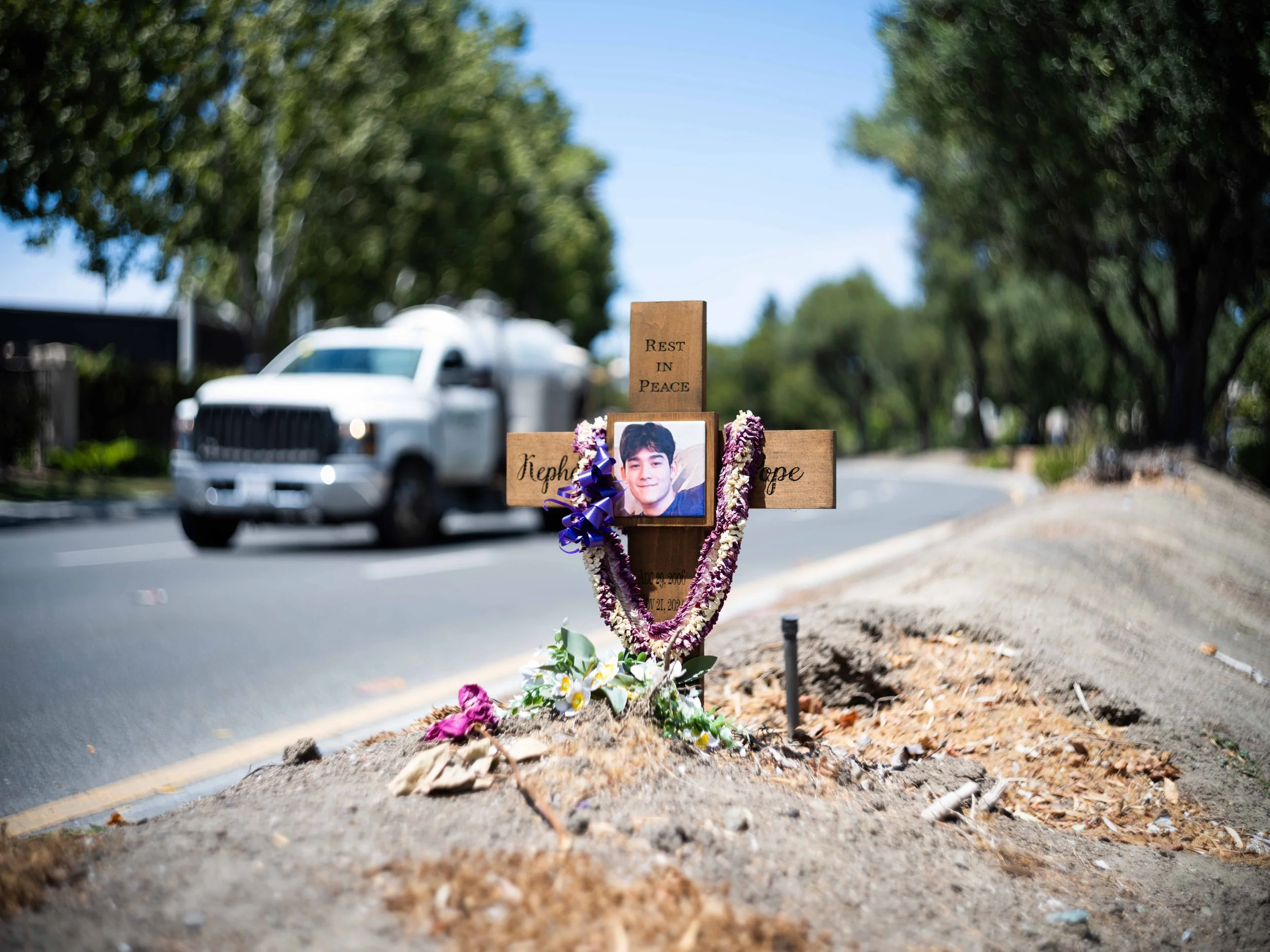
Roadside memorial for Kephas Pope on the El Camino Real median next to Santa Clara University. Photo by Dylan Ryu
The family of Kephas Pope ’27, an 18-year-old Santa Clara University student killed in a traffic accident last November, has filed a wrongful death lawsuit against multiple defendants, alleging that dangerous roadway conditions and negligent construction activities contributed to the tragedy.
The complaint, filed June 30 in Santa Clara County Superior Court, names the California Department of Transportation, Santa Clara County, the City of Santa Clara, apartment complex operators and the driver involved in the fatal crash as defendants.
The nine-count lawsuit includes allegations of negligence, dangerous condition of public property, failure to warn, wrongful death, and premises liability. The plaintiffs seek both compensatory and punitive damages, though no specific monetary amount is stated.
The lawsuit is the latest step in the family’s continued effort to hold multiple parties accountable for what they describe as a “tragic—but entirely predictable—accident.”
“The primary reason for the lawsuit is to make it safer and secure compensation for the loss of the life,” said the family’s attorney, Dana Taschner. “This was a tragedy for them; they don’t want to see another family go through this.”
Pope died Nov. 21, 2024, when he was struck by a falling tree after a BMW driven by defendant Jonathan Drake crashed into the median on El Camino Real. According to the lawsuit, Pope was “waiting in the dirt median in the middle of El Camino Real” when Drake “drove his vehicle onto the median, striking a planted tree. The tree, in turn, became uprooted due to the force of the collision and struck KEPHAS in the head, resulting in KEPHAS’s death.”
The sophomore biochemistry and neuroscience major was walking his bike across El Camino Real from his apartment at the Domicilio complex to campus for an organic chemistry lab when the accident occurred.
El Camino Real, a road directly next to the University’s campus, is described as a “deadly 6-lane road” with a documented history of pedestrian fatalities by the lawsuit. According to the complaint, “El Camino Real is the ‘deadliest road’ in the Bay Area region with a reported 129 fatalities,” citing data showing 58 fatalities in Santa Clara County alone between 2002 and 2022.
“The volume of deaths on El Camino Real is not acceptable,” said Taschner. “We hope that this may go far to change that in the future.”
El Camino Real presented multiple hazardous conditions, including “a significant curve in the roadway” that “prevents pedestrians and bicyclists from visually observing traffic beyond the curve,” according to the lawsuit.
Additional lack of safety features such as “warning signs,” “speed calming devices” or “guard rails and/or median barriers to prevent cross-over accidents” were also listed.
Maintenance work at the Domicilio Apartments is alleged to have created additional hazards on the day of the accident. Apartment management companies Greystar and related defendants “permitted workers to park a Genie ‘Xtra Capacity’ boom lift” in the northbound lane of El Camino Real, “effectively reducing the northbound lanes on El Camino Real from three lanes to two lanes for vehicular traffic,” according to the complaint.
The lawsuit claims this construction activity “obscured KEPHAS’s view of the curved roadway” and “distracted and/or obscured the view of motorists driving on El Camino Real.” The filing alleges the defendants “failed to obtain the required encroachment permit from CALTRANS, COUNTY, and/or CITY for permission to close a lane El Camino Real.”
The family has already filed tort claims against the government defendants, which were rejected by the California Department of General Services. In a February rejection letter, the state wrote that “the claim involves complex issues beyond the scope of analysis and legal interpretation typically undertaken by the GCP.”
Prior to the lawsuit, Pope’s family had received written confirmation from state officials acknowledging the dangerous nature of the roadway.
A separate 2016 Santa Clara University engineering thesis cited in the complaint noted that El Camino Real “can be dangerous for pedestrians and cyclists” due to “higher traffic volumes.”
Government defendants had “actual and/or constructive notice of the dangerous condition in sufficient time before the Incident to have taken preventive and/or remedial measures,” according to the lawsuit, but “failed to take any actions to eliminate and/or reduce the known significant risk and danger to persons, like KEPHAS.”
Despite this knowledge, the filing alleges defendants “failed to take appropriate safety measures such as providing appropriate signage, warning motorists of pedestrians, taking measures to roadway speed, protecting pedestrians and bicyclists, installing speed reduction measures, installing safety features such as berms, median barriers, and/or median guardrails to prevent errant vehicles from entering the median.”
A jury trial has been demanded. No trial date has been set.