Santa Clara County confronts H.R. 1 fallout
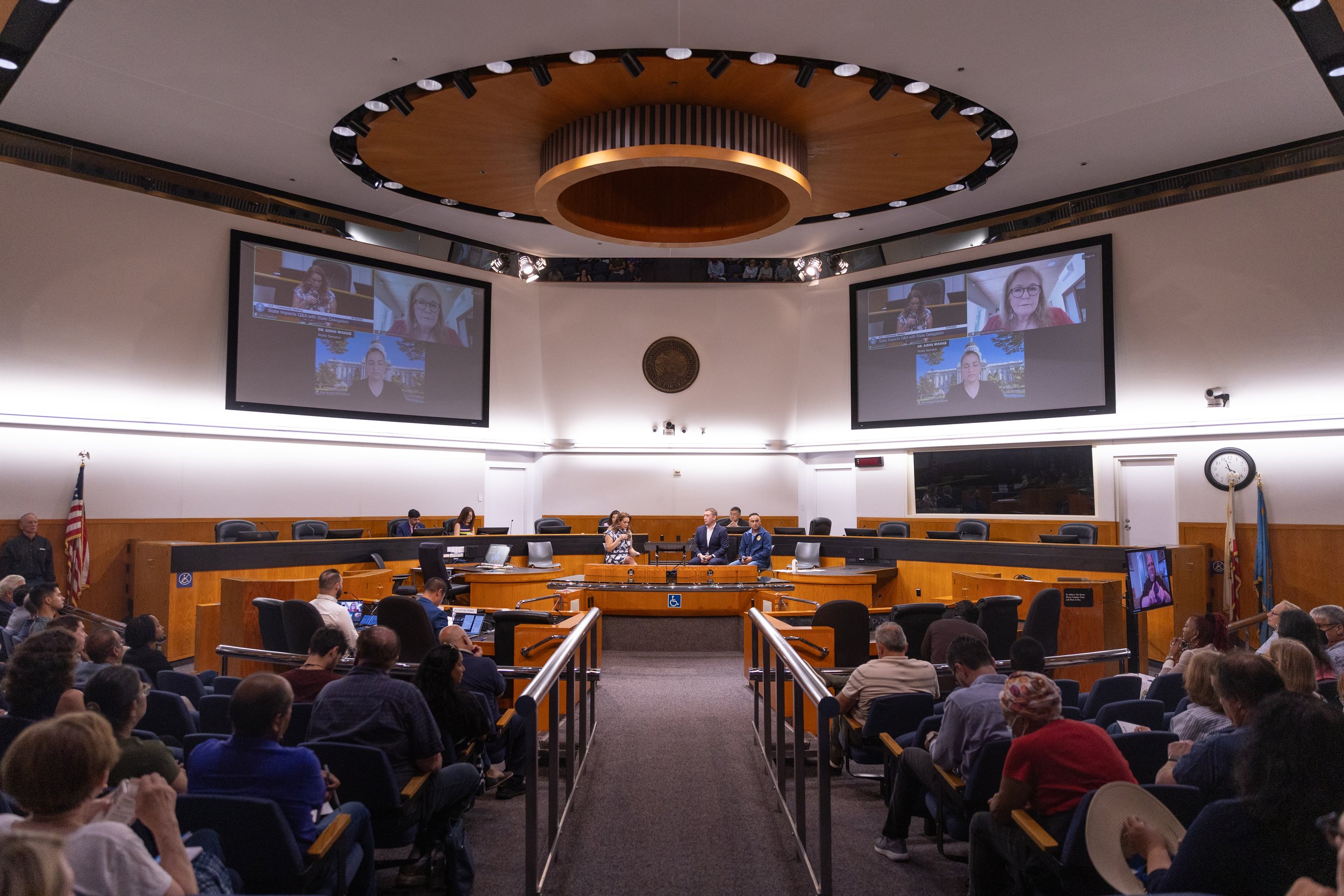
People and county leaders the Board Chambers at the County of Santa Clara Government Center for emergency town hall. Photo by Nina Glick
Santa Clara County leaders and residents gathered Saturday, Aug. 16 at 10 a.m., in the Board Chambers at the County of Santa Clara Government Center for a tense emergency town hall, raising alarms about the sweeping impacts of H.R. 1, the Republican-backed tax and spending package signed into law on July 4. The measure, championed by President Donald J. Trump and passed after weeks of wrangling in Congress, makes permanent the 2017 tax cuts and institutes new ones while slashing trillions of dollars in federal spending.
“This is not a big, beautiful bill,” said supervisor Betty Duong, who helped organize the meeting. “It is a horrific bill that will cause real pain for tens of thousands of families in Santa Clara County.”
The law, officially Public Law 119–21, reduces federal spending by nearly $6 trillion over the next decade. It extends tax relief for corporations and high-income households, eliminates federal taxes on tips and overtime pay, and dismantles a number of clean energy incentives. In exchange, it reduces funding for Medicaid, Medicare, food assistance and education programs, while increasing work requirements for safety-net benefits. The nonpartisan Congressional Budget Office projects the law will swell the national debt by more than $3 trillion and increase the number of uninsured Americans by nearly 12 million within a decade.
For Santa Clara County, which operates the region’s public health system and provides a broad range of safety-net services, the consequences could be devastating according to public officials. “Whether you live in Palo Alto and go to Stanford Hospital or Willow Glen and go to Good Sam, you will face crowded emergency rooms, longer wait times for health care services because of the ripple effects of H.R. 1,” Duong said.
Otto Lee, president of the Santa Clara County Board of Supervisors, warned of the financial impact of the law. “Here at the County of Santa Clara, we are anticipating more than a billion dollars of lost revenues over the next few years,” he said. “This will, without a doubt, create an extraordinary fiscal situation that would have dire consequences for all families. Our county is the public safety net. This bill has now punched a huge hole in that safety net.”
Congressmember Sam Liccardo, former mayor of San Jose, cited analysis from the Congressional Budget Office showing that the top 10% of households would see an average gain of nearly $14,000 under the law, while the poorest 10% would lose about $1,200. “That $1,200 loss means a lot more to a struggling family than the $13,600 gain means to a wealthy family,” he said.
Liccardo also warned that California could lose nearly $250 billion from changes to Medicaid provider taxes, which currently supply a major source of funding for Medi-Cal.
“The aggregate, a trillion dollars, the pain is going to be very widespread, and it’s going to go beyond Medicaid,” he said. “What we’re likely to see four or five years down the road, as a result of this budget, if everything holds, is a cut in Medicare as well as Medicaid, very steep cuts on the order of hundreds of billions of dollars”.
County Executive Officer James Williams, who oversees the county’s $12 billion budget, stressed that Medi-Cal is the backbone of local health care. The Santa Clara Valley Healthcare system, which includes four hospitals and 15 clinics, operates with a “$4 billion budget,” a majority of which comes from Medi-Cal, or Medicaid, and Medicare according to Williams.
“These hospitals are busy providing access to critical life saving care, access, of course, to Medi-Cal beneficiaries and the uninsured,” said Williams. “Our doors are open to everyone in our community, quick access to critical life saving care for every one of the 1.9 million residents in this county, every single one.”
In a release from the Santa Clara Family Health Plan, a non-profit health insurance plan, over 400,000 people rely on Medi-Cal within Santa Clara County.
Congressmember Zoe Lofgren echoed William’s concerns over the impact that the law, which she nicknamed “the big ugly law, or a bunch of bull,” would have on public health.
“This is it guts the Medicaid program, Medi-Cal here in California, the Food Nutrition Program, the clean energy industry, the Affordable Care Act, all of which are going to push families towards poverty,” she said.
The law’s reach extends beyond health care. It makes major changes to higher education, tightening Pell Grant eligibility, establishing new limits on student loans, and delaying debt relief programs. Liccardo warned the cuts would harm the region’s competitiveness. “We are not the place any longer that attracts the best and the brightest from around the world,” he said, noting that the legislation also raises fees for visa applications and immigration services.
To offset some of the shortfall, the county has placed a five-eighths cent sales tax increase on the Nov. 4 ballot. This would increase the sales tax to 9.75% for the county.
The tax is projected to raise about $330 million a year through 2031, according to county officials. But officials conceded the measure would not fully close the gap. The H.R. 1 law is the “most significant revenue impact for county organizations since the passage of Proposition 13,” according to Williams.
Officials emphasized that while many of the deepest cuts would not take effect until 2027, the county must begin preparing immediately. “We need to begin preparing now,” Duong said.
The ballot measure, however, sets the stage for a political showdown between Santa Clara County’s progressive board and San Jose Mayor Matt Mahan, a centrist Democrat who has so far declined to take a position. Mahan has long argued that the county is falling short in helping San Jose address its homelessness and mental health crises.
“I personally don’t know that the county can run four public hospitals,” Mahan said at an Aug. 8 town hall with Supervisor Betty Duong. “Our county’s got almost as many public hospital beds under management as the county of Los Angeles. I don’t know if that’s sustainable.” Mahan was absent during the recent town hall.
Supporters of the tax, including the Valley Health Foundation, are optimistic that Mahan can be persuaded. “The relationship between the county and city of San Jose has always been a complicated one, but I think we can also remember that there’s a lot we agree on,” said Michael Elliott, the foundation’s executive director and chair of the campaign committee for the measure in an interview with the San Jose Spotlight. “Public safety is obviously important to the mayor, and I think the mayor will agree that the idea of losing a hospital and losing an emergency department in San Jose is an unacceptable risk to public safety.”
H.R. 1’s passage reflects a national clash over fiscal priorities, with Republicans hailing the bill as a pro-growth measure and Democrats condemning it as a transfer of wealth to the rich at the expense of the poor. In Washington, House Speaker Mike Johnson called the measure “a victory for working Americans.” But in Santa Clara County, leaders saw it differently. “This is Robin Hood in reverse,” Lee said. “And we are all about to pay the price.”