For Peace or For Power?
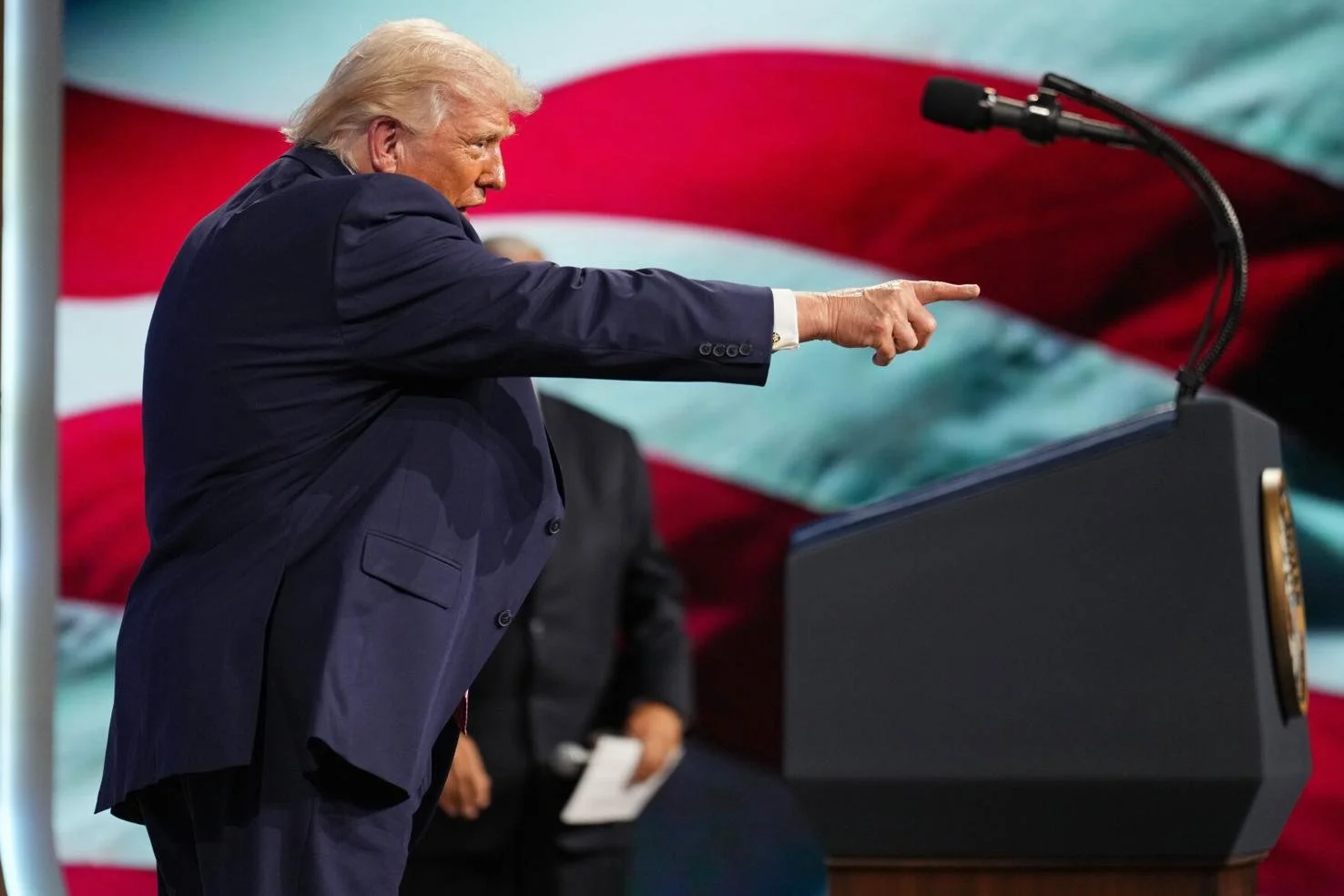
President Donald Trump speaks at the Future Investment Initiative Institute's summit Friday, March 27, 2026, in Miami Beach, Fla. (AP Photo/Mark Schiefelbein)
The United States’ recent attacks on Iran once again highlight the disparity between President Donald Trump's previous campaign claims and his military action. Trump ran on a platform of no new wars, claiming, “We will measure our success not only by the battles we win but also by the wars that we end – and perhaps most importantly, the wars we never get into.”
Indeed, one of the president’s twenty aims of his 2024 campaign was to “prevent World War Three” and “restore peace in Europe and the Middle East.” Since his inauguration, Trump has involved himself in several foreign countries, creating and also attempting to mitigate conflict.
To be fair to the president, his involvement with Israel and Palestine did produce a ceasefire. Geopolitics commentator Bobby Ghosh says Trump deserves full credit for this event, stating, “Had it been left to the druthers of Israeli Prime Minister Benjamin Netanyahu and the leadership of Hamas, there is every likelihood that the devastation of Gaza would have continued into a third year.”
Additionally, the U.S. attack on Venezuela in January resulted in the capture of dictator President Nicolás Maduro, who ignored electoral results, disenfranchised voters, imprisoned those in power and restricted food as a means of control. This is in addition to accusations of narco-terrorism, directing shipments of cocaine and working with the Cartel of the Suns, all according to the U.S. Department of State.
These are two events people may view favorably, and with good reason. We should celebrate the end of the genocide perpetrated on Palestine, and the end of dictatorship inVenezuela. But that is not what these events are. The positive rhetoric surrounding these foreign affairs evaporates when one looks at the intentions bubbling under the surface.
Following the ceasefire in October, Trump said, “This is the end of an age of terror and death and the beginning of the age of faith and hope and of God.” But this agreement has been violated over 2,000 times in just five months, between October and March, according to Al Jazeera.
Trump cannot claim he is “restoring peace in the Middle East” with such empty negotiations as the genocide continues.
Much to the opposite, not only has the U.S. been bankrolling Israel's military for decades, Trump's administration has actually sided even more heavily with Israel in the conflict than previous administrations, according to the Council on Foreign Relations.
If you want to put it in numbers, the U.S. has given over $16 billion in aid to Israel since the start of the war in October2023. The Council on Foreign Relations reports that “Since the start of Israel’s war with Hamas on October 7, 2023, the United States has enacted legislation providing at least $16.3 billion in direct military aid to Israel.” Essentially, Trump is attempting to take credit for ending a war that he largely created and funded.
Even with this being said, it was not Trump's desire for peace that led him to a ceasefire negotiation. Ghosh notes that the deal came after an attack by Israel on Qatar, saying, “This was an attack on a key U.S. ally, one that hosts 10,000 American troops at a strategic air base and has committed to hundreds of billions of dollars in investments in the U.S.—and moreover, one that has promised Trump an upgraded Air Force One.”
As for Venezuela, it is clear that U.S. involvement was purely for economic benefit. On Jan. 6, only three days after the capture of Maduro, Trump tweeted, “I am pleased to announce that the Interim Authorities in Venezuela will be turning over between 30 and 50 MILLION Barrels of High Quality, Sanctioned Oil, to the United States of America.”
Some have called a spade a spade, with TIME saying the efforts of the U.S. in Venezuela “had been framed as an effort to stymie drug trafficking and so-called ‘narco-terrorism,’” when they were really about securing oil.
Moreover, since the capture of President Maduro, few efforts have been made to change the political landscape of Venezuela. Former Vice President Delcy Rodríguez has taken over the presidency, which Trump has approved of. Rodríguez has not been democratically elected, and the previous governmental structure remains in place, leading to uncertainty about whether the state will devolve into authoritarianism again, according to Laura Christina Dib of the Washington Office on Latin America.
It seems the true success of this endeavor was getting a Venezuelan leader who would cooperate with Trump in order to secure oil deals for the United States. Once again, this is not to say that these global events are bad, but they are being sold as “solutions” to large-scale issues, when in fact these actions barely scratch the surface of these crises.
Which brings us to Iran. On Feb. 28, Trump said the U.S. had begun attacks on Iran. This was ultimately driven by pleas from Israeli Prime Minister Benjamin Netanyahu for the U.S. to support their war efforts against the nation.
“Iran is the world's number one state sponsor of terror, and just recently killed tens of thousands of its own citizens on the street as they protested. It has always been the policy of the United States, in particular my administration, that this terrorist regime can never have a nuclear weapon,” Trump said of U.S. involvement.
True, fears of Iran's nuclear program are certainly founded, as are claims of terrorism and poor treatment of Iranian people by the country's leadership. Conflict over nuclear weapons has been occurring between Israel and Iran for years, and uranium enrichment has been on the rise in Iran.
But the conflict continues weeks later, despite a majority of Americans opposing such involvement. “Trump also largely ignored recent opinion polls which found that 70% of Americans oppose military action in Iran,” says The Guardian.
Following the death of Ayatollah Ali Khamenei in these attacks, an event celebrated by many, the world was left wondering what would become of Iran, as Khamenei had been in power for decades. President Trump and Prime Minister Benjamin Netanyahu seem to think these attacks are likely to usher in a new era in Iran. There is rhetoric from these figures implying that the attacks will allow Iranians to bring about a regime change.
But, according to many, including Al Jazeera, a true change is dubious. “Analysts said the decapitation efforts were unlikely to cripple the regime,” said Justin Salhani of Al Jazeera. “Iran could possibly face gradual regime erosion driven by continued economic strain, sustained military pressure, and public discontent,” says TIME.
Trump seems to believe that American involvement will open Iran to new leadership, but war without intent is a questionable way to bring about true change.
And there is seemingly no end to this war — call it what it is — in sight. CBS News says that over 3,500 American troops have been deployed for the conflict.
Surrounding this war is continually contradictory commentary from Trump, who has said for weeks that the conflict would be short-lived. A recent Truth Social post from the President claimed the end is near, but other sources say this is far from the truth.
In the meantime, American troops die, Iranian civilians face destruction and billions are spent. One must wonder of the “no wars” president: to what end?
Trump's foreign policy seems to be an exercise in flashy shows of might for his own benefit, not that of American citizens, or the people that serve as casualties in his power grabs abroad.
“The blood of our young people has always been shed by America, so this was not unexpected,” said an Iranian mother after losing her son in a U.S. airstrike on an Iranian elementary school on Feb. 28.