Vintage Diseases Are Making a Comeback
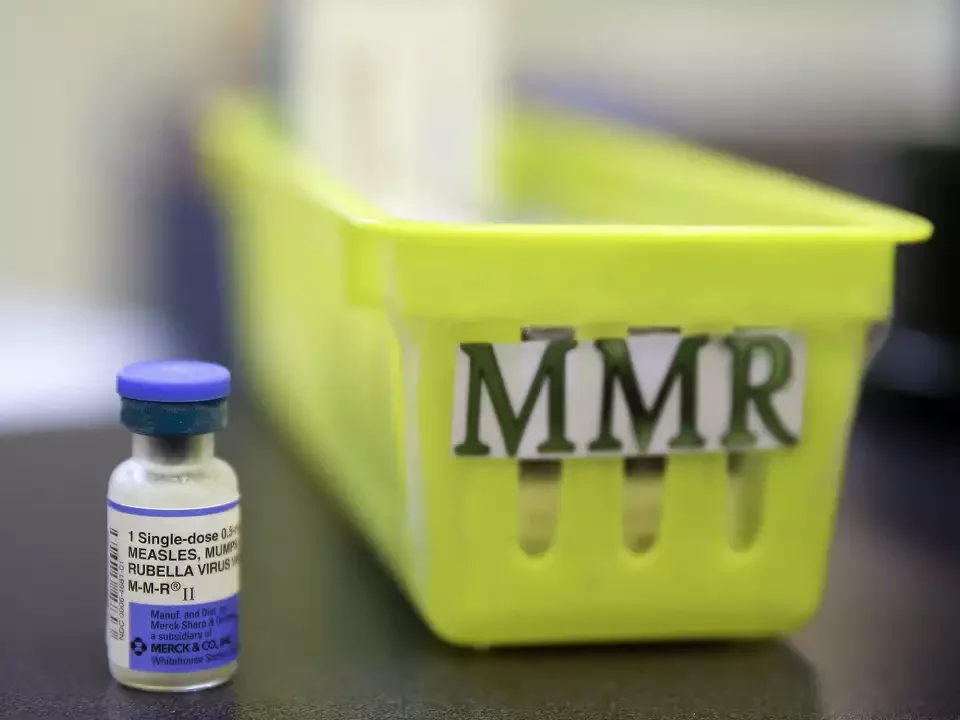
A vial of a measles, mumps and rubella vaccine sits on a countertop at a pediatrics clinic in Greenbrae, Calif., on Feb. 6, 2015. (AP Photo/Eric Risberg, File)
Measles, a disease once known mostly from childhood vaccine cards or history books, may have returned to Santa Clara County earlier than officials first thought.
And it may not be the only long-controlled disease making a quiet comeback.
County officials announced the first confirmed measles case of 2026 on Feb. 25 in a traveler returning from abroad. However, Stanford researchers monitoring sewage through the WastewaterSCAN program detected traces of the virus as early as Jan. 10 in a Palo Alto sewershed, raising concerns the disease may have been circulating weeks before the first confirmed case.
“Measles is a respiratory virus—the most contagious virus on Earth” said Dr. Krishna Surasi, Santa Clara County assistant public health officer and acting communicable disease controller.
Measles spreads through airborne droplets when an infected person coughs or sneezes. Symptoms include fever, a runny nose, cough, red eyes and an eventual rash that spreads across the body. The standard vaccination protocol includes two doses of the MMR,, or measles, mumps and rubella, vaccine: the first between 12 and 15 months of age, and the second between four and six years old.
Because measles is easily spread, even a small number of infections can escalate into a larger outbreak.
“Measles is one of the most infectious diseases around, and the vaccine works really well,” said Santa Clara University Public Health and Biology Professor Craig Stephens. “But it doesn’t take very many people not to get vaccinated for communities to fall below the threshold of herd immunity.”
Herd immunity for measles, said Stephens, is 95% or more of the people in any given community being vaccinated—with measles in particular having such a high percentage given its high transmission rate.
“If you start dropping below that, it spreads like crazy,” said Stephens.
The R₀ for measles (pronounced “R-naught”), or its basic reproduction number, is the highest of any infectious disease, estimated between 12 and 18. This means that in an unprotected population, one infected person can spread the virus to anywhere from 12 to 18 other people.
Toni Spellacy ’26, a public health major at Santa Clara University, stressed the scale of the number.
“The R-naught for the flu is one to two—that’s maybe two people, compared to measles’ 18,” said Spellacy.
Measles rates in recent years have been linked to declining vaccination rates, as anti-vaccination sentiments led parents to delay or refuse routine vaccinations.
Although the California Department of Public Health reports that roughly 95% of kindergarteners are vaccinated—meeting herd immunity requirements—there have still been two subsequent cases in 2026 in San Mateo and Napa counties, including an unvaccinated child in Napa.
Anti-vaccination sentiment gained momentum in 1998 following a study conducted by Andrew Wakefield that claimed children who received the MMR vaccine were more likely to develop autism or other regressive developmental disorders. Since then, the claim has been debunked by dozens of epidemiological studies, and the paper was formally retracted by health journal The Lancet in 2010.
However, Robert F. Kennedy Jr., secretary of health and human services, said in a November 2025 interview with The New York Times that he had advised the Centers for Disease Control and Prevention to retract its stance that vaccines do not cause autism, arguing there is “no proof that they don’t.”
“The experience with the COVID-19 vaccine was seen differently by people,” said Stephens. “The anti-vax movement got stronger, and now—with RFK Jr. in charge of health and human services—vaccine skepticism has spread.”
During the 2023-2024 school year alone, 16 counties in California fell below herd immunity requirements.
“Part of what I’ve learned about public health is that it’s not people who are stupid,” said Spellacy. “It’s people who really care about their kids and want to do what’s best for them—but there’s so much misinformation right now from people in power who we’re supposed to be able to trust.”
In response to this continued skepticism, California joined a multi-state coalition lawsuit against RFK Jr., HHS and acting CDC Director Jay Bhattacharya for their Jan. 5 memo that removed several vaccinations of their universally recommended status, on Feb 24.
“We’re very grateful to be in Santa Clara County, where we have high vaccination rates,” said Dr. Surasi. “The laws and culture in California really help us keep folks vaccinated, especially in vulnerable populations.”
Still, some public health officials and advocates worry about the implications of recent cases—and the broader state of public health infrastructure—despite ongoing efforts to encourage vaccination and educate communities.
“Public health often suffers when things are going well,” said Stephens. “By the time there’s a crisis, we’re playing catch-up. It’s not sexy, it’s not glamorous, and at the national level we have a lot of people who feel strongly about personal freedom—which I understand, that’s a natural human emotion—but there’s also a sort of anti-public health movement.”
Tuberculosis, another so-called “vintage” disease, has reemerged as public health systems have weakened. In 2022, Santa Clara County recorded the third-highest number of latent tuberculosis infections among jurisdictions in California.
Recently, a San Francisco high school was revealed to have 204 latent cases of tuberculosis among its students.
Also a respiratory illness, tuberculosis is the second-leading infectious disease killer after COVID-19, according to the Santa Clara County Public Health Department. Latent tuberculosis infection is not contagious, but it can become active weeks, months or even years later.
Because diseases can circulate undetected for long periods of time, public health researchers are increasingly turning to wastewater surveillance as an early warning system for outbreaks. WastewaterSCAN, a monitoring initiative led by researchers at Stanford University is among those testing sewage samples to track traces of infectious disease within a community across the country.
“We’re looking for the presence or absence of nucleic acid,” said Amanda Bidwell, scientific program manager for WastewaterSCAN. “People blowing their nose, spitting down the sink, going to the bathroom—it’s an unbiased way of looking at community health. It doesn’t require seeking out a doctor or even having access to one.”
Wastewater surveillance also provides an early indication of illness and generates aggregated data for the county or state, according to Bidwell.
“People can shed the virus before showing symptoms,” said Bidwell. “Wastewater can give you an idea of what might be happening weeks before it’s picked up in clinical testing.”
WastewaterSCAN currently monitors around 11 viruses, including rarely detected ones such as measles, West Nile and MPox.
“Most of the time we don’t see those pathogens in waste water, but when we do, it’s really important to look at them,” said Bidwell.
While these wastewater tools have given officials a head start in detecting outbreaks, doctors and public health professionals say that there is no substitute for vaccines, which remain the best way to protect communities against highly infectious disease.
“The best way for people to protect themselves and those around them is by getting vaccinated,” said Santa Clara County’s Dr. Krishna Surasi. “Know your vaccination status. Often, this means calling your health care provider or your school—maybe even your mom. If you can’t find evidence that you’re up to date, call your provider to make an appointment. There’s no risk in getting an additional MMR dose.”