Conformity Gate and Fan Coping
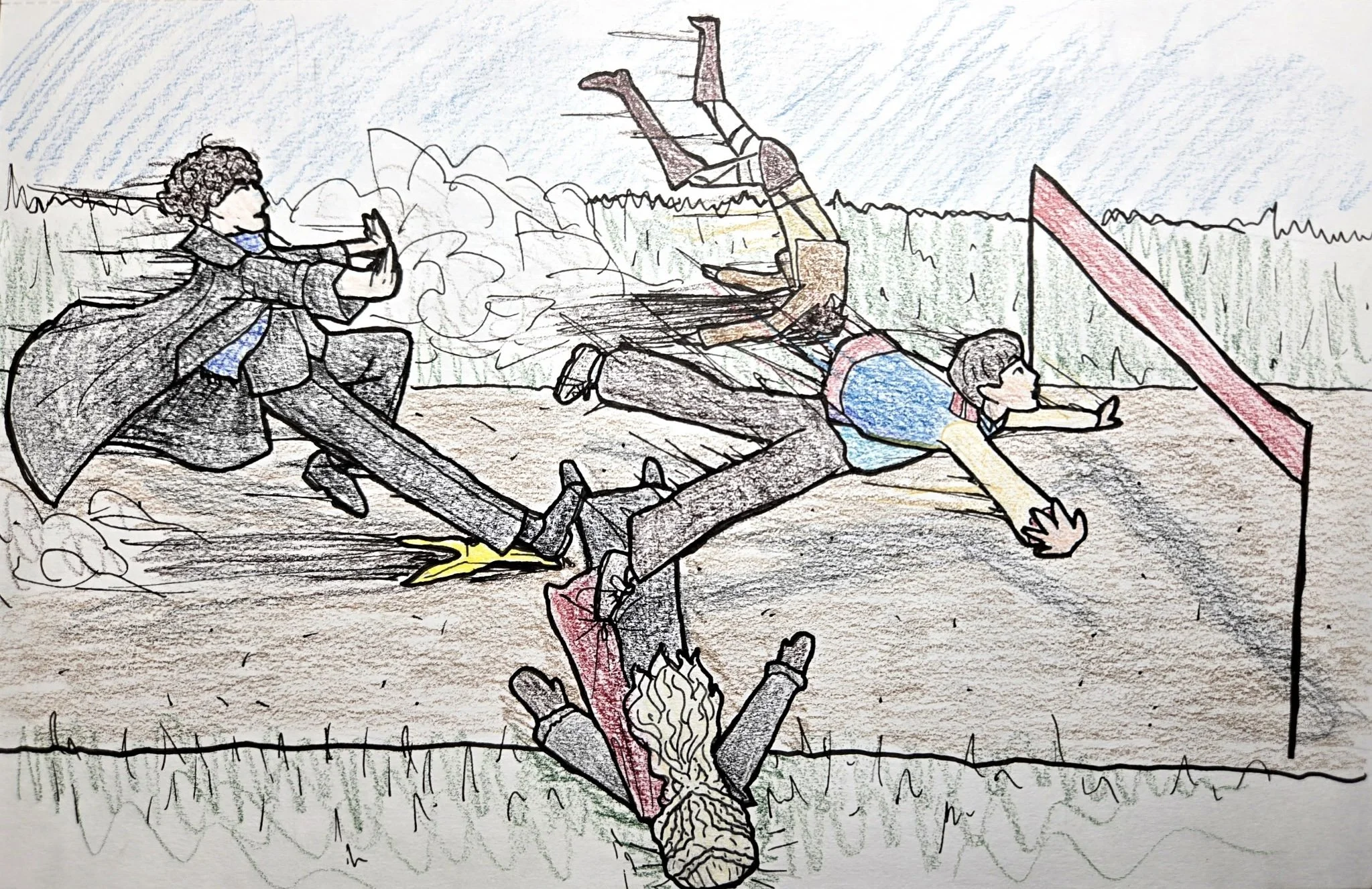
(Jenell Theobald/The Santa Clara)
SPOILERS AHEAD: “Stranger Things”, BBC’s “Sherlock”, Attack on Titan and Game of Thrones
Chapter One: “Stranger Things”
If you were on a certain side of TikTok for the first few weeks of January, it was likely difficult to avoid hearing the phrase “Conformity Gate.” As with most X-Gates in pop culture, it is named after the Watergate scandal. But why, in 2026, is the internet referencing Watergate, and what does that have to do with “Stranger Things”?
On Dec. 31, 2025, Netflix released the finale to its long-running and highly popular show, “Stranger Things”. After a relatively successful Season 4—with the two highest-rated episodes on IMDb stemming from that season—the show faced high expectations.
The first half of Season 5 received generally favorable ratings, but after the penultimate episode was released and became the lowest-rated episode in the series, some fans expressed concern that the Duffer Brothers might not stick the landing.
The finale aired, and Eleven died—possibly—but the villain was defeated, and the remaining characters happily survived. The episode did not include a major twist, and the conclusion followed a more conventional resolution.
For Netflix, however, many fans were dissatisfied with the ending. Some questioned why a show they had followed for nearly a decade would conclude with so little spectacle. For some viewers, an alternative explanation emerged. Echoing the message of Season 4, the characters’ apparent happy endings were interpreted as a form of forced conformity. The ending, according to this interpretation, could not be real. Thus, the theory known as Conformity Gate began to circulate across the internet.
“Conformity Gate is a theory that the show didn’t actually end, but that Vecna, the bad guy, was actually controlling everyone’s minds the whole time,” said “Stranger Things” Fan Avni Shah, ’28.
TikTok users pointed at many small details in the finale that they claimed were proof that, not only was the ending not real, but that it would be revealed in a secret ninth episode.
Fans of this theory looked at details like: the way students at Hawkins High School were seated during graduation, a door that appears to change positions in the background of a shot, and the presence of a board game called Whatzit—a pseudonym associated with the main villain—in several background scenes.
Speculative evidence indicated that this episode would drop on Jan. 7, 2026. Fans pointed to circles drawn on the seventh image of a picture posted by Netflix, and a clock that had the minute hand pointing to seven in the background of another post.
After Jan. 7 came and went, and no episode was out, some fans gave up.
“For a time I believed that there would be a 9th episode, but then I realized it was a false hope,” said Shah.
Others found new ways to reinterpret what they saw as a disappointing ending.
“Honestly I believe Conformity Gate even if a new episode doesn’t come out. Like, that’s just how I interpret that ending. Vecna won. If everything is up to interpretation, that’s how I interpret it lol,” said TikTok user Sheebs.
However, Conformity Gate is just one instance in a long history of fans rationalizing disappointing endings.
Chapter Two: “Sherlock”
BBC’s “Sherlock” ran from 2010 to 2017, and ended with an episode called The Final Problem.
After being scorned with yet another fakeout “he’s actually alive” from the very-dead main villain of the show, James Moriarty, fans were instead met with “Sherlock”’s secret sister who begins a plot to thwart her brother.
Despite a relatively positive IMBd score of 8.2 stars, it still remains one of the most maligned episodes of the show amongst fans.
Back in 2017—as with Conformity Gate—fans insisted that the reasoning must be because BBC would release a secret fourth episode that would address all fan grievances.
It’s been nine years since then, and to their chagrin “Sherlock”’s final season reasons firmly at three episodes.
The parallels between Conformity Gate and “Sherlock” have been obvious to some on TikTok as well.
“‘There’s a secret episode that’ll fix everything!’ Sure babe, I thought there was going to be a secret 4th episode of “Sherlock”. There's nothing special, it’s just bad writing lol.” said TikTok user jacinderblocks.
Chapter Three: Attack on Titan
Attack on Titan has remained one of the most referenced and popular anime of the 2010s and well into the 2020s, but its popularity took a dark turn on Apr. 9, 2021 when the source material, the manga, ended.
To the shock of many fans, the main protagonist—Eren Yaeger—dies, and the world moves on from the mass murder he commits until the inevitable cycle of war continues.
Fans expressed disappointment for a range of reasons, citing the plot’s cyclical structure, its treatment of fate and dissatisfaction with certain romantic pairings. While some speculated—through theories like Conformity Gate and “Sherlock”—that a secret extra chapter might exist, others looked to adaptation for a more definitive ending.
One TikTok user—Elijah.M—posted over 100 videos citing his evidence for why the anime would change the manga ending, looking at things like eye color and the position of Eren’s head when he is killed.
Although the finale did make some subtle changes that made some characters’ sacrifices more meaningful, come November 2023, there was no change that overwrote the manga ending, which remained largely the same.
“What it’s like listening to people talk about the Conformity gate theory but you remember how mfs were genuinely theorizing that AOT would get an anime original ending back in 2023,” posted TikTok user Bazelmon.
Chapter Four: Game of Thrones
Any discussion of series finales would be incomplete without examining the final seasons of Game of Thrones.
The Game of Thrones books are still not complete, and that forced show creators David Benioff and D.B. Weiss to eventually diverge from the non-existent source material. Although author George R. R. Martin told them the ending he had planned for the seventh and final book, they were left to their own devices on how to get there.
IMBd ratings remained strong through the now-original seasons 6 and 7. However, when it came time to end the show in 2019, fan reception fell off hard, with the despised finale remaining at a 4/10 stars on the same website.
“I understand a lot of general disappointment because [the show] seemed like a lot of the plot lines were building up to things that didn’t end up mattering… I think the ending didn’t follow from some of the buildup and it felt rushed,” said Charlotte McManus ’26. “I would consider whatever Martin writes canon, but it would probably impact my perception of the show.”
In the end, Conformity Gate is well past its supposed due date, and a recent documentary about the last episode seems to have finally nipped the idea in the bud.
Unfortunately, sometimes endings just don’t please everyone.