The Transfer Portal has Become College Football’s Biggest Nightmare
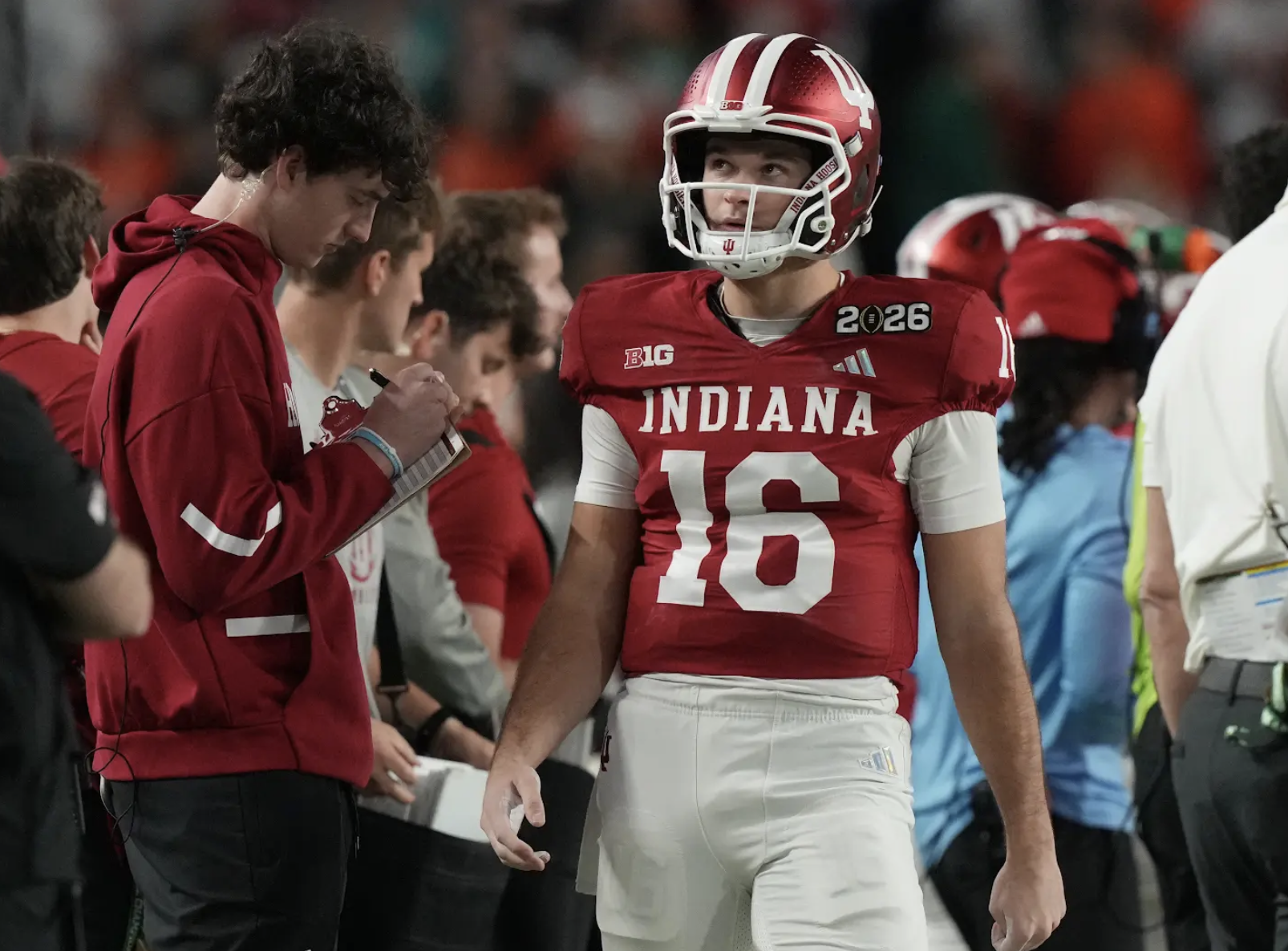
Indiana University quarterback Alberto Mendoza, younger brother of Heisman Trophy winner Fernando Mendoza, entered the transfer portal immediately following the National Championship game on Monday. (AP Photo/Marta Lavandier)
The transfer portal is now open for just two weeks for Division I college football players. In this narrow window, players and teams alike are expected to make many important career-defining decisions.
For the players, that involves whether to stay put, renegotiate their value or uproot their lives in search of more money, more player time or a better situation elsewhere. For the coaches, decisions about which players to retain, who to target in the portal and how to keep their staff from looking at positions elsewhere.
Read that again. This is college football, not the NFL. What are we talking about?
In previous years, the portal operated under two windows—a winter one in December and another after spring practice—giving players plenty of time to decide whether to stick it out at their school or look for better opportunities.
This move to a single, shorter window—plus more restrictions on athlete pay—were lauded as a success of the House v. NCAA settlement. In theory, it would slow the chaos and restore some structure to a sport that badly needed it.
And yet, with more than 3,350 players entering the portal—roughly a quarter of all FBS scholarship athletes—college football has entered an era of free agency that still lacks guardrails and effective leadership. So what went wrong?
The transfer portal was initially introduced as a corrective measure, giving players long-overdue mobility and leverage in a multibillion-dollar industry reliant on their talents. It has now morphed into something far more volatile and destructive.
Today, it is an unregulated marketplace where money talks and stability is a luxury very few programs can afford.
At the heart of this dysfunction is the relationship between the portal and Name, Image and Likeness. The House v. NCAA settlement was supposed to create new guardrails for athlete compensation. A $20.5 million cap on revenue-sharing and a requirement that third-party NIL deals not be “pay-for-play” were instituted to create much-needed structure in the industry. And yet, schools and their collectives are now paying athletes even more money as they become more aggressive and creative in pursuing legal gray areas.
This cycle has produced scenarios that would have been unthinkable just a few years ago. University of Washington star quarterback Demond Williams entered the portal just days after signing a binding contract with the Huskies, prompting the university to explore legal action. The University of Wisconsin is suing the University of Miami for alleged tampering. These are no longer just recruiting battles—they’re legal disputes. Over the “rights” to college athletes.
Roster chaos has become routine. After Penn State hired Iowa State head coach Matt Campbell to fill their vacancy, the Cyclones lost over 50 players to the portal, 16 of which were starters. How do you recover from that?
University of Texas pass catcher Parker Livingstone, one of the team’s leading receivers, left the Longhorns for rival Oklahoma after contract disputes. Oregon lost two running backs in the middle of its College Football Playoff run. South Carolina retained star quarterback LaNorris Sellers only to watch nearly its entire offensive line walk out the door days later.
These are just a few examples. There is still a developing situation with Duke University quarterback Darian Mensah, who is supposedly bound for Miami with compensation near eight figures despite legal language stating no other school can compensate Mensah without the Blue Devils first terminating his contract. The message here is clear—no relationship, message or promise is secure. Everything is transactional.
Administrators hoped that this new, consolidated portal window would restore even a little sanity to the process. Instead, the chaos is just more pronounced. For coaches and team leadership, December has now become a month of simultaneous postseason prep, high school recruiting, roster retention, contract negotiations and transfer portal recruiting. That is not sustainable.
For players, the portal offers new opportunities, but also significant risk. Many enter with hopes to receive a bigger payday or more playing time, yet there is no guarantee of either. When the portal officially closed on Friday, Jan. 16, there remained thousands of players that had not found a new home. Many will not be accepted back by their previous school, and might be forced to drop down a level or step away from football altogether.
End-of-season meetings once focused on development now resemble contract negotiations. Some players are told they can only stay if they take a large pay cut, and others walk in with agents and parents demanding prices that schools cannot match. At the highest levels, programs are assembling rosters costing more than $25 million. That might include name, image and likeness deals, fancy cars or luxury apartment rentals. For college kids.
More and more every day, college football is moving farther away from any traces of amateurism that remain in the sport. The symbolism of this shift is hard to miss. Coaches essentially have to re-recruit their rosters every year. Schools are hiring former NFL executives to manage salaries, contracts and roster construction.
“The portal isn’t the issue, it’s the calendar,” a Power Four head coach told CBS Sports last week. But even that diagnosis feels incomplete. Teams competing deep into the College Football Playoff are now negotiating NIL deals and scouring the portal to help create next season’s roster, all while preparing for a National Championship.
College football did not arrive here by accident. This is the product of half-measures, missing leadership and a refusal to recognize what the sport has become. Until a structure grasps this reality, the chaos will continue, and only the strongest, wealthiest and most adaptable programs will survive.