One Year of Trump 2.0: The Architecture of an Autocracy
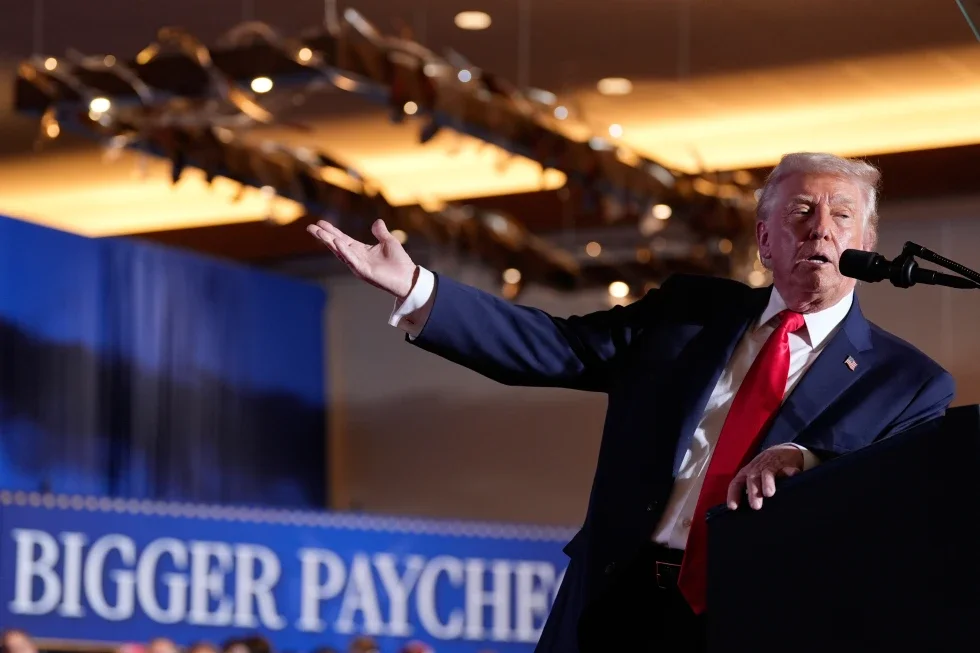
President Donald Trump gestures to a chart as he speaks at Mount Airy Casino Resort, Dec. 9, 2025, in Mount Pocono, Pa. (AP Photo/Alex Brandon, File)
In March of 2025, I wrote about the forcible detention of Mahmoud Khalil, a Palestinian protestor, describing it as emblematic of a “continued authoritarian shift” in the Trump administration. Nearly a year later, it is difficult to overstate how fully that warning has actualized.
As of writing this, President Donald Trump’s administration has undertaken more than 2,300 documented actions during his second term that reflect autocratic practices—those that jeopardize democracy in favor of a dictatorship. The president himself signaled this departure from global norms recently, telling The New York Times that international law is no longer a constraint: “My own morality. My own mind. It’s the only thing that can stop me.”
The central irony of Trump’s second inauguration—one year ago this week—is the gulf between his “America First” rhetoric and what has effectively become a “donor first” governing model. He returned to office promising economic relief, even as 23 Nobel Prize-winning economists described former Vice President Kamala Harris’s plan as “vastly superior.” Immigration was another pillar of his campaign—Trump insisted: “They’re taking your jobs!”—a highly exaggerated claim, as the native-born unemployment rate was the lowest on record in April of 2023. Ultimately, voters hoped that this new government would materially improve their lives.
It has not—Americans have borne 96% of the cost of Trump’s tariffs. But Trump has prospered. By September, his personal wealth had nearly doubled. Over the same period, the combined wealth of the 15 richest Americans increased by nearly $1 trillion—a 33% surge. To finance a new White House ballroom—for which he tore down the East Wing—Trump has turned to a slate of individual and corporate donors. The plan is beset by conflicts of interest, as these entities donated to a Trump project in exchange for a specific benefit. In fact, many of those same donors later received government contracts, are—or were—facing antitrust or Securities and Exchange Commission-led litigation, or stood to gain directly from deregulation.
The normalization of profiteering from governance has spread beyond the president himself. Prediction market platforms such as Kalshi—along with its now-billionaire co-founder—and Polymarket now invite users to wager on deportation totals, Israeli bombing campaigns and even the length of White House briefings. Last week, Press Secretary Karoline Leavitt abruptly ended one such briefing just seconds before the 65-minute mark, triggering losses for 98% of bettors. Allowing those in power to influence outcomes that others are betting on creates a world in which corruption essentially operates as a business model.
Nowhere has this logic become clearer than in immigration enforcement. Under the direction of senior White House officials, Immigration and Customs Enforcement—known more commonly as ICE—has been instructed to arrest 3,000 people per day. Since late September, the majority of those detained have had no criminal conviction. As arrest numbers rise, the share of those with criminal records falls—a pattern possible only when removals are increasingly prioritized over public safety. Violations of immigration law are civil offenses, not criminal, yet detainees report being denied medical treatment, coerced into self-deportation and “violent assaults and sexual abuse by officers.” These abuses are facilitated by an intentional lack of information from ICE regarding the whereabouts of those imprisoned.
The consequences extend beyond noncitizens. In Vasquez Perdomo v. Noem, the Supreme Court granted immigration agents the right to interrogate any individual about their legal right to be in the United States—even if that reason is race. Since then, ICE has, according to ProPublica, “dragged, tackled, beaten, tased and shot” Americans. Over 170 citizens were held by ICE without cause, some for over 24 hours, unable to phone a lawyer or loved ones. In a few cases, ICE has even deported U.S. citizens without cause.
The domestic deployment of such agencies has become commonplace, as federal law enforcement has infiltrated our cities. Trump has sent the National Guard to Los Angeles, Washington, D.C., Memphis, Chicago, New Orleans and Portland—a move later rebuked by the Court—creates a climate of intimidation without any underlying emergency to justify it. ICE, though, has allowed 32 people to die in their custody during 2025 alone. Just last week, ICE agent Jonathan Ross killed Renee Nicole Good in Minneapolis, shooting her three times in the face before a voice in the background says, “Fucking bitch.” That same day, ICE raided a Minneapolis high school. One day later, two more people were shot by ICE in Portland during a traffic stop.
Domestic policy more broadly has prioritized reducing regulation over economic stability. Through an executive order restricting states’ ability to regulate artificial intelligence, the administration has effectively shielded a handful of tech titans from accountability, on the grounds that their technologies are critical to national defense. As these conglomerates pour hundreds of billions of dollars into AI systems, even without any substantive return on investment, American consumers pay the price. In several states, energy bills have skyrocketed by as much as 267% as Wall Street firms acquire utilities, prioritizing power for data centers over homes. By treating critical infrastructure as a private playground for his donors, Trump is transforming the American economy into a subsidized plutocracy—a society serving the elites, by the dollar.
Risk is systematically pushed downward. These giant companies offload volatility onto smaller companies, lenders and consumers through circular deals. Warnings of an AI-driven asset bubble have grown louder, and scientists warn of the extreme danger that AI poses. Even the companies behind large language models admit they fail to understand how their technologies actually work. OpenAI CEO Sam Altman has stated that he believes AI will “lead to the end of the world,” though it would create “great companies” in the process. The tradeoff is telling.
Regulatory collapse has extended into public health. Under the direction of Robert F. Kennedy Jr., the Department of Health and Human Services reduced the number of recommended routine vaccinations from 17 to 11. Kennedy has spent decades working to dismantle vaccine policy, despite overwhelming evidence of its safety and effectiveness. Rising vaccine skepticism has coincided with the worst measles resurgence in decades, jeopardizing the nation’s “measles-free” status. Though new dietary guidelines recommend reducing processed foods and prioritizing fruits and vegetables, they have elevated red meat as a protein and removed limits on saturated fats, contradicting decades of nutritional research linking each to heart disease and cancer. Throughout this change, the president has amplified false claims linking Tylenol to autism.
Internationally, the record is equally bleak. The administration’s decision to shutter the U.S. Agency for International Development, USAID, has dismantled a global safety net that saved 92 million lives over two decades. The human cost of that decision is staggering—already numbering in the hundreds of thousands—and will only grow. Many of the diseases USAID worked to eliminate, including HIV and tuberculosis, frequently take months or years to kill a person, masking the long-term consequences of withdrawal.
In his inaugural address, Trump promised to measure our success by “the wars that we end [and] the wars we never get into.” He has failed to end the war in Ukraine and has conditioned support on his personal belief that Russia will not invade again. And, contrary to encouraging peace, his administration has threatened a plethora of nations, including Greenland, Cuba, Colombia, Mexico, Iran, Canada, Panama, Nigeria, Syria, Norway and Nicaragua.
After months of bombing alleged drug boats—some using aircraft painted to resemble civilian planes—the United States intervened in Venezuela and captured the authoritarian Nicolás Maduro, killing over 100 people in the process. Though it brought hope to many Venezuelans living in de facto exile, Trump’s actions were far from altruistic. Rather, he claims the United States will “run” Venezuela indefinitely, assuming control of the nation’s oil reserves in the process. He also refused to restore democracy in Venezuela, apparently because the opposition leader failed to reject the Nobel Peace Prize and subsequently pass it to him.
Throughout all of this, the president’s erratic behavior has become increasingly difficult to dismiss. He routinely makes demonstrably false claims, including incorrectly claiming his uncle taught the Unabomber at MIT—the terrorist Ted Kaczynski did not attend MIT. He appears disengaged and has even repeatedly fallen asleep during critical meetings. He displays an alarming disregard for basic facts, just as he mistook Albania for Armenia. His hands are perpetually bruised as he takes four times the recommended daily dose of Aspirin. He frequently circulates an ever-increasing number of incredulous AI videos on his personal social media accounts.
But it isn’t all just geriatric incompetence: his administration openly embraces authoritarian imagery and dismisses constitutional limits as inconveniences. ICE has begun going door-to-door in Minneapolis, reminiscent of Nazi practices. Trump refers to migrants as “animals.” Vice President JD Vance once compared Trump to Hitler. Scholars on fascism have begun to leave the US, citing the current political climate. On Trump’s Inauguration Day, Elon Musk—the world’s richest person—apparently did a Nazi salute. According to independent Special Counsel Jack Smith, Trump, “beyond a reasonable doubt,” engaged in a “criminal scheme” to overturn the results of the 2020 election. And 210 Jan. 6 criminal defendants have claimed that Trump incited their assault on the Capitol. The defining feature of Trump’s brand of fascism is that he seems to hold the richest 1%—not the nation—in the highest regard.
The endgame is no longer a secret. Susie Wiles, the White House’s chief of staff, recently described him as having an “alcoholic’s personality.” The New York Times recently published an opinion piece outlining the addictive nature of power. Russel Vought, director of the Office of Management and Budget, mused about ensuring career civil servants were “traumatically affected.” Deputy Chief of Staff for policy and Homeland Security Advisor Stephen Miller has already argued that the president possesses “plenary authority,” defined as complete and unrestrained power. Just last week, Trump boasted about his accomplishments, arguing that they were so impressive, “We shouldn’t even have an election.” Trump has openly flirted with a third term, directly challenging the 22nd Amendment. He also declared, “I run the country and the world.” These are statements of intent, representing the ultimate goal of the “donor first” government: to remove the inconvenience of elections and constitutional limits entirely, ushering in an era of hypercapitalist fascism.
Much of this has come to feel disturbingly “normal.” I urge you to remember that it is anything but. Trump’s second term has fused personal enrichment, state violence, and open contempt for accountability into a single governing philosophy. The danger lies not only in any individual policy but in the steady normalization of the idea that power exists to be exploited. What we are witnessing is a growing conflict between a plutocracy and any meaningful version of populism that prioritizes the common good.
Take Trump at his word. When a leader believes that the only restraint on their power is their “own mind,” then the transition to autocracy is already well underway. This year simply laid the groundwork for what is to come. His administration continues, deliberately, to dismantle the checks and balances that are so central to democratic governance and freedom. And yet, there remains a critical truth: these actions reflect the will of a minority, not the nation as a whole.
The United States is not yet an autocracy. But it will become one if the judiciary and legislature continue to capitulate. Complacent representatives must be reminded—publicly and relentlessly—of their responsibility to the people they serve. Institutional resistance matters, but it is insufficient on its own. Only sustained collective action can prevent the erosion of a fragile democracy.