Is Journalism Dead?
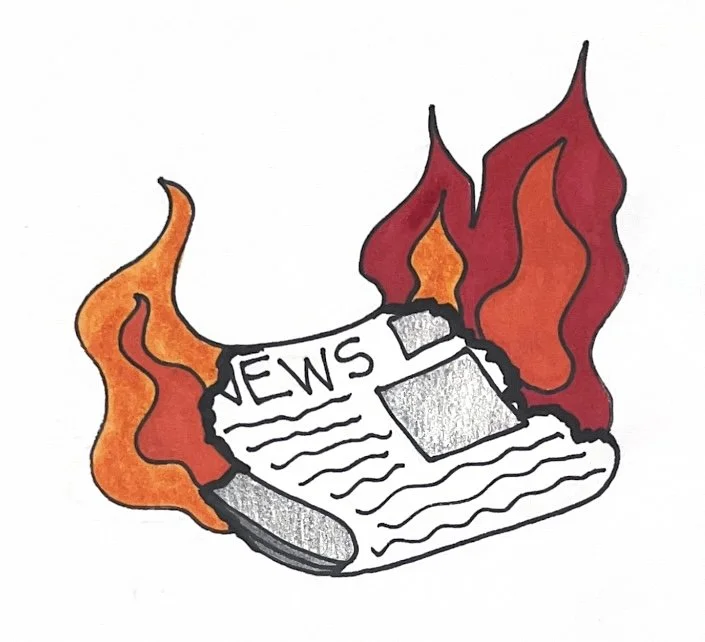
Graphic by Evelyn Crothall
William Randolph Hearst—a powerful media mogul of the 19th century—is often allegedly quoted as saying, “You furnish the pictures. I'll furnish the war.” It speaks to a time when only a few large newspapers dominated the public imagination and flow of information. These few press barons could make or break an election—or even a war. Print had the power to move mountains.
We have thankfully, gratefully, moved beyond such times—but what times have we moved into?
Gone are the days of print newspapers, says this writer, whose words shall be printed in ink on one of those few remaining newspapers. Many large news companies have made the vital move online, especially to social media, but that means news has largely been reduced to mere seconds.
Yet, inaccurate and false information dominates the flurry of media we find on social media or even broadcast news.
So the question remains: Is journalism dead? Unfortunately, local news organizations have largely seen their demise.
“Local community is where we have the most in common,” said my professor and professional journalist Lisa Davis, who teaches journalism courses at Santa Clara University. “If all we read is from a national perspective, you’re less likely to be reading about important information in news where your community actually comes together to work something out.”
With the few remaining major players only being large, national news companies, and the collective chaos of social media, there seem to be endless options. And yet, we have far fewer trusted and respected news sources than in the past.
“Here’s the problem,” said Davis about the proliferation of misinformation as news has shifted from traditional media to the internet. “I think in the industry we’re so focused on survival, we never really educated the public on how to think about that. And that was a mistake because the public still largely doesn’t understand what they’re looking at … media literacy is a huge deal.”
Dreary, though this may sound, there is hope!
Local community journalism is one of those places where we have the most in common because we share so much of our community—the restaurants, schools, crimes, and places that people call home. That’s why, in recent years, efforts to revitalize community news organizations have sprung up through foundations and universities in the hopes of preserving and giving resources to these smaller local newspapers.
Not to sell my own wares, but the flow of information—good and truthful reporting—had and still has a vital place in our society.
“Journalism has never been more important. It plays a very important role in democracy,” said Davis. “Which is to say that when a public is not appropriately—meaning accurately—informed then they are not able to make informed choices.”
I think that we’re in a new era of the proliferation of information—the information age—as some have called it. News has already changed drastically in ways we never could have imagined—but good local journalism might just be the key to regaining that sense of trust and commitment to the community that has been lost.
So, is journalism as we know it dead? Davis responds without hesitation: “Absolutely not.”