Just Because You Don’t See it, Doesn’t Mean it isn’t There
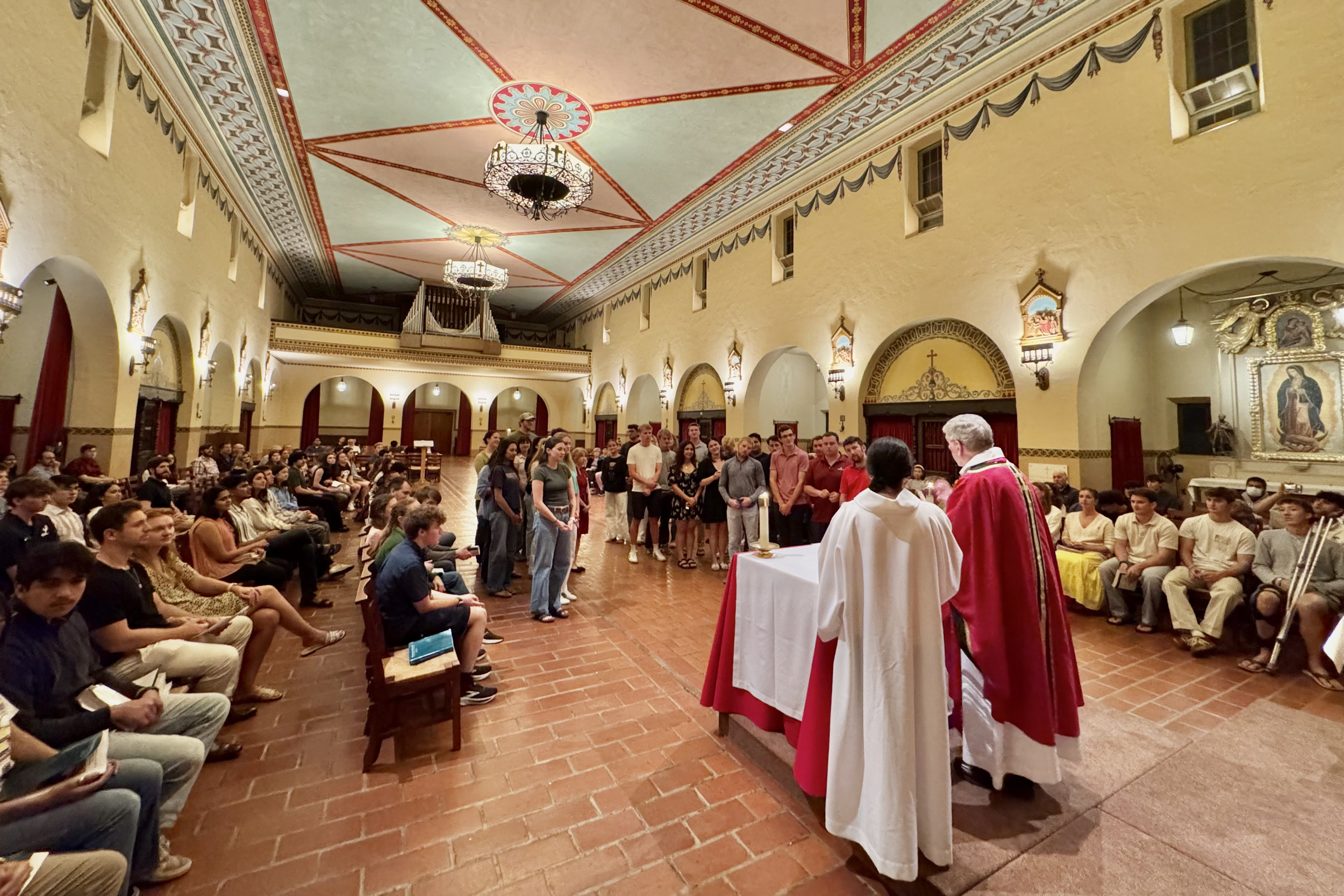
Students participate in student mass—held weekly in the Mission Santa Clara de Asís at Santa Clara University. Student mass is held weekly on Sundays at 8 p.m. (Photo by Flavio Olivieri, Courtesy of Katie Castillo)
Most students at Santa Clara University can be found at home on a Sunday night, decompressing from a day spent in the library or paying the price for Saturday’s fun. Others—a friend’s apartment, out to dinner, calling home or already tucked in bed in anticipation of an early Monday class.
For students Katie Castillo ’26 and Nathan Tu ’27, Sunday night is spent just slightly behind and a few steps up from the altar at the Mission Church—where the two music liturgical interns sit every week, helping lead the songs of worship for the 8 p.m. student mass.
The 8 p.m. mass is a “community builder,” said Castillo. It’s there for students, and the liturgical team anticipates the weekly possibility to make a connection with whomever may have chosen to come through the door.
“All of the homilies are at the students, all of the preaching is going to be mentioning your finals,” said Castillo. “It’s going to be mentioning, ‘it’s week 10,’ ‘oh, this event was happening on campus. I wonder if you were there.’ And like all of the Fathers are going to engage with us as a community, as a whole.”
The intimate weekly service has seen steady growth in student engagement numbers—attendance reportedly increased by 57% over the past two academic years, per the Santa Clara Magazine.
“It’s just been very meaningful,” said Tu of working in the church. “And I think especially in the Mission, which is a very beautiful place, it’s just brought a lot of purpose into my life and my college friends too.”
Despite flourishing engagement, and the considerable host of campus organizations and departments dedicated to the Jesuit flagship, the religious aspect of University life seems still to remain largely invisible to much of the student body.
“I feel like a lot of people forget we’re Catholic, like that we have that Jesuit identity,” said Castillo. “I don’t know if everyone, like if there wasn’t a Mission in the middle of the school, I don’t think people would see it.”
The lack of visibility from the greater student body doesn’t indicate a lack of community—rather, the religious environment on campus offers a home for many students. But as a university in the diverse Bay Area whose students represent a multitude of religious identities, the presence of faith in University life and curriculum is more multifaceted than meets the eye.
Religion in comparison
In the United States, the modern concept of a religious university conjures a considerable image, one that builds a reputation of religious affiliation as something that dominates the university’s identity—and looks the same across the board.
But as schools take root in different areas and welcome students, faculty and staff of varying denominations and identities, the mission adapts.
“Every Jesuit school has a slightly different mission based on where it is,” said Fr. Matthew Carnes, vice president of mission and ministry at the University.
“So, you know, Georgetown in Washington D.C. was very much about all these political forces coming together, and you had all these people kind of fighting over those things, but also kind of needing to find common ground,” he said. “Here, it’s much more around innovation. It’s around change. It’s a place that’s embracing of change. It’s embracing of diversity, you know?”
In comparison to other Catholic behemoths like the University of Notre Dame and Boston College, or even notable institutions like LDS-dominated Brigham Young University or Christian-affiliated Grand Canyon University, Santa Clara University’s religious identity appears to many as less prominent.
But behind appearance lies an important deviation—the University serves a student community far more diverse, both in religious affiliation and individual identity, than many of these major institutions.
More than 80% of the student body at Grand Canyon subscribes to Christianity, and at BYU, the number of non-LDS students make up a mere 1% of overall enrollment. At Santa Clara University, only around half of the undergraduate population identifies as Catholic.
“In some ways, it is a much easier world to be in if everybody is like me,” said Fr. Paul Soukup, a communication professor at the University. “But as a matter of fact, we live in this multi-faceted world.”
Bay Area roots and a diverse, multi-faith student body help to shape the University’s approach to religious identity through encouraging dialogue about how a religious presence can be inclusive and have respect for all—from the University’s Catholic population, to its students of other faiths, to those who have no relationship with religion at all.
“It’s more diverse than some other university communities I’ve seen,” said Carnes. “And I think all of that enriches who we are, and then ultimately the conversations around faith.”
The University’s Jesuit mission emphasizes that the doors are always open to those who want to get involved through their faith, but that the journey isn’t forced, and it’s not going to look the same for every student.
“I think the University is trying to be a university, in other words, something that is broadly oriented,” said Soukup. “It’s not a religious school, it’s not a seminary, and so we’re not looking to be a catechetics program to teach people, you know, about faith only, but to look at, okay, what is the role of religion and belief in your life and society.”
A relationship between religion and curriculum
When it comes to integrating faith with curriculum, similar considerations arise.
The University has integrated enrollment in three Religion, Theology and Culture—or RTC—courses as part of their core curriculum, one of the few areas where a direct engagement with religious ideas is required.
Although the core requirement is mandatory, the University’s religious studies department emphasizes providing a wide range of possible classes to fulfill the requirement to help students avoid feeling restricted.
“We want to try to offer as many entrees into understanding and learning religion as we can, and as many connections for our students,” says James Bennett, chair of the University’s religious studies department. “And increasingly, given the religious diversity of our student body, and we’re one of the most religiously diverse areas of the entire country, we want to reflect that and represent that.”
Priority is also placed on reflecting similar ideals in the makeup of the department’s faculty—hoping students’ willingness to engage with curriculum will be fostered by learning from instructors that mirror their own diverse identities.
“I think it’s important for students to see themselves in the faculty at large and connect with and I think it’s important that we have the broadest possible understanding of what religion is, and how religion is, to be faithful to what we’re doing,” says Bennett. “So yeah, I think that’s very important, and we’ve really very explicitly tried to have that shape our hiring and where we see ourselves going.”
Through such considerations, the department hopes to help students connect meaningfully with faith on their own terms.
“I think that the Ignatian perspective on the world is of great value, regardless of your own and I’ve really come to appreciate that again, we can kind of provide the legs for that, the theological underpinnings, the ritual underpinnings, all that sort of thing as we send students out to make a difference,” said Bennett.
For those on campus that have roles both in the Jesuit community and University faculty, giving students a way to see intersectionality on display through their roles builds student perspective on what religion in education can look like, beyond what may be most expected.
“Most of the time, I teach in clerical attire, because I want them to see that actually a person of faith can be an intellectual and an academic who is not constantly like saying, ‘Okay, I’m going to convert you,’” said Carnes. “It’s much more about, let’s really do some deep dives on the empirics of who’s practicing faith and what does that look like, or who’s, you know, where’s democracy, that’s one of the big topics in my class.”
Finding the balance
To join religion and education in a way that feels timely and respectful, Santa Clara University’s religious community members affirm that the goal for the relationship between students and their faith is grounded in simple means: to find meaning, however that looks for each student.
“Given all of the things going on in this kind of age group coming into adulthood, people are looking for meaning, and you know, some will find it in exploring their own spirituality or exploring the traditions of spirituality,” said Soukup. “Others are going to find meaning sometimes in an academic pursuit.”
Forging the relationship is an ongoing journey—and those at the University remain open to discovery on how it can be done better to serve all students.
“The Jesuit vision and nation spirituality has always been really broad in terms of welcoming people wherever they are,” said Carnes. “And so on one hand, we really want to be open to everybody. On the other hand, we’re really proud, and we think the Catholic tradition has a lot to say. And so how can we draw on that in ways that are meaningful to our students?”
As the University and other institutions like it grapple with how to promote their faith-based ideals while remaining respectful to diverse, individual student bodies, the emphasis remains on finding the balance.
“Religion is like someone putting out a hand to you,” said Castillo. “You can choose to grab it, or you don’t have to. It’s your choice.”