Trump’s College Sports Gambit
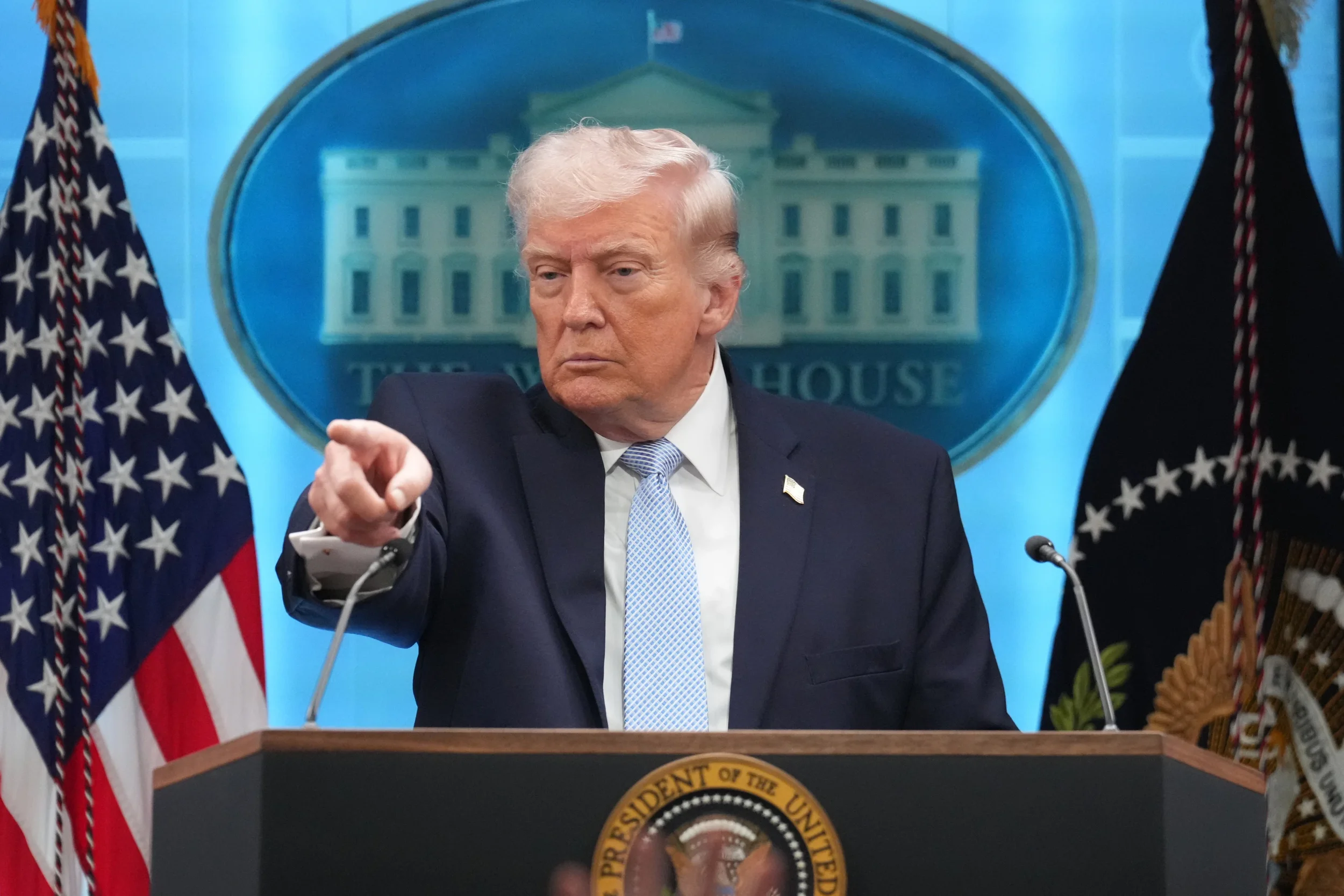
President Donald Trump speaks with reporters during a news conference in the James Brady Press Briefing Room at the White House, Monday, April 6, 2026, in Washington. (AP Photo/Mark Schiefelbein)
On Friday, President Trump signed an executive order he hopes will reshape college athletics. Titled “Urgent National Action to Save College Sports,” the order tells federal agencies to evaluate whether violations of certain rules should affect a university’s eligibility for federal grants and contracts, while also pushing the NCAA toward stricter transfer and eligibility rules.
The order is being sold as a dramatic rescue for the college sports system. In reality, it is better seen as an attempt to push the NCAA, universities and Congress toward rules the administration wants, even if the White House doesn’t actually have the legal authority to impose all of them on its own.
Most importantly, the order tells the NCAA’s governing body to move toward a stricter eligibility and transfer portal model, including a five-year participation cap, a ban on pros returning to the college level and a one-time immediate eligibility transfer rule before graduation.
“College sports cannot function without clear, agreed-upon rules concerning pay-for-play and player eligibility that can’t be endlessly challenged in court, as is the case now,” the White House said in a news release.
The order is to go into effect on August 1. However, there are many structural problems
An executive order cannot, by itself, rewrite the antitrust law or just erase judicial decisions that have already impacted NCAA restrictions. The House v. NCAA settlement, approved last summer, allowed Division I schools to directly share revenue with athletes, with a cap at approximately $20.5 million per school.
Obviously, schools have found loopholes to spend more money than this, especially on football rosters. But, it reinforced the trend that major changes to compensation and governance are being driven by government and negotiated settlements, not by the NCAA.
In other words, Trump is trying to restructure limits that the courts have spent years dismantling. The order itself practically concedes that judges will likely have the final say. That is why the Aug. 1 deadline should be seen as more of a political one than a guarantee that the new rules will go into effect.
The order also says those NCAA-style rule changes are to be made only “to the extent permitted by law and applicable court orders.” For once, the administration knows it is trying to force order onto a system that has very little; a system that has been blown open by antitrust litigation and skepticism toward restrictions on player movement and compensation.
Unfortunately for those excited about this new order, a federal judge will likely strike it down before it goes into effect. ESPN reported that multiple lawyers who work with colleges or athletes believe judges would likely find the order unconstitutional or unenforceable if challenged. Trump himself reportedly acknowledged in March that his administration would likely be sued.
Let’s equate this to a chess move. Trump’s order is like a flashy queen sacrifice, but one done with a purpose. It’s dramatic, aggressive and forces a reaction. It may not survive all the way to the endgame, but that is not necessarily its purpose; it shifts attention and opens the board up politically.
That is why the order still matters even if a judge blocks or narrows it. If the order fails to hold up in court, it may still work as intimidation. Its mere existence puts pressure on the NCAA, but also on Congress. It gives federal agencies and legislators a framework to investigate whether certain practices, like the current transfer and eligibility regulations, should affect schools’ federal funding relationships.
The Trump administration has repeatedly threatened universities’ federal funding as a governing and power ploy in his second term. Trump has already pulled federal funds from universities as a negotiating tactic in other areas, with mixed results, including an instance in which a federal judge prevented the administration from withholding funds from Harvard over a separate executive order issue.
AP also reported that a federal judge in Boston issued a preliminary injunction halting the administration’s effort to require public schools in 17 states to produce admissions-related race data.
It would not be surprising to see the administration use this same intimidation tactic in the athletic world. They are willing to push universities—albeit for other purposes—and courts are left to clean up the legal mess afterward. The NCAA may also feel pressured to move closer to the White House’s preferences, not because the order is perfect but because the costs of resistance are too large.
In a more perfect scenario, Congress could also finally decide to pass a law in this field. The White House explicitly says in the order that Congress is “strongly encouraged” to pass legislation quickly. There is and has been bipartisan support in both the House and the Senate to get that done.
Unfortunately, getting things done has become a rarity in the federal legislative body. But maybe some executive power could be the boiling point? One can only hope. Trump’s order may increase the sense that Congress either writes the rules itself or leaves the issue to courts and a president who is happy to govern by threat.
That, in the end, is what this order really is. Not stable legislation, but a power move. The August 1 deadline is real on paper, but whether the eligibility and transfer changes are truly in force by then is much less certain.
The much stronger prediction is that the order will pressure institutions immediately, invite lawsuits the moment enforcement gets serious, and intensify the push for Congress to finally take meaningful action on something it has avoided for years.