Between Faith and Identity: LGBTQ+ in the Church
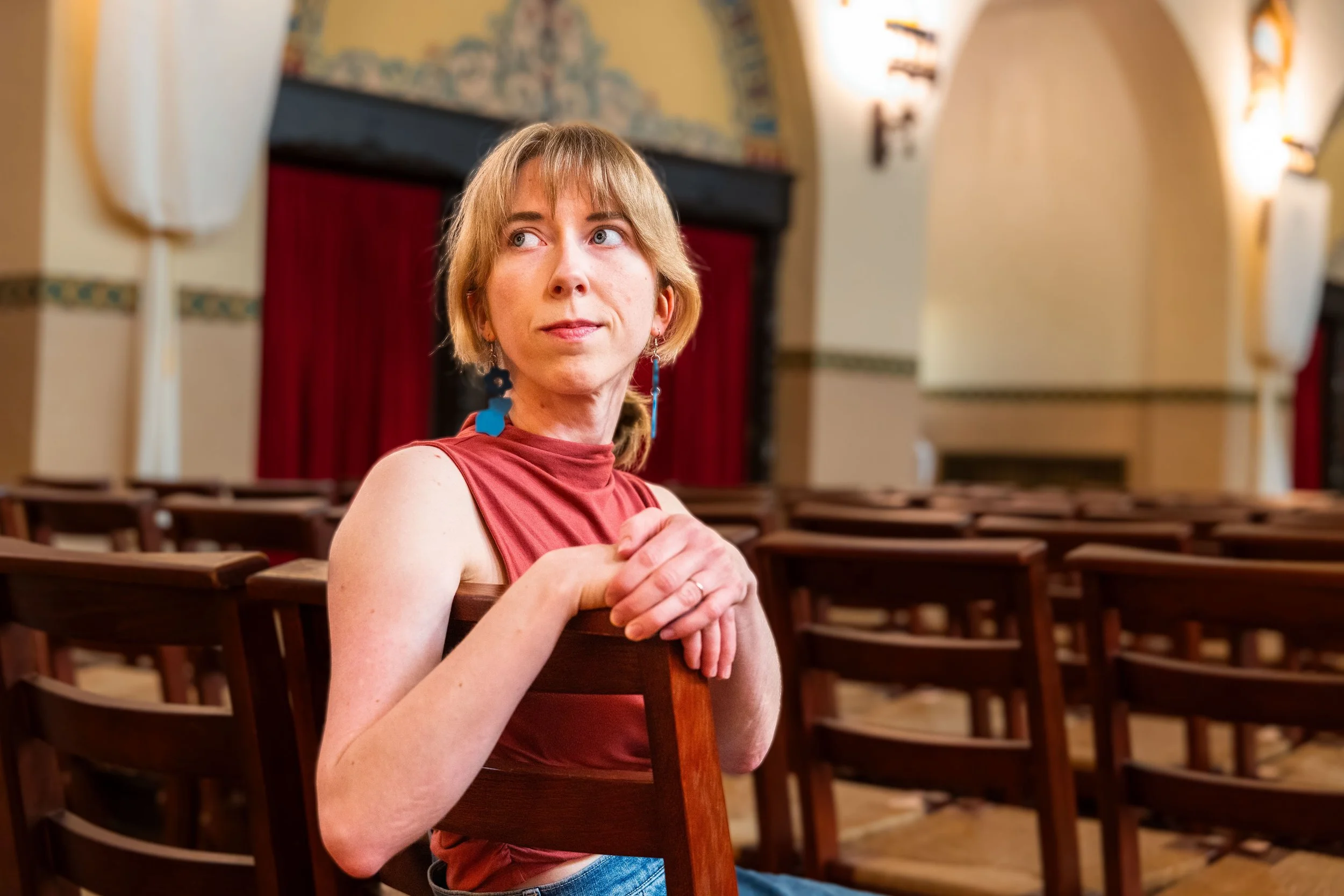
Emma Ferrell sits in Santa Clara University's mission church. Photo by Dylan Ryu
The Catholic Church currently defines homosexuality as “inherently disordered.” But queer and transgender Catholics exist. The Church is supposed to be a place which welcomes all out of compassion, but it has yet to be fully reconciled to our LGTBQ+ siblings who already can experience profound rejection from their communities and families.
“Obviously, I felt that it was very hypocritical of me to believe in a religion and also be bisexual,” says Trinity Lopez ’26. “I remember when I was in high school and coming to terms with the fact that I was queer. I had a lot of self-hatred and I even remember going to a confession … it’s just very difficult going to a Catholic school, growing up Catholic and just being queer.”
A student at Santa Clara University who wished to remain anonymous said, “I very much came from a church that was relatively conservative. There was a lot of negativity surrounding this … being LGBTQ was a big one. I was like: I can be both, right?”
Emma Ferrell ’25, now a graduate student pursuing a masters of arts in counseling psychology with a specialization in LGBTQ+ counseling, remembers when she started dating a girl her junior year. She remarked that her University-run Christian Life Community group leader never talked to her in the same way again. “I think people who were raised in religion know this, but you can tell they’re praying for you.” After finding out, her family did not invite her to her Goddaughter’s First Communion, leaving Ferrell to think: “Do they regret having me be their child’s godparent?”
Can someone be gay and Catholic? Despite their unique exclusion, LGBTQ+ Catholics still choose their faith. But we live in a pivotal time in history, as shifting attitudes, laws and Popes leave these questions hanging. How have they been addressed? Not without great controversy.
“Many people disagree with me and think that I am a heretic and a sinner … and of course I always invite them into a conversation, but they never come in person to speak to me,” says Elise Dubravec, a campus minister who works with LGTBQ+ students and youth.
“It is possible to be LGTBQ+ and Catholic because there’s millions of them around,” says Jim Martin, S.J., editor-at-large of America Magazine and founder of Outreach, an LGTBQ+ Catholic resource. “It’s simply how you are. And if you're a baptized Catholic, you’re a baptized Catholic.”
Due to the controversial nature of his ministry he has received “protests and death threats.” But Fr. Martin hopes that the church will work to remind the LGBTQ+ community “that they’re welcome in the church and that the church is theirs too, just as much as it is for anybody else.”
“The irony is no one is a perfect Catholic,” Fr. Martin remarked. “No one says these people shouldn’t be Catholic.”
Fr. Matt Carnes, S.J., the vice president for Mission and Ministry at Santa Clara, emphasizes the need for the Church to always grow in “the kind of love that we know Jesus showed and then that the gospels call us to.”
But there is hope. Although LGTBQ+ persons experience discrimination, violence and sometimes even death for their identities, their goodness is present if it's not always recognized. They can be true to themselves and also be Catholic.
“I wish people had told me earlier, especially in my own coming out journey … you can have that overlap. And I personally think … it might even enrich your life in both of those ways,” says the anonymous student from Santa Clara University.
“I just remember him comforting me because I was crying,” Lopez said, remembering her experience of coming out to her priest in high school. “I remember him … telling me there’s nothing wrong with you for feeling the way that you feel about others. It’s not a sin to love somebody. God is a God of love, and he’s not a God of hate.”
Inclusion in the Church is not a battle to be fought, but it’s a journey towards greater reconciliation and understanding. Ultimately, it’s about love. I hope that I will live to see the day when greater compassion and understanding will guide us in that quest for greater love.