On Being Indigenous
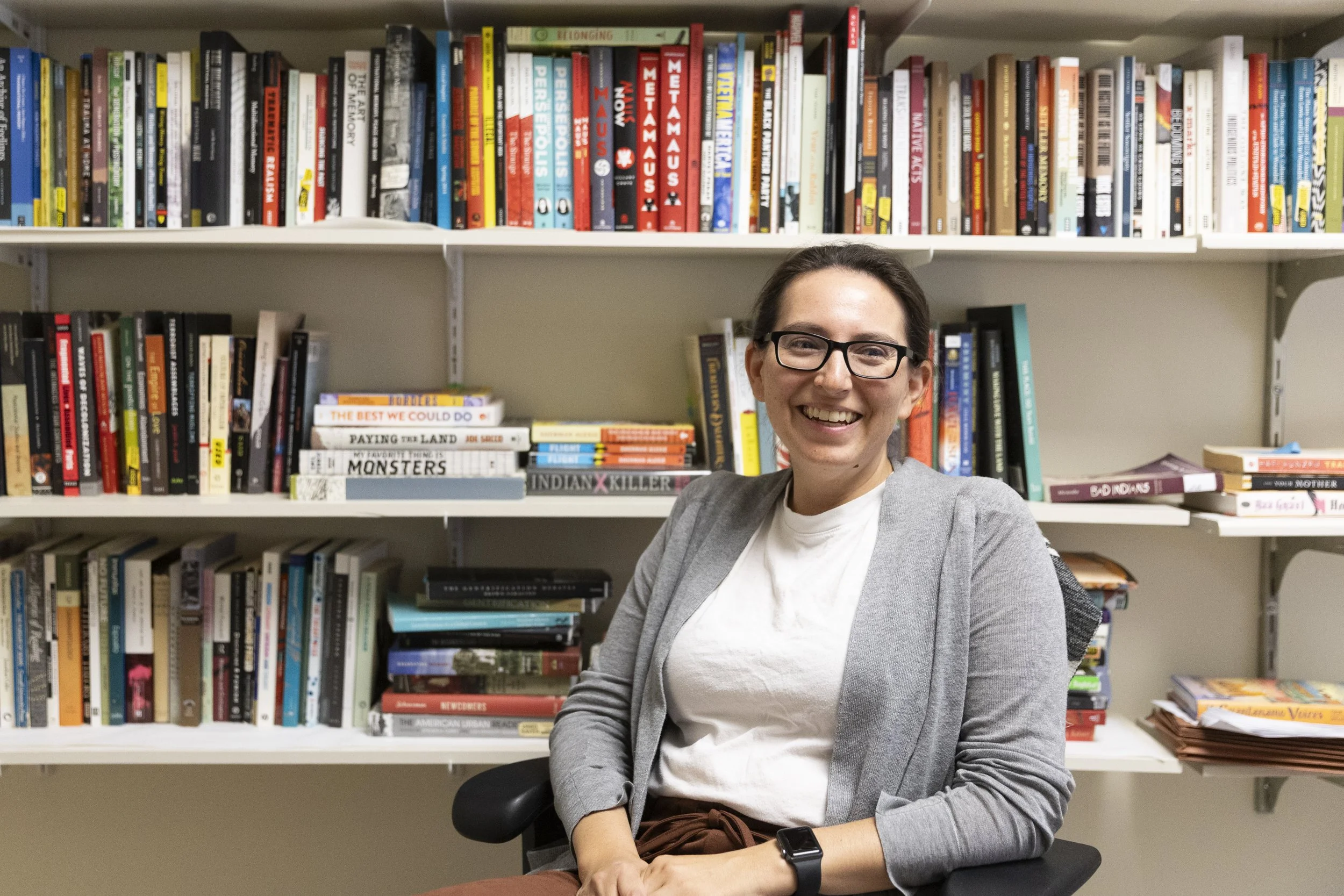
Assistant professor of English Jessica Young talks with students in her office in St. Joseph’s Hall on Monday, April 20, 2026. (Nina Glick/The Santa Clara)
Santa Clara University is the only educational institution in the United States to be built on the site of a Spanish mission.
The missions were organized efforts by the Spanish Catholics to evangelize and became tools for their colonization of what is now California. The ancestral tribal land of the Muwekma Ohlone became a site of forced culture and religion, with Indigenous slave labor responsible for the construction of Mission Santa Clara de Asís.
There are 7,612 recorded Indigenous deaths at Mission Santa Clara. The rose garden directly adjacent to the church is settled atop a mass grave.
“I’ve grown up in the shadows of missions my entire life,” said Jessica Young, a professor of English at the University and an enrolled member of the Seneca Cayuga Nation of Oklahoma.
Young identifies both as Urban Indigenous—tribal members who live off of tribally affiliated land in urban areas—and Pan-Indigenous.
She also holds ties to local indigeneity through activism in the Bay Area.
Young has always had an interest in teaching. Upon attending college, this emerged as an interest in literary theory and then, later, ethnic studies and Indigenous critical theory specifically.
“I had a mentor, Jodi Byrd, who was Chickasaw, and they introduced me to Indigenous critical theory when I got to the University of Illinois,” she said. “Jodi came at the right time of my life, where I was starting to learn more about that side of myself culturally, and they taught me what it was to be Indigenous politically.”
“The more I worked with Indigenous critical theory after I graduated, the more my students were interested in it, the more I kept investing and teaching in it,” said Young
Joining Santa Clara University faculty in 2024, professor Young was faced with new avenues to explore indigeneity on the site of a mission.
“The relationship between the University and the Muwekma Ohlone Tribe goes back to the early 1980s: things have definitely come a long way since I joined SCU in 2010,” said Lee Panich, professor of anthropology and longtime collaborator with the Muwekma Ohlone on their relationship with the University. “The turning point was in 2018 or 2019 when Father Engh—University president at the time—formed the Ohlone History Working Group. That brought together SCU personnel and the leadership of the Muwekma Ohlone tribe and the Ohlone Indian Tribe to review the existing monuments and markers about Mission Santa Clara and Ohlone history on campus.”
Young echoed sentiments about continued positive relations between the Muwekma Ohlone and the University, citing the Thámien Ohlone Augmented Reality Tour, launched in 2023, which allows students to see 3D recreations of native culture on a phone as they walk to campus, complete with factual information in every area.
“When I came here, it became clear that the faculty and the students really want to learn more about Indigenous literature, history and perspectives,” said Young.
Still, the personal struggle of being Indigenous on mission grounds remains for Young.
“What is enough to reconcile the history of missionization? I don’t know what that answer is. Even commemorating that history isn’t enough to combat the structural violence that exists against native people,” said Young.
“I wasn’t sure how I was going to deal with working at the site of a mission. Sometimes I’m not always sure how I feel about it. Sometimes it’s really hard. Sometimes it’s an emotional gut punch. There are days I walk past the mission cemetery area and I get really sad.”
Professor Young became a mother in 2021, and also noted the layered sense of duty to form connections to their culture.
“I do feel some sense of needing to tell my daughter and to teach her a little bit about where we come from, who we are, but to do it in a way that feels authentic to our identity. I do teach her some crafts; we do some beading and stuff like that.”
Tommy Orange’s ‘There, There,’—which follows a group of interconnected Urban Natives living in Oakland as they grapple with their own Native identities—has been praised by Young for resolving tensions about feeling like a ‘real’ native person, given her removal from her ancestral lands.
“‘There, There,’ I think, gave me permission to not be quite so fanatical about it,” said Young.
However, with deepened connections to her identity has come heightened tensions around her explanation of difficult topics as an educator.
Young recalled how the changing political climate affected her previous institution and made her more guarded when speaking on indigeneity.
“I had to tone down my definition of settler colonialism and talk about violence a little more abstractly. My brain was at war with itself over using the old or new definition. It was a moment where I realized I had been censoring myself,” said Young.
Young cited her transition to Santa Clara University as refreshing and affirming regarding speaking and educating according to truths despite new norms as higher education faces continued backlash from the federal government.
“I have developed a strategy to talk about difficult things about racial histories. To remember it’s not people, it’s structures. White supremacy rather than, say, white people,” said Young.
She remains passionate about teaching the truth regarding both historical and contemporary Indigenous issues and maintains a desire for continued growth and change at the University.
“Missionization history is a hard history to tell people,” said Young. “If they knew what lies under our feet, would they have that normal college experience? Would they be able to focus on their studies, without thinking all the time about it?”