Santa Clara University’s Modern Chiron
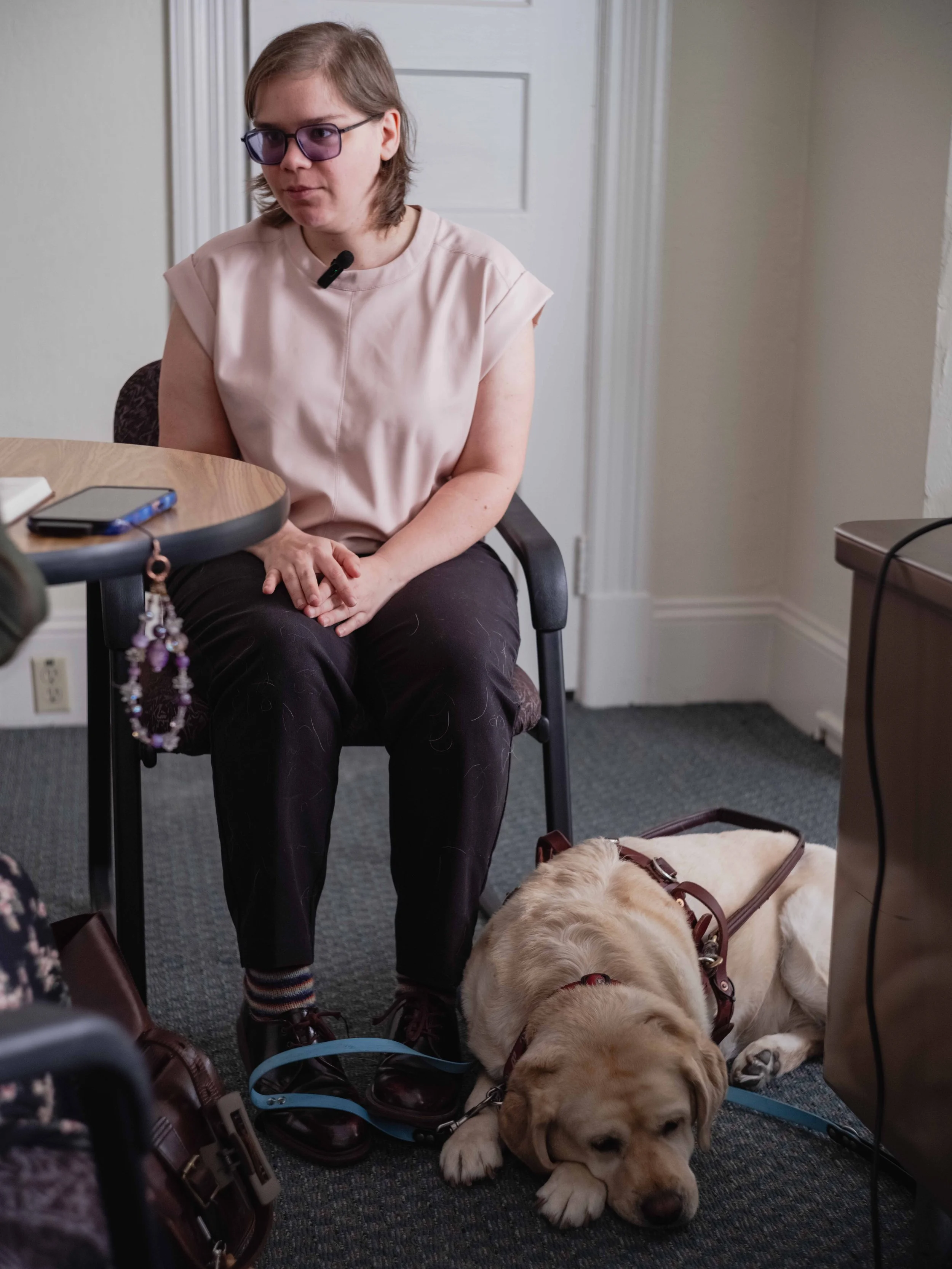
Professor Melberg discusses her academic journey while sitting her former show dog, Nora, lays next to her. (Dylan Ryu/The Santa Clara)
Chiron—a wise centaur in Greek mythology—is a teacher, mentor and healer to great heroes such as Achilles and Peleus. Unlike other centaurs, he was raised and educated by the gods Apollo and Artemis, who taught him about prophecy, medicine and more, but most importantly, how to be kind.
Professor Katherine Melberg from Santa Clara University’s classic literature department is a teacher much like the mythical Chiron. She has spent time learning ancient Greek and Latin during her academic years and aspires to travel someday. Though she struggles with her conditions that affect her sight, she perseveres through her passion in teaching. Melberg grows the minds of students and teaches them how to explore the deeper meaning of mythology and classic literature.
Most reflective of her Chiron-like philosophy is her cultivation of well-rounded students—encouraging them not only to excel within their majors, but also to engage with the arts and develop a broader ethical understanding of society.
Katherine Melberg’s Journey
Melberg—who received her bachelor’s at Miami University in Ohio before moving to the University of Wisconsin for her Master’s program—has a self-proclaimed fascination with languages. She majored in classical languages and German.
However, Melberg has faced challenges along her way. “It wasn’t until I got into my mid-20s that I started having really significant trouble with my vision,” said Melberg.
Melberg was diagnosed with two types of optic-altering neurological conditions: strabismus—misalignment in one’s eyes, where the eye connection is unbalanced—and nystagmus—a condition in which the brain causes faulty signals to the eye muscles, creating uncontrollable eye movements.
“It’s very hard for me to focus my vision, and I have very little depth perception,” she said.
“It happened about halfway through my graduate school training,” said Melberg. “I was premature, so it’s probably a result of that. But for whatever reason, your brain can compensate for those problems really well when you’re younger. In the period between when my vision really tanked and when I started using a white cane, I was really frustrated because I was falling all the time and I didn’t have a great explanation as to why.”
“So suddenly when I started using a white cane, things picked up really quickly. Then I did some braille training,” she said. Melberg was retrieving a lot of new information—on top of also learning more about Latin and Greek and teaching others during her grad year.
The Vision Beyond Sight
Alongside Melberg, English professor José Villagrana also gave his insights on teaching with vision impairments.
“I found that my K-12 and my undergraduate and graduate education never really met my needs, and I even had difficulty articulating my needs. There is that initial barrier of getting it out there,” said Villagrana. “Because of that, I really want to make sure that others have a better experience than what I had.”
Villagrana continued to speak to the layered challenges of accommodations existing on either side of the classroom.
“There are numerous students who describe how they’re reticent; to speak aloud in class and so on,” said Villagrana. “And in English classes, that’s essential. So here’s the tough part: how can I be accommodating to people who need accommodations? The idea of accommodations is always at a baseline from a certain kind of able-bodiedness. So, I have to make the shy person raise their hand even higher and be more visible so that I can see them.”
Despite the challenges that Melberg and Villagrana have faced, it hasn’t stopped them from being impactful teachers and maintaining intrapersonal relationships with students.
“The ability to understand other people—and people seem to understand me—is something very admirable to me,” said Melberg.
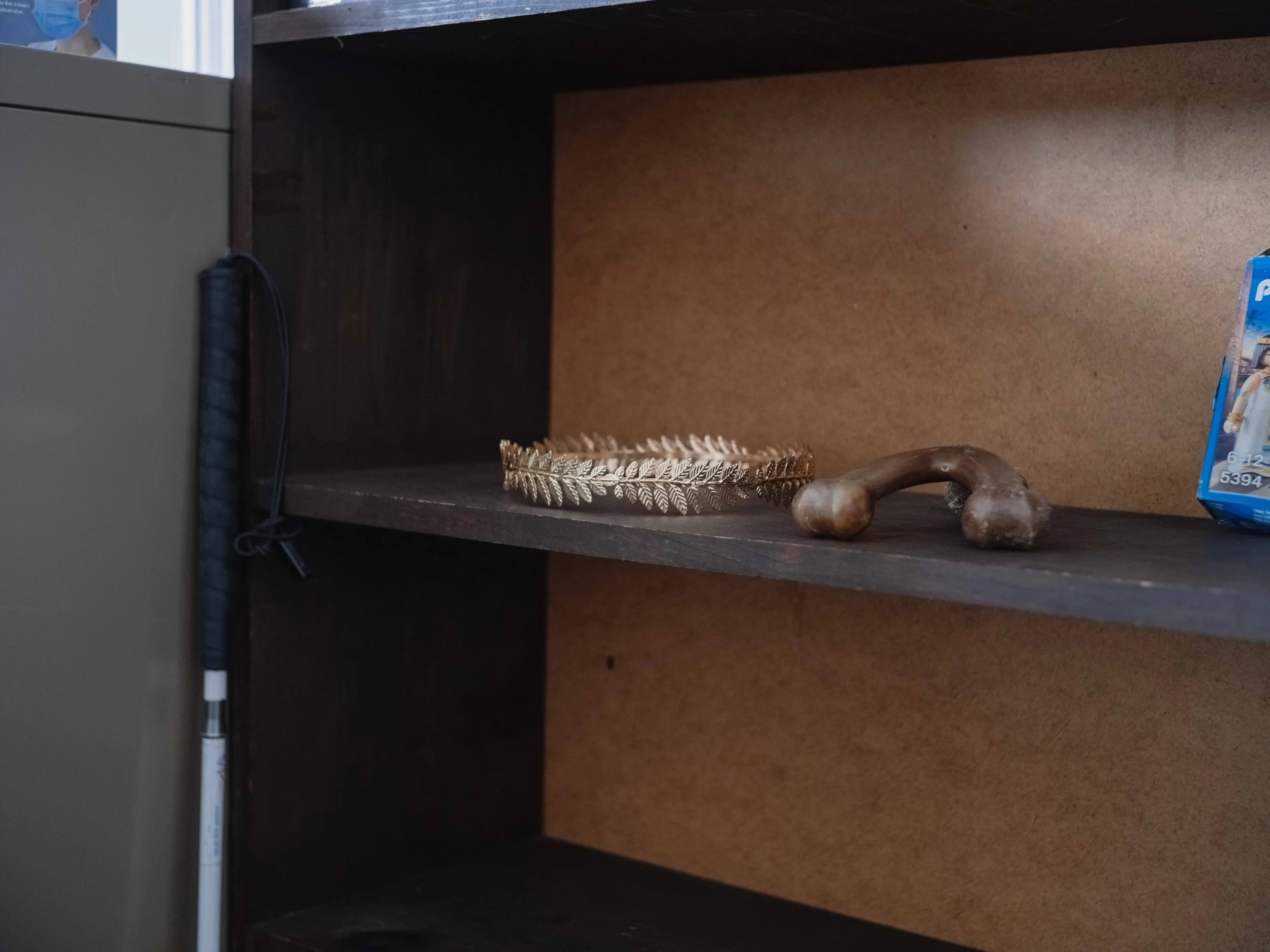
A laurel, dog chew toy, and a history-themed Playmobil toy sit on a shelf next to Professor Melberg’s white cane in her office in the Classic’s
House . (Dyan Ryu/The Santa Clara)
Nora
Melberg is not alone in her journey.
Melberg has her loyal dog Nora, who is her everyday guide.
“Due to my lack of depth perception, especially in Wisconsin, with the wind and the snow, I was having trouble getting stuck on ice puddles,” recounted Melberg.
Since Melberg isn’t completely blind, she wasn’t able to get a regular guide dog. In fact, Nora wasn’t always a guide dog. Rather, she was a former show dog. It was only after many failed attempts to get a guide dog that Melberg was able to contact a dog trainer who introduced Nora. “The last dog place that I was moving through, had almost selected a dog and then they said no. So they told me they knew this trainer that does private training.” said Melberg.
Since then, they’ve been inseparable, learning to communicate and build a relationship of trust.
The Future
Although it is only her first year teaching at the University, Melberg has interacted with many students through her lectures, emphasizing kindness and exploration despite challenges.
“Dreams can be expansive. Find what makes you happy and feel fulfilled,” said Melberg to students looking toward the future.
Teachers and mentors such as Melberg, Villagrana and Chiron continue to create spaces for students to express themselves and their needs while preparing them for the demands of the professional world.
Both Villagrana and Melberg cite their passions as integral to the work they continue to do.
“Be fearless in everything that you do,” said Villagrana. “Because you can do it, and you’re worth it.”