Where Movement Meets the Mind
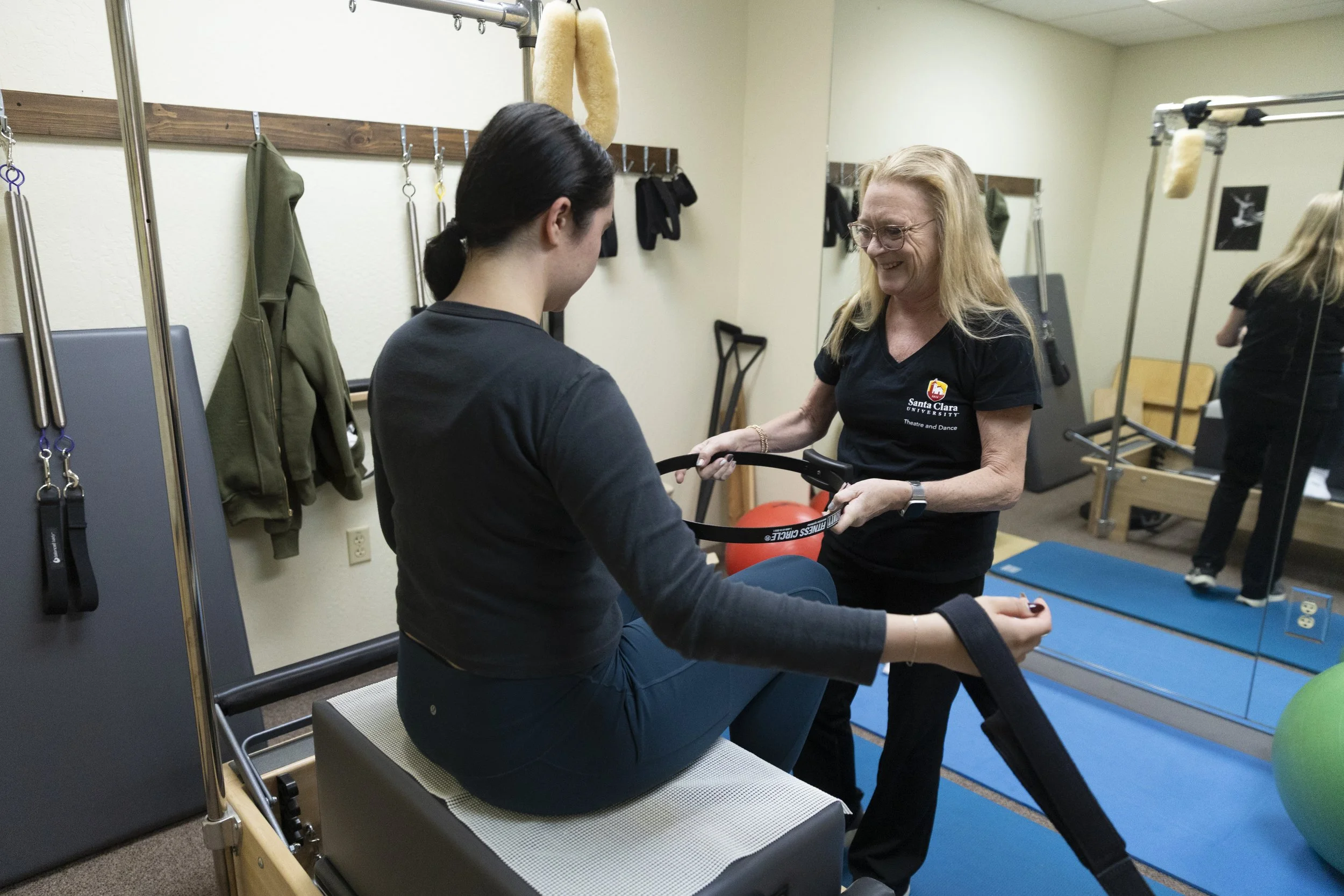
Professor Karyn Connell assists a student in a Pilates exercise in the Pilates room in the Music and Dance Facility on Friday, April 17, 2026. (Nina Glick/The Santa Clara)
In a ballet class, a small correction can change everything.
“When you’re teaching grand allegro—big jumps—in ballet, I find a lot of times people are concentrating. Their eyes are focused down,” said Professor Karyn Connell, who teaches ballet and Pilates at Santa Clara University. “You’re trying to jump up, and your eyes are focused down. That’s counterintuitive.”
Shifting where a dancer looks is a subtle adjustment. For Connell, it represents something much larger: the connection between the brain and the body.
Drawing from years of dance experience and recent training in neuroscience, Connell has developed a teaching approach that blends classical movement with an understanding of how the brain processes it. Her work focuses not only on how dancers move, but why they move the way they do.
Connell’s journey into movement began early—not entirely by choice.
“Ballet was because of my parents,” said Connell. “I was a very shy child, so they took me to the doctor, and he said, ‘You’ve got to get this kid in something.’ So they put me in dance, gymnastics and cheerleading.”
Later, she discovered Pilates, initially as a cross-training tool.
“I did it more to give me a second career after dancing, but also because it helped me so much as a dancer when I had injuries or when my body was feeling achy,” said Connell.
While anatomy had always been a part of her training to some extent, Connell’s deeper interest in the brain-body connection is more recent.
“There was always a brain-body approach, but I never really went into depth with it until two, maybe three years ago,” said Connell.
Since then, she has studied neurological approaches to movement, focusing on how different systems in the body interact.
“I started looking at the different systems that we have within the body,” said Connell. “The visual, which is the eyes, vestibular, which is the ears, and proprioception, which is touch.”
At the center of her teaching and learning is the idea that movement is not just physical—it’s neurological.
Connell breaks down body stability into a four-quadrant model. “When you watch any exercise, you look at those four quadrants to find out what is not stabilized,” she said.
By adjusting those imbalances, instructors can do more than fix technique; they can actually retrain the brain.
“You’re changing the map in the brain, because we are all mapped to move a certain way,” said Connell.
This concept is not just theoretical—it shows up in how students experience her classes.
Megan Baldemor ’26, a biology major and student of Connell, sees this connection firsthand.
“Karyn doesn’t explicitly talk about neuroscience concepts, but they’re definitely being applied,” said Baldemor. “Her classes place a strong emphasis on musicality, and that relates to how the brain processes rhythm, timing and integrates auditory stimuli with movement.”
Baldemor also pointed to Connell’s emphasis on body alignment.
“Because of her background in anatomy, she has a clear understanding of what movements are safe and sustainable for the body,” said Baldemor. “My sense of placement and body awareness has improved significantly since working with her.”
Connell’s work extends beyond the classroom.
“For neurological conditions, it is trying to get people who have had strokes or chronic injuries to get out of pain and to move with life,” said Connell.
Although Connell has not worked directly with these individuals, she has studied how these methods can be applied beyond the classroom.
Rather than focusing only on the area of pain, her approach considers the body as a whole.
“You give an exercise and watch them do that exercise. You don’t look where the pain is, you look at every other part of their body,” said Connell. “What’s moving that shouldn’t be? And that’s what you address.”
For Connell, these ideas come back to a simple but powerful belief: in her classes, movement becomes more than just physical; it becomes a way of understanding the body, the brain and the connection between them.
“Movement is life. Even when we are standing still, we are still moving,” said Connell. “Your blood is flowing through, you are breathing, your heart is pumping. If your eyes are closed, there is still movement happening.”