Pragmatic Patriotism
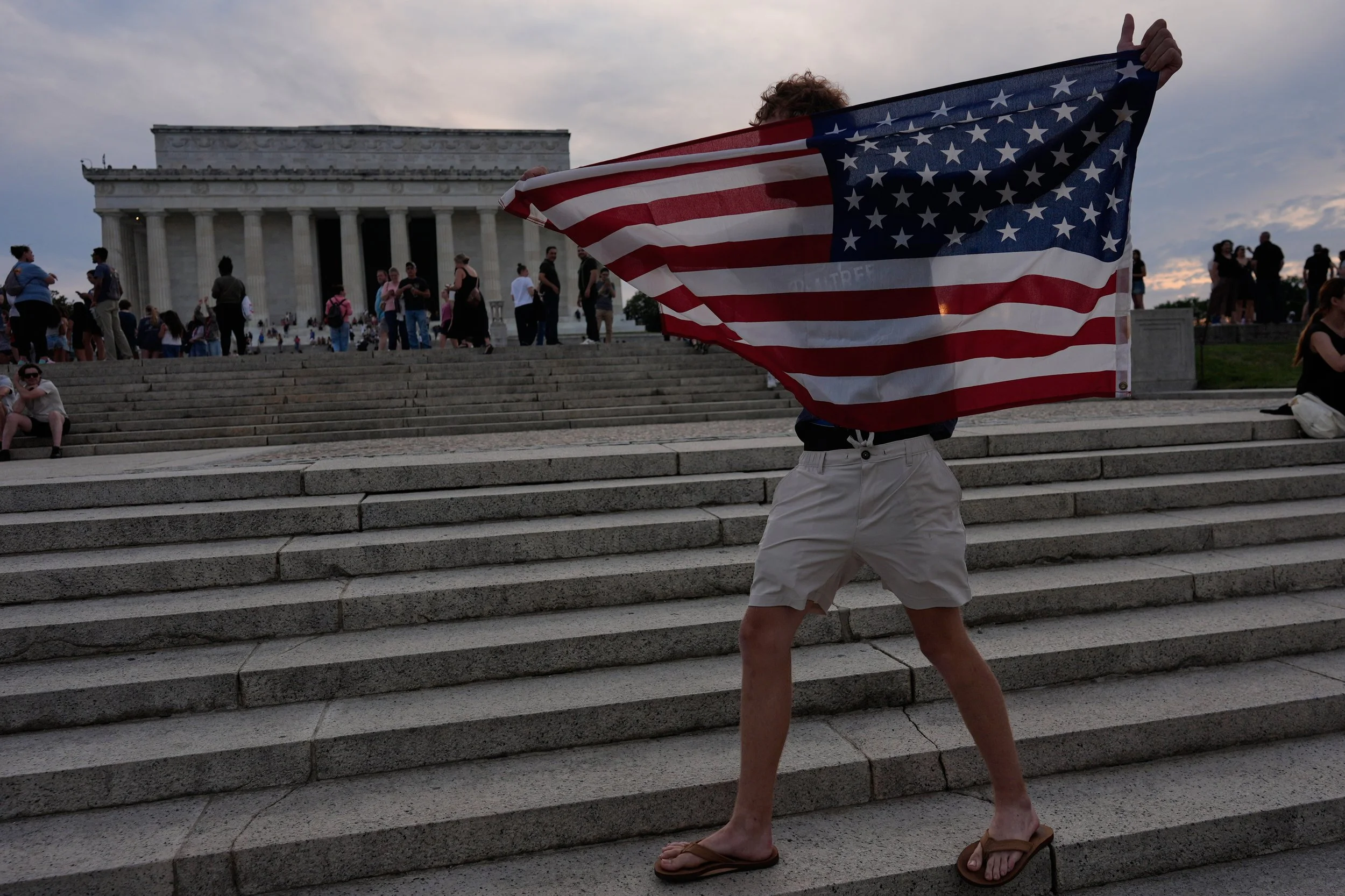
A person holds up an American flag at the Lincoln Memorial Thursday, June 25, 2026, in Washington. (AP Photo/Carolyn Kaster)
In just a week, the United States will turn 250 years old. Americans across the country will celebrate in typical 4th of July fashion, enjoying food, drinks and time with friends and family. Unobscured by the day’s festivities, however, is the precarious state of the nation.
This year’s 4th of July offers a unique chance for reflection, especially for students at Santa Clara University and other institutions of higher learning. College and university campuses have historically been some of our country’s most politically active communities, and the 4th of July is a deeply political event. This year’s momentous anniversary, coupled with unprecedented national politics, surfaces questions about the relationship college-aged Americans have with their country.
Cash Carrillo ’28, a history and political science major at the University and one of a few students who told me about their relationships to patriotism, said that he is a patriot, but in a specific sense. He is a big fan, especially in our present moment, of Mark Twain’s quote that “Patriotism is supporting your country all the time, and your government when it deserves it.” Carillo said that “Events like the march against ICE last quarter and the ability to participate in the recent elections make me proud to be part of this community and to be politically involved in America.”
Carrillo’s interpretation of patriotism involving political awareness is commendable. It seems that the dominant cultural understanding of patriotism, however—especially among college-aged people—skews less towards politics and more towards unskeptical nationalism. I think the way that our college classrooms discuss patriotism—or fail to address it—reflects this.
As Carrillo told me, “ It is…hard to be unconditionally proud of one’s country in the way we associate with patriotism.” An academic community understandably does not want to be a part of a movement or ideology that misrepresents both our country’s history and its present moment. This aversion is perhaps one reason why patriotism rates are lower among college students than the rest of the adult population.
In 2022 the Archbridge Institute, a non-partisan thinktank, conducted a survey of 2000 college students across 130 American colleges and found that 56% were very or somewhat proud to be American. That’s compared to 2021 data showing that nearly 70% of the total adult population reports feeling extremely or very proud. More recent data from last summer showed that between 2021 and 2025, 41% of Generation Z Americans felt very or extremely proud to be an American, compared to the 58% of Millennials, 71% of Generation X and 75% of Baby Boomers that did. Between 2006 and 2010, when a lot of Millennials were in college, 77% of them were very or extremely proud.
The same data shows that patriotism has declined over the last couple of decades across all adult generations. Still, there’s a discrepancy between different age groups, and it likely has something to do with the evolving nature of higher education.
The explanation can be somewhat encouraging if looked at a certain way. When people go to college, they learn more and open their minds to new ideas. The initial effect of widening someone’s viewpoint, in the context of American history and politics, is predictably that they become more skeptical of people who unabashedly praise America.
Higher education curriculums have indeed evolved over the last few decades to especially consider an increasing amount of perspectives. Voices and experiences that weren’t necessarily given a platform in 1990 are quite loud in colleges and universities today. See our English or history classes for an example of this diversity.
This is, in many ways, a positive trend. A potential byproduct of studying American culture and history from more perspectives, though, is an aversion to identifying with ‘patriotism’ because of how we often culturally think of it: presumptuous and unrigorous.
Enlightened perspectives on American exceptionalism are good—we care about the truth, of course. Still, it’s fair to recognize that they also have indirect consequences. It’s possible that in distancing ourselves from potentially ignorant claims about America, we’ve forgotten to articulate our own version of patriotism.
We put American concepts—like popular sovereignty or freedom of speech—into practice all the time, so I don’t mean to say that we don’t care for them anymore. The amount of college students who don’t feel proud to be an American, though, suggests that these concepts aren’t what come to mind when they think about their country.
The degree to which Santa Clara University replicates the national trend is not totally clear. A student who wished to remain anonymous said, referring to patriotism, that “you see both sides of it, but it really depends on the people you hang around.” Carillo said he thinks there is relatively more patriotism at the University than at others around the country. Hannah Ziesche ’28, on the other hand, admitted that there exists some variety but that “as a whole, college students are pretty disillusioned by patriotism since this country has let us down more in our lifetime than lifted us up.”
In my mind, college students are, by and large, patriotic in their thoughts and actions. They care about the issues that face their country, and voice their opinions with the hope of making a difference. But the fact that most of them don’t recognize this as pride is an issue.
Students shouldn’t feel proud of their country’s shortcomings. But patriotism doesn’t need to only concern the past. There should be a certain forward-facing pride in the abstract principles of America, and the act of just striving toward them can offer us a great deal.