Dear Future Presidents: Please Say Sorry
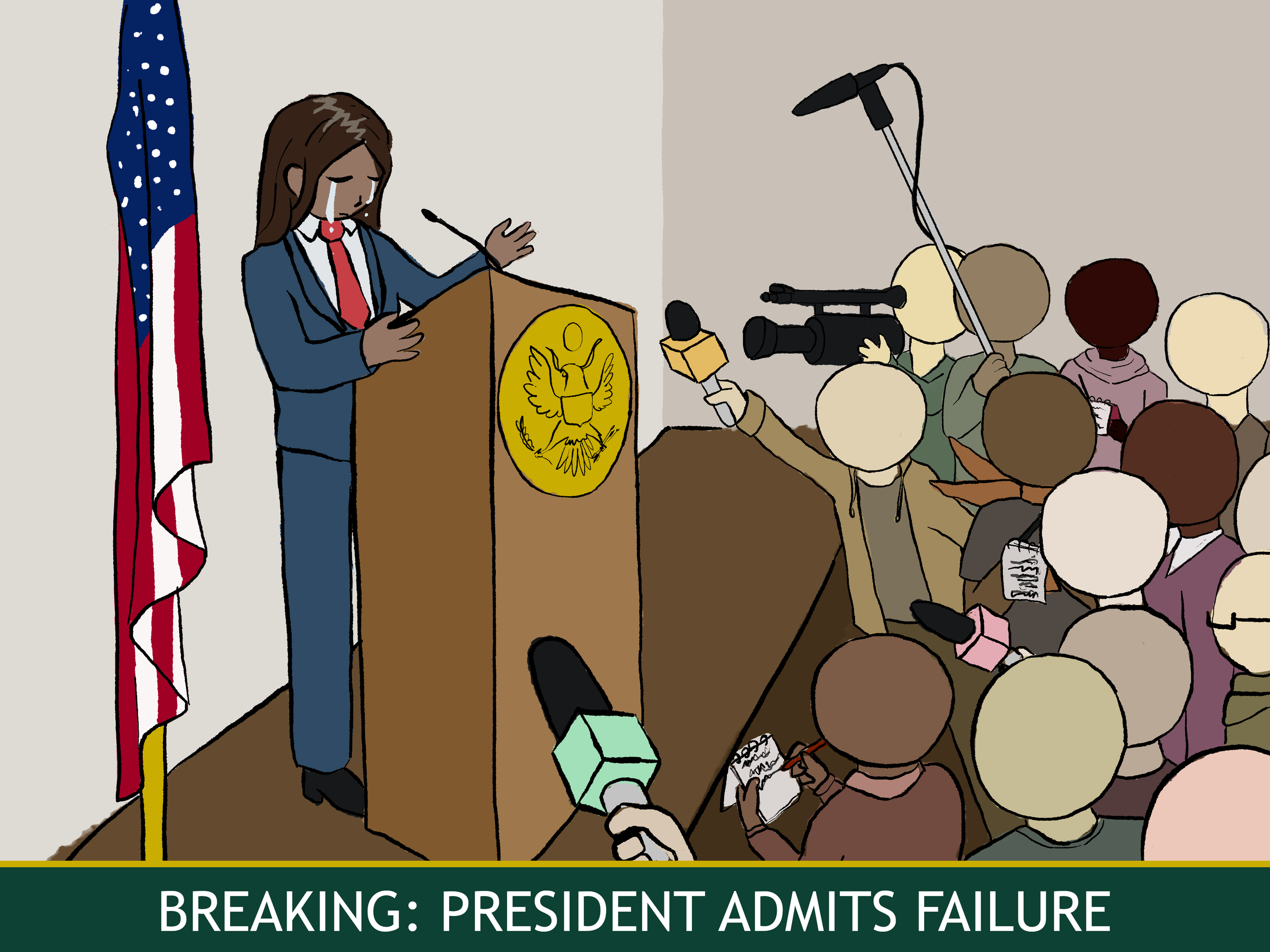
(Jenell Theobald/The Santa Clara)
In the span of two and a half weeks, federal ICE agents murdered Renee Good and Alex Pretti in the streets of Minneapolis. Protesters have since flooded streets across the country with increased outrage and conviction. Here at Santa Clara University, more than 600 students walked out of class on Friday, Jan. 30, and marched across campus. The Trump administration has thus far offered nothing in words of remorse.
Despite recently ordering the withdrawal of 700 agents from Minnesota, the President himself has been far from condemnatory. He said in an interview with NBC that his administration could use a “softer touch,” which feels like a slight understatement. JD Vance has acted as usual, firing off tweets blaming victims and, most recently, questioning what he even had to apologize for. You can find many similar statements from other members of the administration.
Apologies are out of the realm of possibility with these grifters. Nobody in MAGA—not Trump, not Vance, not even Karoline Leavitt—is going to apologize for the atrocities that have taken place. The disease runs very deep with this group.
But, truth be told, we wouldn’t expect it from any Presidential administration. Humility is not exactly a part of political discourse. Politicians certainly may try to appear as normal human beings, but when they actually mess up, it’s rare that they come forward with a genuine apology. Data from the Political Apologies Database shows how apologies have increased over time but are still relatively infrequent. There are a few reasons for this, some more obvious than others.
In our culture, there’s an implicit understanding of corruption in politics. Especially among those with an anti-establishment bias—which is common on both sides of the political spectrum—it’s treated like common knowledge that politicians don’t genuinely care about us. Of course they won’t apologize.
There’s also a rationality to not apologizing. According to a Cambridge study, in certain cases apologies from public figures can be seen as confirming wrongdoing. Another shows that apologies can be perceived as a sign of weakness or anti-nationalistic.
This is consistent with our larger national mythology, but also seems somewhat backwards. Admitting our own faults might throw a wrench in notions of American exceptionalism. But if that’s the case, were those ideas really genuine to begin with? We’re supposed to be the model of liberal democracy. It’s not very democratic to never be able to tell the truth.
Democracies thrive on information. You can argue that a lack of quality information is a large reason for our current circumstances; media like the Joe Rogan Experience have become influential sources for many, despite their bias and unreliability. But what if our primary information providers could be the politicians themselves?
Trust is a constant desire for public figures. Entire political campaigns are founded on this concept. It’s the reason that some politicians choose to ride the subway, go to an ice cream shop, or, more strangely, post memes on their social media account late at night. They want us to think that they’re just like us.
One thing we most definitely all do is fail, and most of us apologize for it. This is how we build trust in our relationships with others. We find it encouraging when a friend admits they made a mistake, and it’s considered endearing when the quarterback of our favorite NFL team cries in his press conference after throwing a game-losing interception.
It doesn’t have to be altogether different in politics. To be clear, certain mistakes don’t deserve our forgiveness. At this point, an apology from President Trump wouldn’t change much. The damage has been done. But in the future, apologies could serve to build a bond between public figures and the rest of us.
It’s true that the consequences of presidents’ actions are incomparable to what we face when we spill our coffee in someone else’s car. This is a reality of our political institutions—the stakes are extremely high. Politicians know this, but don’t tend to give their version of a post-game press conference.
While uncomfortable, it would be beneficial to adjust our culture. We must recognize that the leaders we elect will fail at times. This prevents any figure from rising to the status of a strongman, someone people claim is perfect. It’s a guardrail against what we are seeing right now.
This is, perhaps, the ‘real’ populism—one that doesn’t involve stooping to the easiest popular narrative. Quite the opposite, actually. It would be a system that weeds out inauthentic followers. We trust the politicians—and acknowledge their faults—and they tell us the truth. Narcissistic and conspiratorial politics would fall out of style, and voters who favor that would have to adapt.
I hope it’s clear that I’m not naive about how politics works; I understand that what I’m suggesting would require a dramatic shift in our culture, as well as reform within the institutions that disincentivize apologies. You can think of innumerable reasons why things will never change.
I also hope it's clear that in no way am I dreaming of a fairy-tale ending to the hell-hole we are living in. If anything, I mourn the loss of our democracy and am imagining it being rebuilt from the ground up.
It feels like our current administration is a lost cause. We’ve seen their playbook over and over, and it doesn’t change. Reform similar to what I’m discussing doesn’t feel possible right now.
Instead, this is a message to our leaders who come next—assuming others do. The game we currently play reveals our needs and desires. A genuine attempt at meeting them begins with the ability to say sorry.