Santa Clara University Professor Wants to Abolish the Minimum Wage
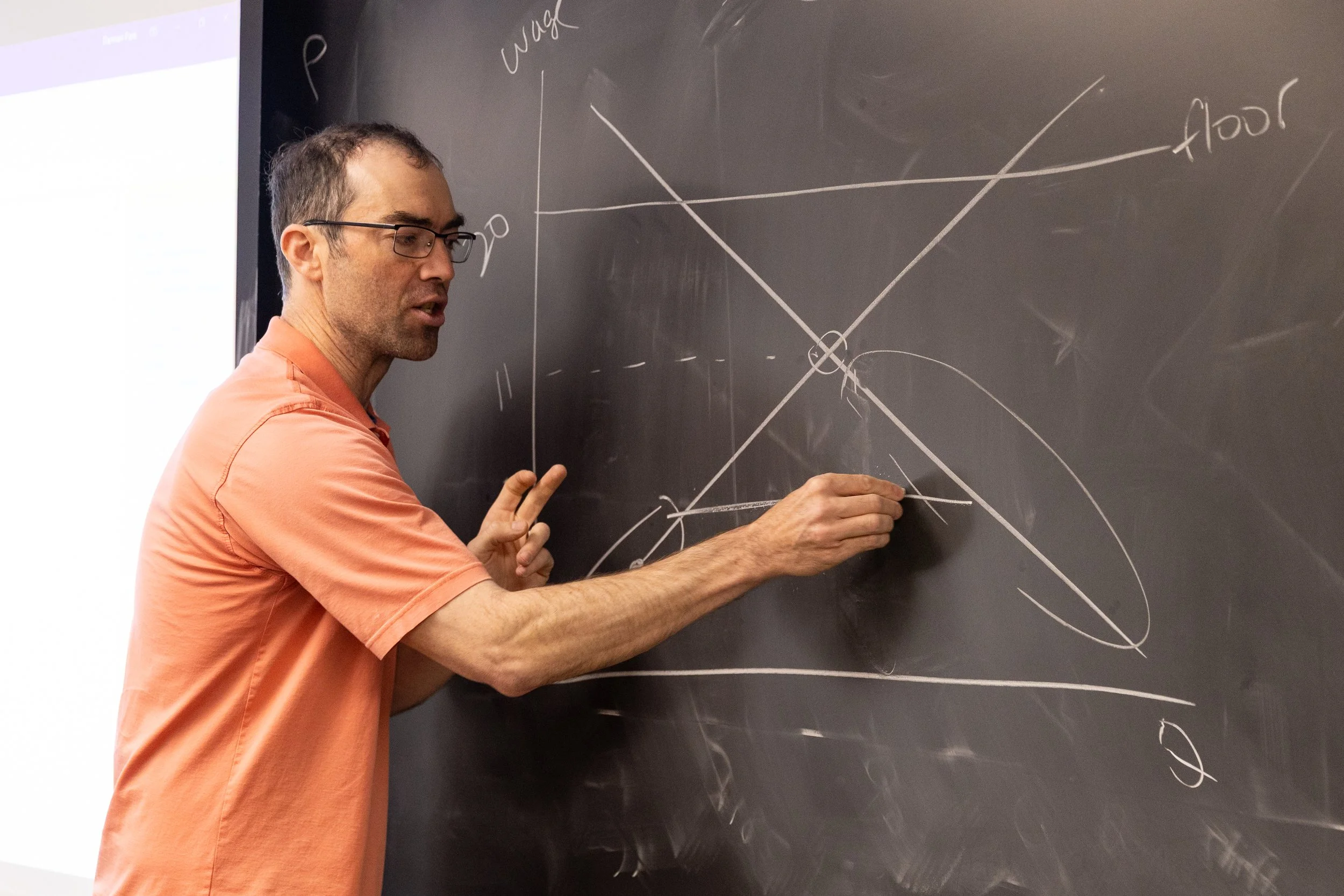
Damian Park explains his theory on the minimum wage after teaching a class on Wednesday, Oct. 29, 2025. (Nina Glick/The Santa Clara)
You’d be hard pressed to find an economics crash-course like the one given by a Santa Clara University professor on Oct. 8, in Vari Hall. When I walked in, he had divided the chalkboard into 3 sections labeled “I love it,” “I hate it” and “I’m in between.”
The question? “How do you feel about the minimum wage?”
Damian Park, an economics professor at the University and the facilitator of this University Honors Program (UHP) conversation, didn’t answer his own survey, but I can assure you of what his vote would have been. He hates it.
Why? Park is a libertarian. And, as he says, he’s a “curious individual.” He does not follow conventional wisdom in the field of economics, nor in his daily life.
He will lecture his introductory economics classes on why Gavin Newsom’s rent control policy is terrible and explain why eating less meat isn’t the solution to climate change. It wasn’t until only a few months ago that he upgraded from his trusty iPhone 7.
“The right way to go is not what the Democrats are proclaiming, and not what the Republicans are proclaiming either…there’s gotta be something different here, because they’re both sounding awfully shitty to me,” Park said.
Park generally doesn’t believe in making decisions for other people—“For some reason, being coerced and told to do something just strikes me as unjust.” He argues that the minimum wage is a prime example of coercion in that it restricts people from selling their labor at a price of their choosing.
He used an example from his Berkeley neighborhood to illustrate his point: some years ago, Park found a sign posted near his house advertising a 12-year-old girl’s babysitting services. She was charging five dollars an hour—well below the minimum wage but not an issue because she was too young to be officially employed.
Macy was competing on price to gain leverage in the labor market. A 12-year-old might be less trustworthy than a 16-year-old, so how can a 12-year-old find opportunities? Charge less.
Park considers this to be a crucial ability, regardless of your age and situation. The minimum wage, however, doesn’t allow adults to navigate the labor market like Macy. Instead of viewing it as protecting workers, Park views it as limiting their options.
Interestingly, Park’s argument for abolishing the minimum wage is actually intended to help those at the bottom. If the minimum wage didn’t exist, it’s reasonable to think that some of these people would be able to find work, even if it wasn’t for much at first. As they built their skills and rapport, they could climb the ladder and earn more.
But with the minimum wage, Park argues, we don’t give the least fortunate members of society a chance to get back on their feet. There’s a massive barrier to entry for the people who are truly down on their luck.
If some people argue against the minimum wage due to greed and lack of empathy, Park is not one of them. “When people see my viewpoint,” he told me, “they think I’m callous towards those individuals. I care deeply about them…I’m invested.”
When he gathered votes from students sitting before him at the UHP conversation, Park didn’t find anyone who agreed with him. The crowd was split between “I love it,” and “I’m in between,” but no haters.
When I sat in Park’s office a few days after the talk, I asked him if he thought this tension had something to do with what’s called social desirability bias—the obligation many feel to support policies that sound good. This could be playing a role, he said, but there’s likely other reasons.
For one, he senses a misunderstanding regarding labor markets among students, but even economists too. Many people believe the minimum wage is the only hope for lower-skilled workers, but Park doesn’t buy into the narrative.
“I think that’s a poor reading of what’s going on,” he said. “My sense is that most individuals, when you give them the freedom to try new things, they find their path and they get more productive over time.”
Understanding the positive correlation between productivity and higher earnings, Park claims, “is fundamental to thinking that a worker is not shit out of luck if they don’t have a minimum wage.”
Another reason for his argument not landing, Park believes, is other disciplines attempting to teach economics. “I don’t try to teach biology,” he told me, and insisted that non-economists should not impose economic theory. The result of a historian, anthropologist or English professor attempting to explain our economic world, Park argues, are hollow and misguided preconceptions about certain issues.
For example, one student used the term “late-stage capitalism” at the talk, and Park was quick to argue that a word such as that doesn’t provide a helpful framework. Instead, he’d like to see a stricter economic rigor be applied to debates about policy.
At one point during the event, Park smirked and replaced the phrase “race to the bottom” with “race to the equilibrium,” referencing the relationship between supply and demand in labor markets.
Park’s inclination towards freedom in the context of social justice is not limited to the minimum wage, either. There are other issues that he thinks could be greatly alleviated with more liberty. In health care, for example, Park would like to see non-doctors be able to provide more care, and thus bring costs down.
On the topic of affordable housing, he’d like to see California drop its kitchen and bathroom requirements for apartments in order to bring more homes onto the market. An unorthodox approach compared to the normal strategy of vouchers and subsidy, but food for thought.
Damian Park does not take a traditional approach to solving issues in our world. His style of reasoning is unlikely to land with the average person. But to me, his University Honors Program conversation was refreshing.
Seeing someone committed to improving the world, but arguing we take an unorthodox approach to get there, is the type of thing that any academic institution should welcome. In a day and age where intellectual freedom is at risk, we should celebrate unusual arguments like Park’s, especially if they are in the name of a more just society.