Sullivan’s Santa Clara Takes Shape
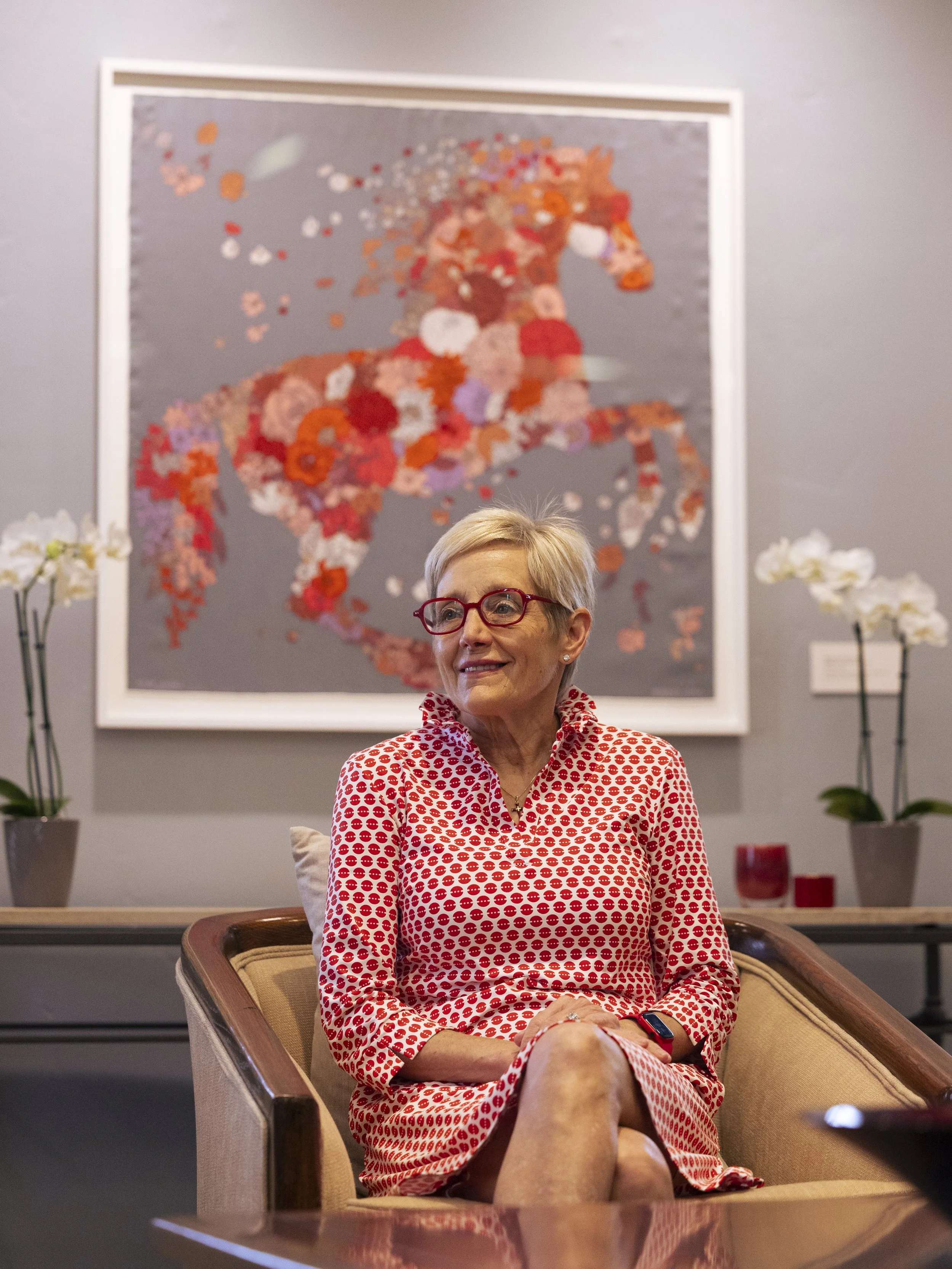
Santa Clara University President Julie Sullivan sits in her office in the Walsh Administration Building on Friday, May 29, 2026, in front of a framed scarf given to her by women who were on the Santa Clara University Board of Trustees early in her tenure as president of the University. (Nina Glick/The Santa Clara)
It does not seem that long ago that Julie Sullivan stood before Santa Clara University in a red academic robe and told the campus that the day was not really about her.
“Today we celebrate Santa Clara University,” Sullivan said at her 2022 inauguration. “We are here to affirm its powerful mission, commemorate its past, reflect on the world in which it exists today, and look with great hope and excitement towards its future.”
Four years later, that future began to take shape around the class of 2026—the first class to spend its entire undergraduate experience with Sullivan as president.
For Sullivan, the milestone is not the end of a story. It is the close of a first chapter.
Her reflections begin with students.
“It’s been such a pleasure getting to know our students better,” Sullivan said. “I’ve been remarkably impressed with the students here.”
She named AI Collaborate, Innovation Fellows, Mindset Scholars, Associated Student Government, the Multicultural Center and The Santa Clara newspaper among the student groups and leaders that have stood out to her.
“It’s just been remarkable to see the leaders that this University attracts,” Sullivan said. “I think it’s a blessing to help support them in their work.”
When Sullivan arrived in 2022, her presidency was historic before it began. She became Santa Clara University’s 30th president, as well as the first woman and first layperson, a non-clergy member, to lead the University since its founding in 1851.
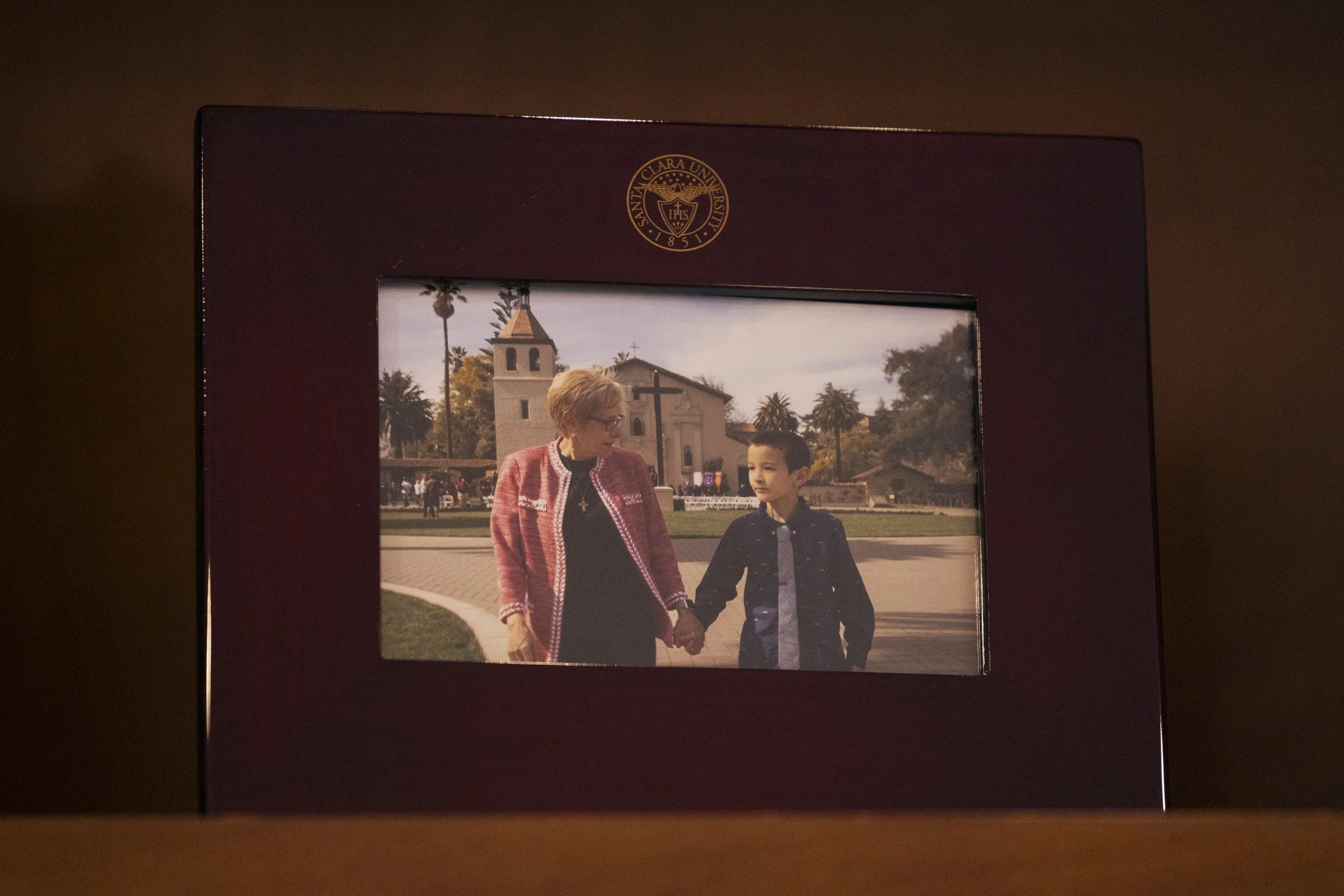
A framed photograph of Santa Clara University President Julie Sullivan walking with her grandson on the day of her inauguration as president of the University sits in President Sullivan’s office in the Walsh Administration Building. (Nina Glick/The Santa Clara)
It was not the first time Sullivan had carried those two firsts. Before Santa Clara University, she spent nine years as president of the University of St. Thomas in Minnesota, where she was also the first woman and first layperson president.
But Sullivan said the meaning of those firsts has felt different at each university. At St. Thomas, she said, the attention was more on gender.
“The women who worked at the University, the faculty and staff, even the female students really went out of their way to share with me how meaningful it was to them to be a part of an organization that a woman was leading,” Sullivan said.
At Santa Clara University, she said, being the first layperson has been more significant because of the University’s deep Jesuit identity.
“I think here, because the Jesuits are such a strong part of this community, being the first layperson has been more significant to me,” Sullivan said.
At her inauguration, Sullivan said the University had to “preserve the best of the past while stepping boldly into the future.” That balance—between tradition and expansion—has marked much of her first four years.
When she arrived, Sullivan said, the University was still emerging from COVID-19 and a period of leadership changes. What it needed most, she said, was “stability and a renewal of its joy.”
“I think that we have been able to create both of those,” Sullivan said. “Not only have we achieved stability, I think we’ve really gained a lot of momentum.”
The data tells part of that story. According to University Common Data Set figures, total enrollment rose from 9,178 students in fall 2022 to 9,823 in fall 2025, an increase of about 7%. Undergraduate enrollment grew from 6,115 students to 6,695 during the same period. First-year applications also rose, from 16,650 in fall 2022 to 20,032 in fall 2025, an increase of about 20%.
The student body has shifted in other ways. The share of first-year students from outside California fell from 46% in fall 2022 to 38% in fall 2025, while the percentage of first-year students living in college-owned, operated or affiliated housing rose from 92% to 94%.
Growth has also come with rising costs. Estimated full-time undergraduate expenses rose from $74,646 in 2022-23 to $86,970 for 2026-27, an increase of more than $12,000. At the same time, need-based scholarships and grants for degree-seeking undergraduates increased from about $72.9 million in 2022-23 to an estimated $98.7 million for 2025-26.
Sullivan said expanded financial aid is one of the clearest ways Impact 2030, the University’s strategic plan, has begun to affect students.
“One is, we have significantly increased the financial aid budget in order to make Santa Clara University accessible to all talented students, regardless of their socioeconomic need,” Sullivan said.
She cited the California Promise Program and a similar commitment for Cristo Rey high school graduates as examples of that work.
Other pieces of Impact 2030 have been more visible: the planned medical school with Sutter Health, the new Applied AI and Human Potential center and the decision to move the Jesuit School of Theology to Santa Clara University’s campus.
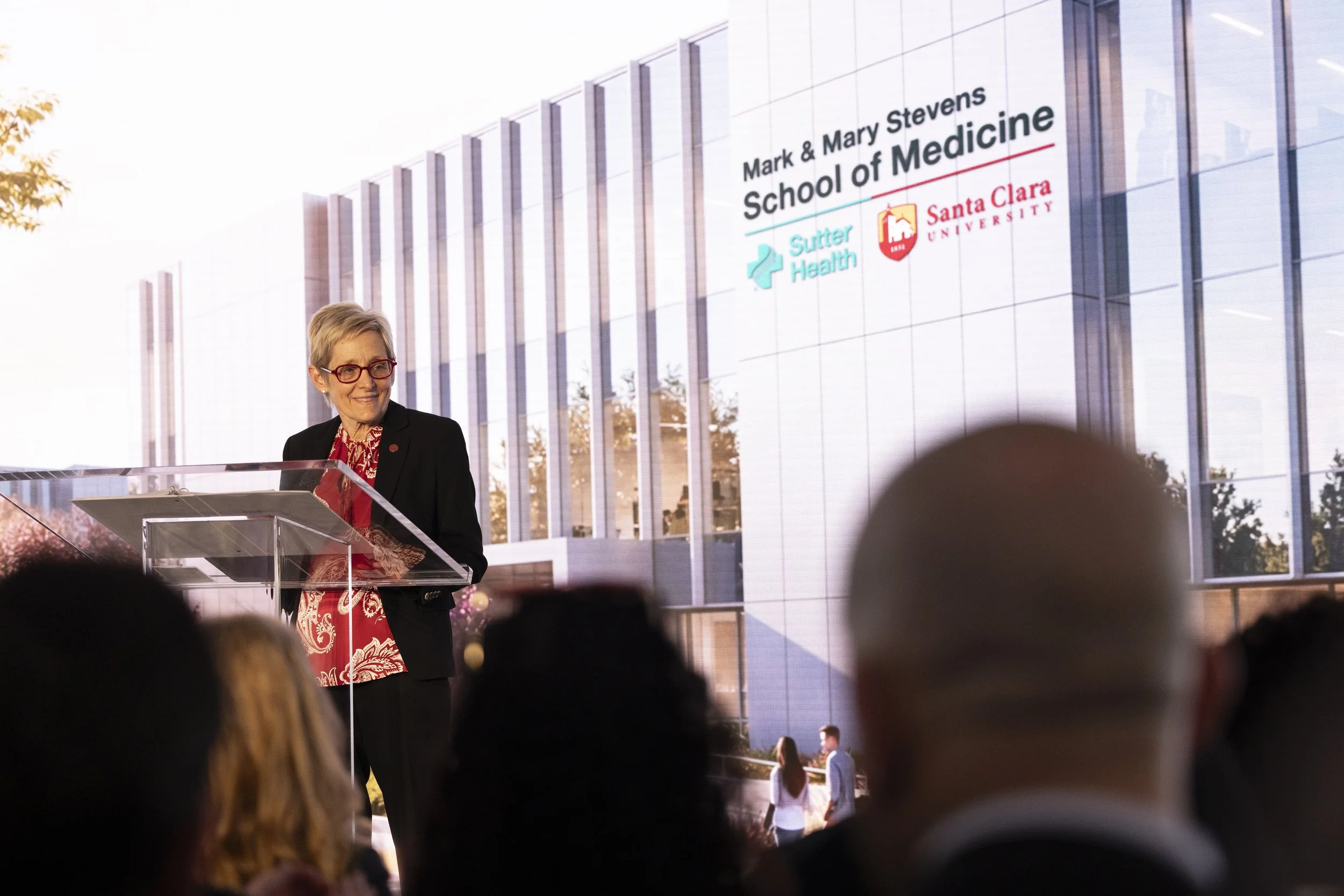
Santa Clara University President Julie Sullivan speaks at an event announcing Santa Clara University and Sutter Health’s plans to launch the Mark & Mary Stevens School of Medicine, a new medical school funded in part by a $175 million gift from Mary Matthews Stevens ’84 and her husband, venture capitalist Mark Stevens on Friday, May 15, 2026. (Nina Glick/The Santa Clara)
Of those, Sullivan said the planned medical school may be the decision that matters most a decade from now.
“It is the right time to create a school from a white sheet of paper and create it to serve the future of health care,” Sullivan said.
The Jesuit School of Theology’s move, she said, may be just as important for Santa Clara University’s identity.
“I think we have yet to even fully imagine the opportunities that are going to evolve because of that,” Sullivan said.
At Sullivan’s inauguration, speakers described her as a leader of resilience, energy and courage. In the years since, another phrase has followed her: unbridled optimism.
Asked whether that phrase still fits, Sullivan did not hesitate.
“My nature is one of unbridled optimism,” Sullivan said. “In fact, I describe myself as not only is my glass half full, much of the time it’s spilling over.”
But she said optimism does not mean ignoring what is difficult.
“I try not to be naively optimistic, because there are challenges, and you need to anticipate those challenges and address those challenges,” Sullivan said.
As the class of 2026 prepares to leave, Sullivan said she understands Santa Clara University differently than she did when she arrived. What stands out most now, she said, is the way students and alumni carry their relationships with them long after graduation.
“I think how special the relationships are within this community,” Sullivan said.
For the class of 2026, Sullivan’s presidency was not a transition they watched from afar. Students have watched the campus as it recovered from the pandemic to one expanding into medicine, artificial intelligence and a broader vision of Jesuit education.
Sullivan said the next year may be less about launching new initiatives and more about carrying forward the work already underway.
“I describe myself as a builder,” Sullivan said. “I do enjoy building, but I also try to pace that building at an appropriate pace that we can do it well.”
Near the end of the interview, Sullivan returned to the same place she began: gratitude.
“I feel very, very blessed to be here,” Sullivan said. “This is the best job I’ve ever had.”
Four years ago, Sullivan told the campus that Santa Clara University should be a University “driven by dreams and rooted in human experience.”
For the Class of ’26, the first class to spend four years with her as president, those dreams are no longer only inaugural language. They are part of the University they are leaving behind.