“The Life of a Showgirl” Might Just be All For Show
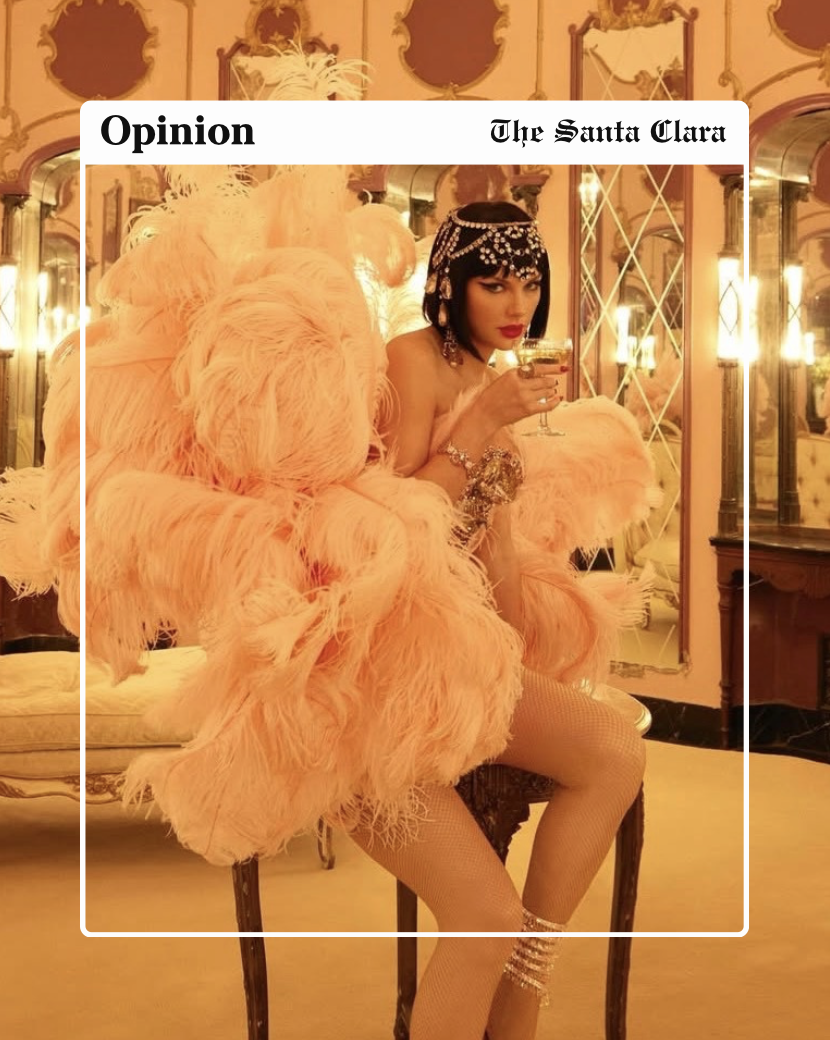
The artist poses for promotional photos in anticipation of her newest album release. Photo taken from Taylor Swift’s Instagram account, @taylorswift. Photographers: Mert Alas and Marcus Piggott.
Like countless other young people, I grew up in a world tinted red. The shade of bright ruby worn and personified by a certain blue-eyed, bombshell popstar to be specific. Every car ride, every late night dance party, every high school heartbreak—my youth and young adulthood enjoyed a constant intertwine with the worlds and words created by Taylor Swift.
Despite this longtime love affair, recent years of Swift’s work have inspired a deviation from my once torrid personal passion. After the miraculous COVID-19 quarantine sister albums Folklore and Evermore—works that I, along with many others, deem to be the singer’s highest seen peak—subsequent projects have proved woefully less inspiring. Upon listening through the singer’s latest full-length production—“The Life of a Showgirl,” released Oct. 3—my melancholic feelings on the recent evolution of Swift’s work are only further solidified. While dubbed “beautiful,” “rapturous,” “frightening” by Swift herself, the album’s contents and concepts appeared more to me as a signifier that the once prophetic well may have finally run dry.
The 12-track endeavor, which Swift announced in early August on fianceé Travis Kelce’s podcast “New Heights,” was conceptually rolled out through a decadent soiree-themed, glitzy, feather boa-clad photoshoot. The promo characterized an album aiming to be reminiscent of the likes of 2001 film Moulin Rouge, with Swift as the Nicole Kidman-esque darling performer, desired by all but understood by few. For the sake of giving credit where credit is due—this media churn-out reinforced Swift’s consistently effective dedication to reinvention. The promotional choices further evidenced that the star always seems to be able to find new ground to claim for both marketing and embodying a new phase of work.
Unfortunately, the intrigue and high stakes promised by such a promotional angle was ended rather abruptly upon first listen of the album. The sound of the work—marked by a return to collaboration with past producers Max Martin and Shellback—certiainly felt very glittery and pop-centric. While there were tracks that seemed to occupy the ‘showgirl’ sound Swift was aiming for—see the strings featured on “Elizabeth Taylor” and rock-esque instrumentals of “Actually Romantic”—most didn’t sound wildly different from the familiar world of synth and high hats found on past works, namely 2021’s “Midnights.” While consistency certainly isn’t an inherently bad thing, evolution and excitement are always a necessity in music—and whether or not the album hit such marks is questionable.
It’s in the lyricism of “The Life of a Showgirl,” not the sound, however, where I found true disappointment. The writing choices featured on the album harbor a similar overall issue to other recent projects, that being the presence of a certain brashness that makes the lyrics feel near mortifying to listen to at times. Swift herself says on “Eldest Daughter,” “I’ve been dying just from trying to seem cool,” and unfortunately, she’s right—and it shows. Throwing out commonplace internet euphemisms about eldest daughters and “girl bossing too close to the sun” simply doesn’t cut it for Swift, whose past careful lyricism and raw, critical, original phrases have come to define the beauty of her work. This vernacular instead feels juvenile and provocative in all the wrong ways.
Similarly, vulgarity is sexy and enticing when it serves a purpose, but Swift’s use of it throughout the 12-track run reads more as a teenager learning to curse for the first time, trying to fit something shocking in every phrase as if to say ‘see, look what I can say out loud.’ The adoption of George Michael’s “Father Figure” melody on her track of the same name was a genius incorporation of a classic, catchy tune that became immediately watered down by this very phenomenon; “I can make deals with the devil because my dick’s bigger” feels as though Swift was aiming for a tongue-in-cheek moment, but the elicited reaction was closer to a heavy eye-roll. What such language added in shock value, it lacked in maturity.
The issue is not so much that her lyrics have all just suddenly begun to have an absence of depth or air of casualness—“Shake it Off” was obviously not Shakespearean. The difference lies rather in the fact that even when the lyrics were trite, or meant to be more infectiously fun than poetic, they still always felt real. Swift’s best and most moving work doesn’t come when she thinks of herself as a character to be portrayed—it comes as a result of earnest reflection and writing less of what sounds smart, and more of what sounds real. That certain semblance of vulnerability and intentional nature within her work seems to have been lost somewhere—and without it the quality suffers greatly.
The album was clearly a momentous effort—but not in authenticity, personal touch or nuance. It feels rather like a grandiose show, one that leaves the audience with no clear message after the curtains are drawn. Maybe that was intentional, or maybe it wasn’t. As Swift sings in the titular track—“you don’t know the life of a showgirl, babe.”