University Panel Envisions Hope Ahead of Gaza Ceasefire
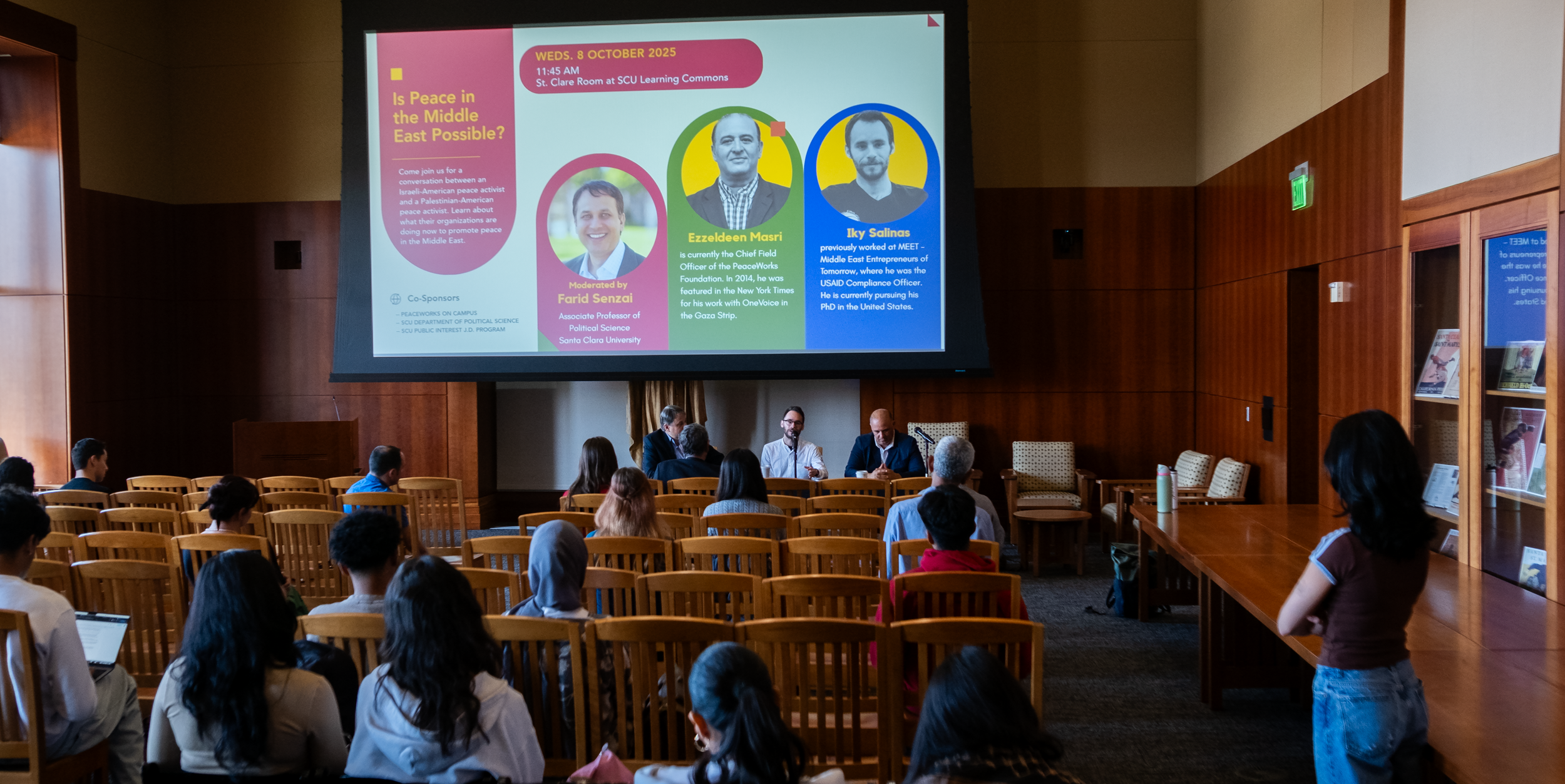
(Right to left) Farid Senzai, Iky Salinas, and Ezzeldeen Masri answer questions from the Santa Clara University community on their panel. Photo by Dylan Ryu.
Correction Oct. 14, 2025: Original article contained an error and has been corrected to note that the event co-sponsor is School of Law's Public Interest JD Program.
Hours before Israel and Hamas confirmed on Wednesday that they had agreed to a temporary pause in fighting in Gaza, two peace activists expressed cautious optimism at Santa Clara University, anticipating a breakthrough in the devastating two-year war. The discussion, titled “Is Peace in the Middle East Possible?” highlighted a widespread fatigue on both sides and urged the prioritization of investment in construction over conflict.
Israeli-American activist Iky Salinas, who previously worked for Middle East Entrepreneurs of Tomorrow, known as MEET, described the conflict as a “race to the bottom” that inflicts psychological damage on individuals. “If you can invest time and effort and energy into building up instead of breaking down, then I think both sides would live much better lives than what we are seeing today,” Salinas said during the panel in the St. Clare Room at the University’s Learning Commons.
That optimism proved accurate. Palestinian-American activist Ezzeldeen Masri, Chief Field Officer of the PeaceWorks Foundation, discussed the roles the U.S. plays in the development of the ceasefire. “No other country around the globe has told Israel what to do,” Masri said. “The only country around the world that has leverage over them is the United States.”
Later Wednesday, Israel and Hamas separately confirmed they accepted elements of a plan put forward by the Trump administration. The agreement outlined a pause in fighting, where remaining Israeli hostages will be freed in exchange for Palestinian prisoners. U.S. President Donald Trump’s envoy, Steve Witkoff, and his son-in-law, Jared Kushner, had arrived at Sharm el-Sheikh earlier for the crucial talks.
The agreement marks the biggest breakthrough in months in the war, which began with Hamas’ deadly attack on Israel on Oct. 7, 2023. About 20 of the 251 people taken hostage are believed to be still alive. The conflict has since led to the killing of tens of thousands of Palestinians, the destruction of most of Gaza, and an upended state of global politics.
The panel, co-sponsored by the University’s department of political science and the School of Law’s Public Interest JD Program, focused heavily on the challenges of a lasting resolution, particularly the two-state solution. Masri outlined the Palestinian demand for a demilitarized state based on the 1967 borders, encompassing the West Bank, East Jerusalem and the Gaza Strip. He emphasized that Israel’s holding of territories occupied in the 1967 Six-Day War is illegal.
He offered a concession regarding military capability, expressing Palestinian aspirations for stability: “We want peace. We want to live mixed with you, in peace and economic prosperity,” said Masri. “To the extent that we forfeit our right to have an army, an Air Force, and the Navy, we just want to have a strong police presence.”
However, the discussion quickly turned to the security guarantees for a demilitarized state, particularly in light of the war that has killed over 67,000 Palestinians. Masri contended that reliance on militant groups proved futile for protection: “the weapons of Hamas and jihadist Islamic did not protect us civilians from the Israeli army. We lost 60,800, more than half of them are civilians, and Hamas weapons did not protect the civilians,” he said.
Salinas acknowledged the difficulty of establishing security guarantees, especially given historical failures of international forces. He pointed to the challenges faced by previous attempts: “UN peacekeepers in Israel and Lebanon didn't manage to protect anyone, basically, right? It didn't stop Hezbollah from launching missiles, and it didn't stop Israel from invading Lebanon,” Salinas said.
Moderator Farid Senzai, a professor of political science, noted that 700,000 to 750,000 settlers currently reside in the West Bank. Salinas acknowledged that settlements are understood to be “one of the biggest obstacles” to peace. He noted that settlers in isolated pockets in the middle of Palestine would need to be moved back into recognized Israeli territory to ensure the Palestinian state has a single piece of land.
Salinas also addressed Israel’s growing global isolation, arguing that supporting the creation of a Palestinian state alongside Israel is essential for recovery. He suggested that the opposing sides have reached a “mutually hurting stalemate,” making it “no longer worth it to continue the conflict.”
Despite uncertainties remaining about elements of the Trump proposal—such as Hamas’ disarmament and future governance of Gaza—the deal was met with “huge joy” among hostage families in Tel Aviv and relief among exhausted Palestinians in Gaza.
Reflecting on the prospects of peace, Salinas saw one clear path forward. “I think that the only way to do this, and this is short, but sure way, is to make Israelis want to pursue peace, which means it’s all up to social change and social reform,” he said.