A Conversation With Queer Author Caro De Robertis
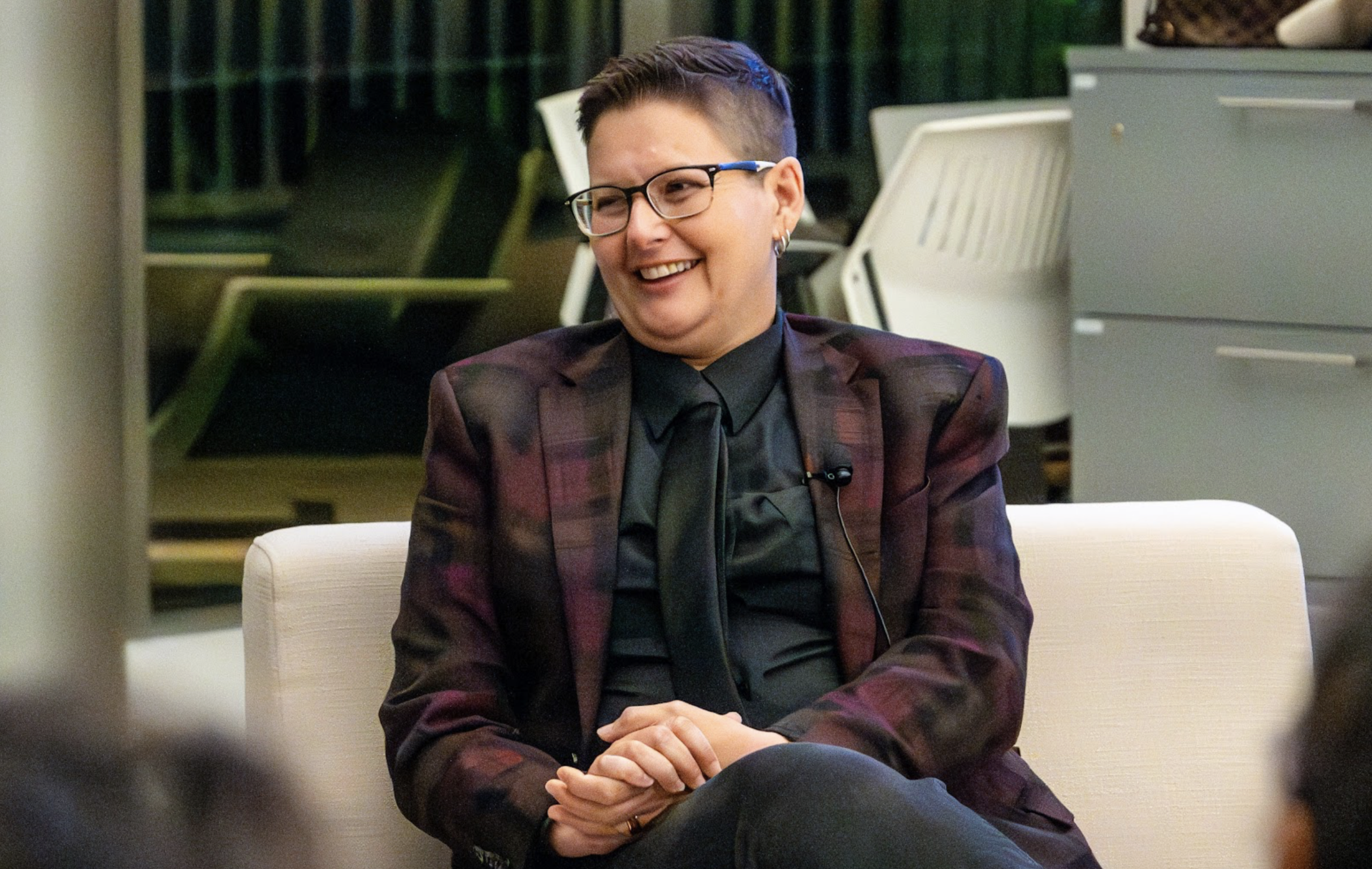
Author Caro De Robertis smiles during the talk about their book “So Many Stars: An Oral History of Trans, Nonbinary, Genderqueer, and Two-Spirit People of Color” with Dr. Ruby Mendoza. (Tianbao Yang for The Santa Clara)
Santa Clara University students and faculty gathered on the third floor of the Edward M. Dowd Art and Art History Building for a Q&A with author Caro De Robertis, who uses they/them pronouns, on Nov. 12, 2025.
The event focused on their latest novel, “So Many Stars: An Oral History of Trans, Nonbinary, Genderqueer, and Two-Spirit People of Color” Before Dr. Ruby Mendoza—a professor of LGBTQ+ studies at the University—began the conversation with questions about the book, two students provided context for the session.
Paloma Helms ’28, one of Mendoza’s students, took the stage to welcome everyone to the event, diving into recent threats faced by the transgender community and explaining how this discussion with a queer author would provide vital exposure to underrepresented sectors of the LGBTQ+ community.
Shelly Cormier ’26, another of Mendoza’s students, went over Robertis’ many awards, most notably the Golden Poppy Octavia E. Butler Award and Stonewall Book Award.
Cormier then explained some of the background behind “So Many Stars” for audience members who hadn’t read the text, noting that it is “an oral history documenting experiences of trans, nonbinary, genderqueer, and Two-Spirit elders of color.” The text presents various conversations and interviews conducted by Robertis with twenty different POC elders from across the queer spectrum. It is organized by chapter into different conversation topics, with the various voices intertwined throughout to create a cohesive narrative.
The first question of the interview centered on who Robertis is as a person, to which they replied, “I am simply one more person who wishes to live an authentic life against the odds.”
Robertis went on to describe their history of disownment and estrangement from their family, as well as their struggle to reconcile their gender-nonconforming and Uruguayan identities. “You can’t be Uruguayan anymore; you can’t be both trans and Uruguayan,” they were told.
Mendoza later asked Robertis to read a passage from their book, and they chose a quote from their interview with Bambi Salcedo: “When I was 12, I was living two different lives. I had my street friends, my gang friends, and then I had friends who were gay and trans and queer.” Robertis explained how this quote—and Salcedo’s grappling with her trans and Mexican identities—deeply resonated with them.
To conclude the Q&A, Mendoza asked Robertis about local events students could get involved in. Robertis highlighted their upcoming museum curation, “Conjuring Power: The Roots and Futures of Queer and Trans Movements,” which will be open to the public at the Yerba Buena Center for the Arts in San Francisco from March to August 2026.
“Hearing Robertis’s legacy of developing oral histories and working extremely hard to understand historical conversations was really eye-opening, “said Dr. Mendoza about the event. “It showcases to students that our work is not just intellectual but also powerful and riveting.”