International Students Struggle to Find Temporary Housing Over the Winter Break
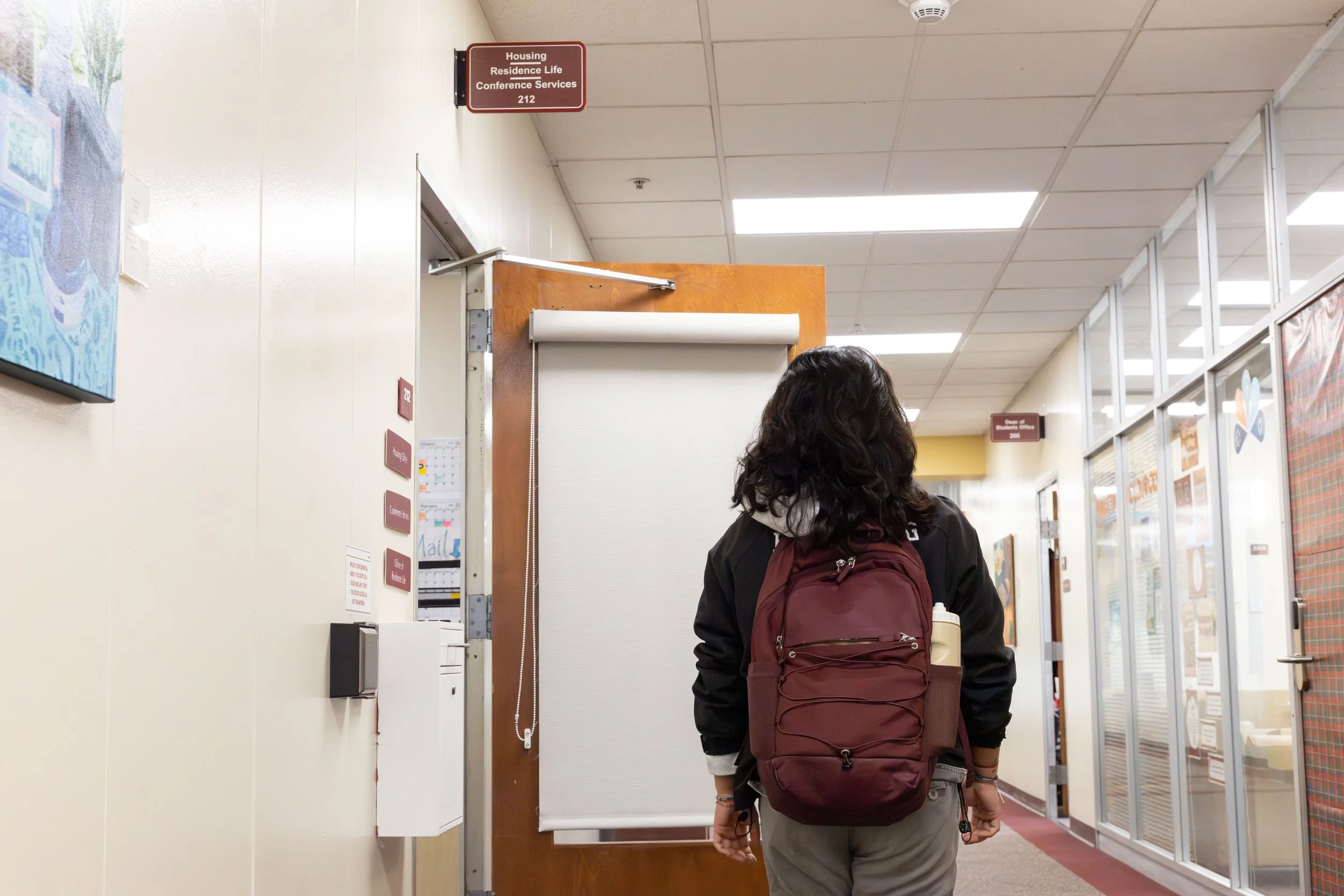
International student Elise Murugasu ’26 walks towards the Housing Office in the Benson Memorial Center. (Elaine Zhang/The Santa Clara)
An earlier version of this article mischaracterized the reasons student Nina Ding chose to remain in the Bay Area during winter break. Ding clarified that her decision was voluntary and not the result of financial constraints. The article has been updated to reflect her experience accurately.
Winter break at Santa Clara University lasts only three weeks, but for some international students, that short stretch can mean weeks of uncertainty. During her first year, Nina Ding ’27 had to pick between finding off-campus housing or flying home after residence halls closed for winter break. Ultimately, she chose Airbnb, with hopes of using her winter break to explore the Bay Area in place of returning home.
The University closes its dorms shortly after fall quarter finals, typically around mid-December, requiring students to leave until early January. Many go home. Others, like Ding, may decide to remain nearby for personal, cultural or logistical reasons that extend beyond finances, but still must deal with arranging alternate housing.
For many international students, returning home is not always the preferred or most practical choice. While holiday flights often become more expensive during peak travel season, students stay for a range of reasons: long travel times, family dynamics, visa considerations or the desire to remain connected to campus life. Regardless of reason, University housing remaining available would provide an alternative to having to find short-term housing.
“It’s not easy to find short-term housing,” said Ding. “Your only choice would be Airbnb, and Airbnb costs a lot of money.”
Short-term rentals also come at a steep cost. In Santa Clara County, the average daily Airbnb rate is $165.30, according to AirDNA Data, making multi-week stays particularly expensive for students.
Students who can’t return to their home countries and don’t have friends or relatives nearby must piece together temporary housing once the dorms close. The challenge is especially acute for first-years and sophomores, who are required to live on campus and often are less familiar with local housing options.
“For my first year, it was really, really difficult,” said Elise Murugasu ’26 from Singapore. “I didn’t realize the dorms closed until my friends started telling me. I wasn’t the best planner, so it was stressful trying to figure out what to do.”
Murugasu ended up joining an upperclassman teammate from the rugby team on a trip to Lake Tahoe. “I was really lucky,” she said.
Had that invitation not appeared, she said she isn’t sure where she would have stayed. “I don’t have relatives here. Everyone I have is back home,” she said.
Financial considerations can still weigh heavily on some international students. Holiday round-trip flights often spike in cost, with fares upwards of $2,000 to various parts of China and $2,500 to India—the two most represented countries among international students at the University. For students who choose not to or cannot return home, the limited winter-break housing options can add additional stress.
These costs make it impractical for many students to travel home for only a few weeks. While some do go back anyway, others remain in the Bay Area and scramble for housing.
Both Ding and Murugasu said they wished the University would keep at least one residence hall open for international students during the break, noting that some universities offer limited on-campus options for students who do not leave. One example includes the University of Chicago, which has an international house that remains open during the winter break. The University Villas do remain open over the break, but they are largely populated by upperclassmen and graduate students.
International Students and Scholars, or ISS, sent an email reminding international students of the housing closure on Nov. 14: “As I hope you are aware, with the exception of the University Villas and Neighborhood Units, all residence halls close for the Winter Break at 9:00 p.m. on Friday, December 13. Residence Halls reopen Saturday, January 3 at 9 a.m. If you live on campus and do not have an option for housing over winter break, please reply to this email by November 21.”
The message also told students that ISS would help identify those with housing needs before referring them to the Housing Office, which oversees break policies.
Melissa Heid, director of International Students and Scholars, said her office works to ensure students do not fall through the cracks. “While ISS can and does advocate for international student needs around housing, the Housing Office ultimately oversees housing policies,” she wrote.
“The Housing Office has asked us to identify students who are in need of emergency housing over the break,” said Heid. “I see this as a one-time exception, but hope that we can continue conversations about long-term international student housing needs.”
Eddie Grace, the University’s housing services director, said the Housing Office is aware of the difficulties international students face. “Especially in recent years, there have been groups of students that face exceptional circumstances that prevent them from securing housing during that break,” he said.
While most students do go home during the winter break, many in recent years have decided to stay in the United States because of concerns related to their visas. Grace added that the Housing Office works with ISS and the Dean of Students office to identify students who may need emergency accommodations for instances such as these.
According to Grace, the University is unable to keep residence halls open during the break because campus services operate with reduced staffing. Residence directors and other key personnel are off duty for the holidays, making it difficult to safely oversee the buildings.
Instead, the University offers emergency housing on a case-by-case basis, often in off-campus locations. Students can contact the Housing Office, Basic Needs program or ISS if they need support.
This winter, Ding, now a junior, plans to return to China to visit her family. Murugasu will be flying home to Singapore.
But for the next group of first-years facing their first winter away from home, the search for temporary housing will likely begin again.