U.S. Oil and Immigration Policies Face Global Uncertainty
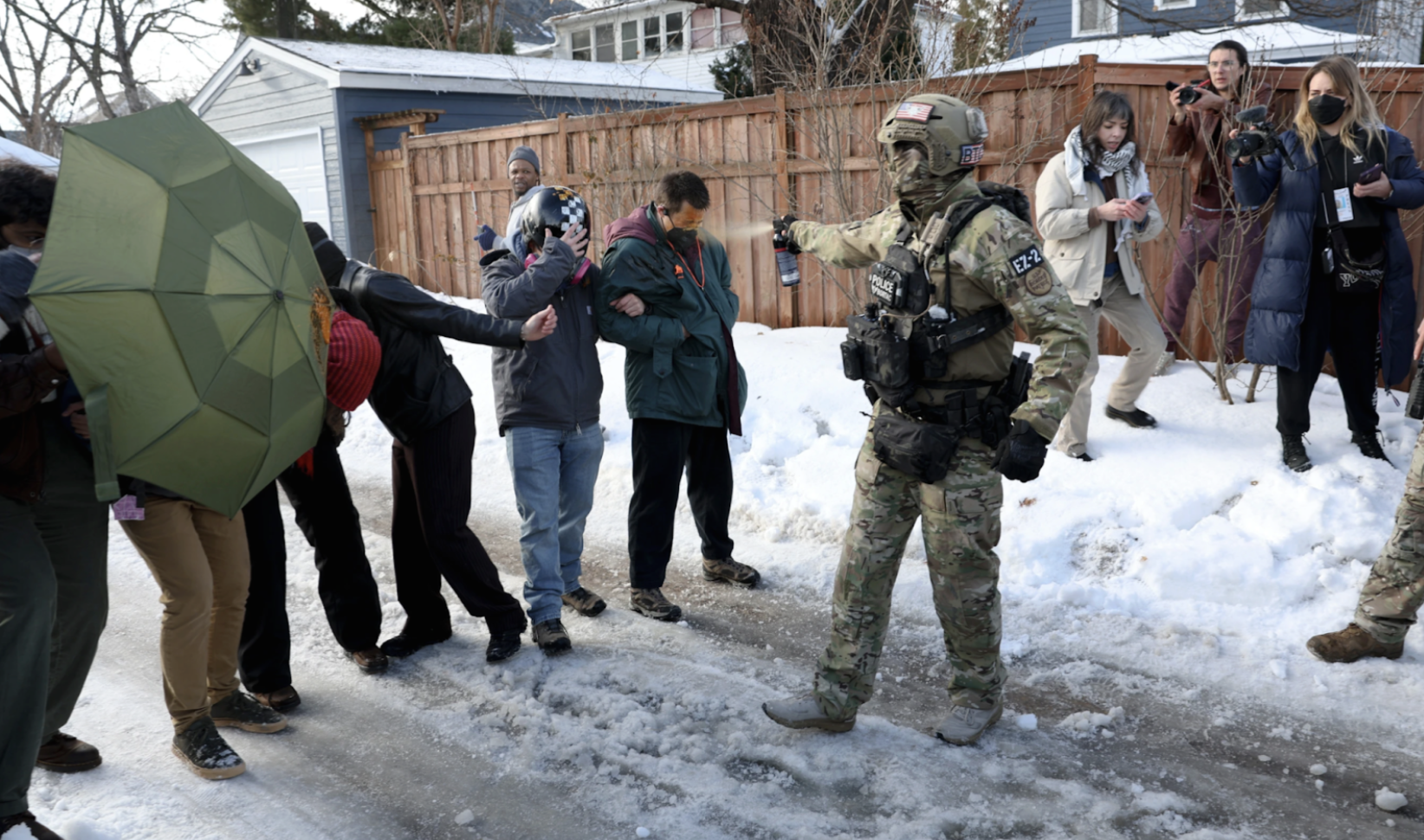
A federal agent sprays a protester with a chemical agent at the scene of the shooting of Renee Good in Minneapolis on Jan. 7, 2026. (Ellen Schmidt/MinnPost via AP)
The United States seized a seventh Venezuelan oil tanker on Jan. 15, as posted by U.S. Southern Command on X early that morning. Such seizures have been frequent in the weeks following an American special forces raid on Venezuela to capture its president, Nicolás Maduro, on Jan. 3.
“The only oil leaving Venezuela will be oil that is coordinated properly and lawfully,” reads the Southern Commands post, citing defiance of President Donald J. Trump’s quarantine of sanctioned vessels in the Caribbean as the cause of action.
“We’re taking back what was taken from us; they took our oil industry,” said President Trump during a White House meeting with oil and gas executives Jan. 9, backing his public plans to run the country and reform its oil system. This broader strategy overlaps with U.S. Homeland Security Advisor Stephen Miller and U.S. Secretary of State Marco Rubio.
“Trump’s agenda centers on oil and countering China in Venezuela,” said Kenneth Faulve-Montojo, a professor of political science at Santa Clara University. “Stephen Miller’s agenda is to increase deportations, specifically of Venezuelans. Marco Rubio’s agenda is to cause the fall of the Cuban regime by first toppling Venezuela’s socialist government.”
These domestic and foreign priorities merged near the beginning of Trump’s second term, with the three politicians using the framework of concerns over drug trafficking, immigration and oil.
“I was kinda shocked,” said political science major Sam Sackett ’26 in reaction to the capture of Maduro. “I’m curious what this means for Venezuela in the long term, and how much the United States is going to have to do with it.”
“We haven’t seen anything like the current domestic situation since the civil rights movement, particularly regarding the use of federal forces,” said Faulve-Montojo. “The key difference now is that federal forces are triggering much of the reaction.”
U.S. behavior has shifted more to promoting itself as a “special democracy,” he said. “The U.S. is using force and tariffs to bully its way.”
This use isn’t limited to the international sphere: increased deportations and stricter immigration policies have led to domestic violence as well. Immigration and Customs Enforcement, or ICE, presence in Minneapolis resulted in the shooting and death of Renee Good on Jan. 7 and several clashes with protesters.
“Violence is escalating,” said Faulve-Montojo. “Unlike the George Floyd protests, we are now seeing federal agents directly confronting protesters.”
The Trump Administration has also made several claims to Greenland, Panama and Canada, causing global concern for the future. On Wednesday Jan. 21, Trump stated there is “no going back” on his attempts to take over Greenland.
“During Trump’s first term, he was constrained by experienced advisors,” said Faulve-Montojo. “But in his current administration, he is surrounded by people who find ways to execute his ideas.”
With large uncertainty prevaling, it’s up to individuals to educate themselves beyond just what professors go over in class, he said. “Keep learning and reading about the facts. More knowledge helps.”
