Santa Clara University Proposes Core Curriculum Changes

(Dylan Ryu/The Santa Clara)
Santa Clara University’s core curriculum is under review, with a new proposal that would create a unified set of classes for all students at the University to take. The proposal, created by the Core Curriculum Revision Committee (CCRC), aims to simplify requirements, increase flexibility, have students take classes that engage across the three colleges and emphasize a Jesuit education.
The CCRC has been working on the core curriculum proposal since June 2024, and although it has now been proposed, it is still in the early stages and has not yet been approved.
Currently, students in the College of Arts and Sciences, Leavey School of Business and the School of Engineering all have slightly different core requirements—specifically a difference in required language competence. Students in the School of Engineering are able to fulfill each of the Arts; Science, Technology and Society; and Civic Engagement requirements via their Senior Design.
“A true liberal arts education, a true Jesuit education, does mean that it is rooted in the humanities,” said communications professor Chan Thai, the Social Sciences faculty representative for the CCRC. “That students are exchanging ideas with one another, that you can talk to a philosopher, even if you’re a business student or even if you’re an engineer, but we’re not getting that right now in the current core.”
Mae McGivney ’28 came in as an undecided major and through core classes has since declared a major and two minors.
“I would not have had a major or minors if I didn’t have the core curriculum,” she said. “And would have felt so much pressure to declare a major, because I would feel like I wasn’t working towards anything … freshman year, I genuinely didn’t take a single major-specific class, and I still felt like I was working towards a degree.”
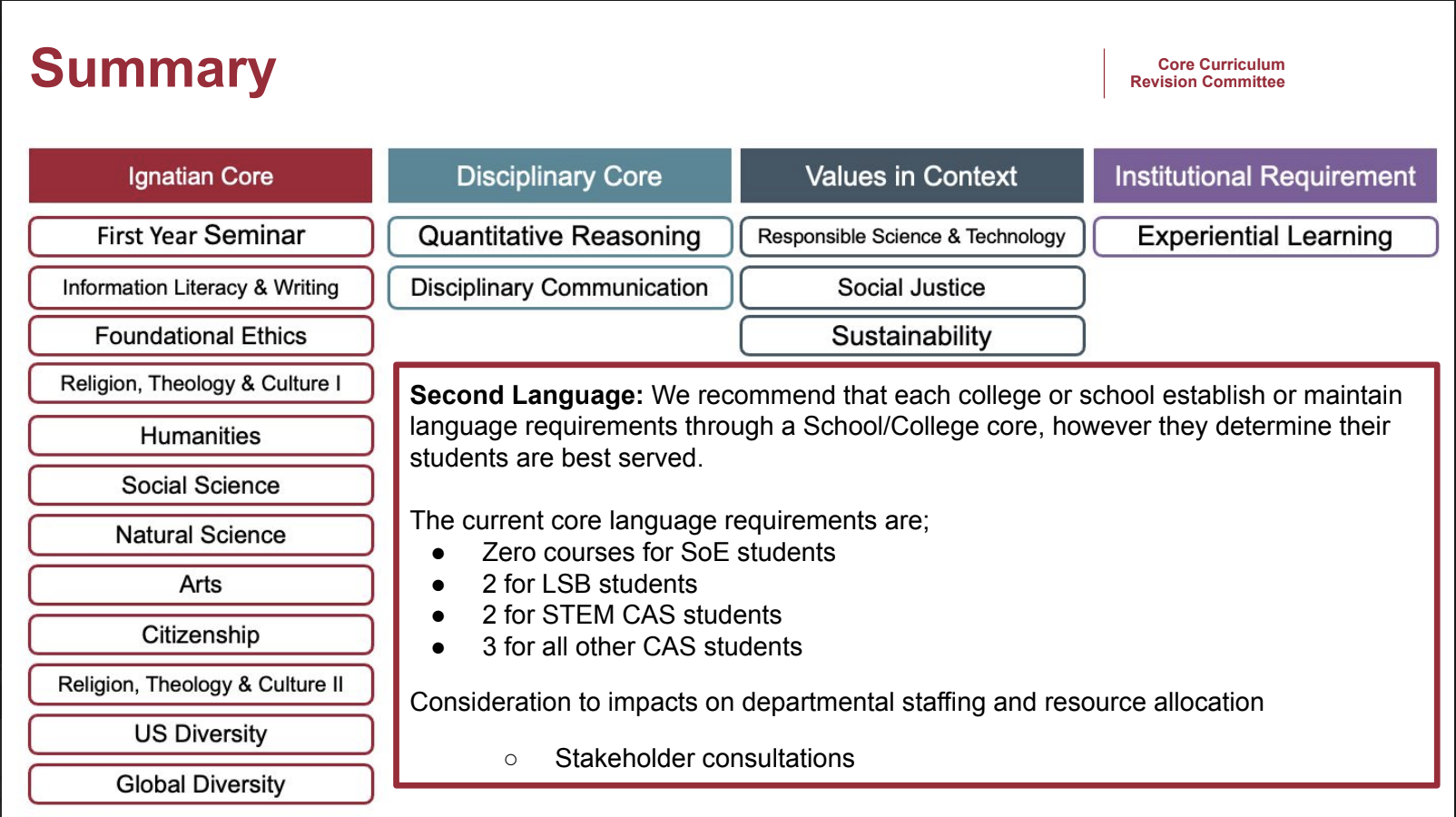
Graphic of the new proposed core sent out to faculty and University stakeholders. (Core Curriculum Revision Committee)
The proposed core includes 12 core classes, called the Ignatian Core, that will be taken in an integrated classroom that includes students from all three colleges. It is designed to eliminate differences in the core between the colleges.
The proposal would eliminate the pathway and second-language requirement from the University’s main core, and reduces the Religion, Theology and Culture requirements from three courses to two.
Out of the 18 Santa Clara University students polled in Benson Memorial Center, eight agreed the core requirements should be lowered. “Right now it’s mostly humanities, not a true well-rounded core,” said biology and neuroscience double major, Caitlyn Rock ’26. “25 reading and writing classes isn’t really a well-rounded curriculum.”
“I think the Cultures & Ideas classes should be at least cut in half,” said business student Mac Benton ’27. “Religion same thing; maybe merge one or two of them?”
“We are suggesting and strongly recommending,” said Dr. Thai, although the second-language classes are not included in the proposal, “that each college adopts the policy that’s already in place.”
Under the current requirements, Leavey School of Business students and those pursuing a bachelor of science in math or natural sciences in the College of Arts and Sciences must reach at least level two. All other College of Arts and Sciences majors must reach at least level three, while engineering students can satisfy their requirement through two years of high school language study.
Still, the possibility of removing the second-language requirement has sparked concern among some faculty.
“I think it is a great shame and disappointment to imagine a Jesuit education that does not involve second language,” said classics professor Daniel Turkeltaub.
“Learning a second language, it compels students to think in a different framework. That grammar alters, it affects the way we think,” said Professor Turkeltaub. “And when we study a different grammar, we learn, we expand the ways in which we can think, in which we can think about the world, in which we can perceive how things in the world happen, and how relationships work between people.”
McGivney, who after taking her core language requirements declared an Italian studies minor, could not imagine her college education otherwise.
“I just think really important things come out of learning a language, and that’s like a skill that just can never be replaced,” she said.
Contrastingly, several students believe the changes to the core curriculum are beneficial to learning. “The foreign language is a dumb requirement for the business school,” said Benton. “I think that a lot of these should be optional.”
Santa Clara University is rooted in the Jesuit tradition established by St. Ignatius, which emphasizes education for the whole person—mind, body and spirit.
“The whole purpose of being at a school that’s mission-driven is to ensure that our students walk out of here with the type of education that we hope aligns with the Jesuit values and the Jesuit mission,” said Thai.
Faculty members are concerned that eliminating the second-language requirement for the core university requirement would also eliminate an essential part of a Jesuit education.
“I think that especially at a Jesuit university, where we strive to form students of competence, conscience and compassion, and with a global type of comprehension and understanding, I think that it’s absolutely essential that our students learn how to communicate with people of other languages,” said Chair of Modern Languages Jill Pellettieri.
Several students expressed their interest in keeping the current core requirements. “I think it’s good to have our student body be well-rounded and be knowledgeable in a lot of different things,” said neuroscience major Finn Bussiere ’27. “I know I have a lot of engineering friends whose cores are less than College of Arts and Sciences or the business school, and I feel like they may be less interdisciplinary in what they can think about.”
In anticipation of—and wanting to avoid possible pushback—they aimed to stick to five guiding principles throughout the process:
Embrace the distinctive mission and values of Santa Clara University and its social justice and financial initiative under Impact 2030, prioritize a common core experience for all undergraduates, provide greater flexibility and choice for undergraduates by paring back the number of core requirements, instill clarity and simplicity in the curriculum and consider potential impacts on departmental staffing and resource allocation.
As conversations spark of the University also moving to a semester system, the core will have to be revised with that switch anyways. This proposed core is more suited for a semester system, yet will still have to be cut down slightly.
The proposal now awaits further review, a process that will determine whether the Ignatian core will become a reality for future students.
“I want to encourage people to think about this is to really prioritize the student experience,” Professor Thai said. “If we really think about what we’re offering our students. To me, it will be worth the work that we have to put in to change some of our classes and change the way that, you know, we do things.”